When a commercial open-grid rolling security grille jams, business operations halt immediately. For storefronts, counter windows, and parkades, downtime creates an immediate financial loss ranging from $500 to $2,500 per hour in lost foot traffic, delayed inventory receiving, and security risks. Facility managers face a critical decision: can this issue be safely un-jammed in five minutes, or does it require professional dispatch for commercial garage door repair?
Rolling Security Grille Stuck: Diagnosis, Safety Triage, and Repair Framework
Published: Nov 17, 2026
Symptom-Based Diagnostic Matrix
Commercial security grille failures fall into distinct mechanical distributions:
- 42% Track Misalignment & Guide Obstruction: Impact from equipment or debris binding vertical guides.
- 28% Motor & Limit Switch Failure: Micro-switch slippage, capacitor breakdown, or thermal overload trips.
- 18% Spring Fatigue & Cable Binding: Loss of tension or bound counterbalance cables.
- 12% Link & End-Lock Misalignment: Distorted lattice links causing the curtain to telescope inside the hood.
Diagnostic Case Analysis
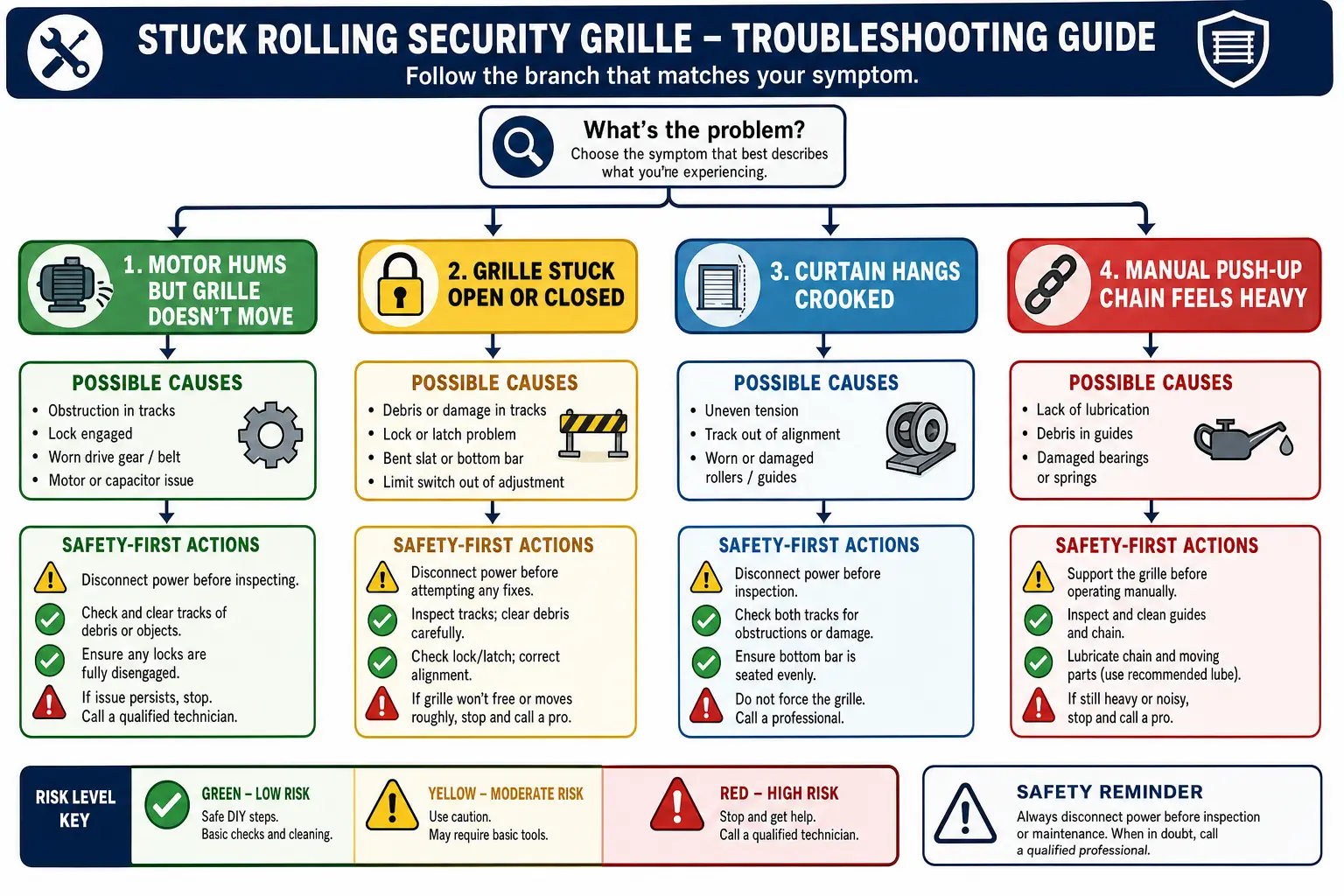
- Motor hums or clicks but the grille does not move: Indicates a bound motor capacitor, an engaged solenoid brake, or structural binding in the side channels.
- Grille travels down but will not roll up: Points to misadjusted limit switches, thermal motor overload, or fatigue in the counterbalance spring assembly.
- Grille hangs unevenly or jams at an angle: Caused by snapped lift cables, loose end-locks, or binding links requiring specialized broken rollers repair or track realignment.
- Manual grille feels impossibly heavy: Directly indicates broken torsion springs or counterbalance shaft failure.
Still stuck? Get it fixed today.
24/7 emergency service from licensed local technicians.
Mechanism-Specific Troubleshooting Protocols
- Manual Push-Up Grilles: Check side guides for track friction or metal distortion. Verify bottom-bar slide bolts are fully unlocked before attempting to raise the curtain.
- Hand Chain Hoist Grilles: Inspect the hand chain lock to ensure it hasn’t engaged. Verify that the gear teeth are clean and check if an emergency fire governor has dropped. If slack develops over time, review proper methods on how to adjust garage door opener chain assemblies.
- Electric Motor-Driven Grilles: Verify main power supply feed and key switch integrity. Check for control circuit faults by evaluating commercial garage door opener wiring connections.
Safe DIY Fixes vs. Mandatory Professional Interventions
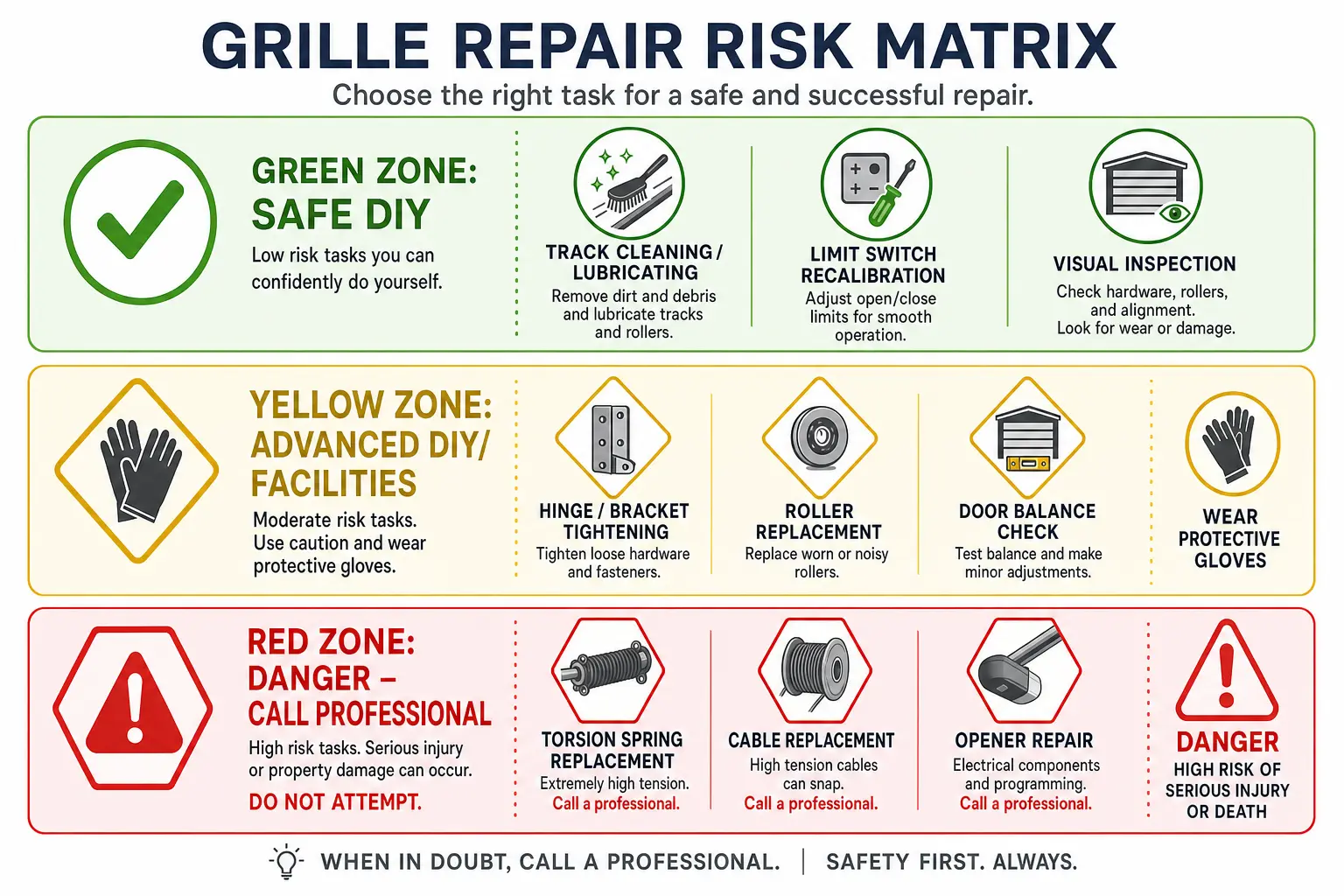
Strict safety boundaries protect staff and equipment while keeping facilities compliant with DASMA standards:
- Green Zone (Safe DIY): Clearing debris from guide channels, applying silicone spray lubricant, and allowing overheated drive motors to cool down for 20 minutes to reset thermal relays.
- Yellow Zone (Facilities Maintenance): Basic limit switch calibration, motor clutch override disengagement, or clearing minor slack when a garage door off chain condition happens.
- Red Zone (FATAL DANGER – Call Professional Immediately): Servicing high-tension torsion springs, which store over 200 ft-lbs of torque. Never attempt shaft replacement, barrel unwinding, or heavy curtain lattice rebuilds without qualified technician support.
Emergency Manual Override Protocols
During power outages or mechanical lockouts, execute override procedures carefully:
- Disengage Motor Clutch: Pull the manual release cord firmly to disengage the operator shaft from the drive barrel.
- Operate Hand Chain: Pull the chain with steady tension. Avoid sudden jerks that could trigger the fire governor drop-test mechanism.
- Establishing correct installation guidelines for your roll up garage door setup ensures manual overrides function smoothly when needed.
Repair vs. Replacement Decision & Cost Benchmark Framework
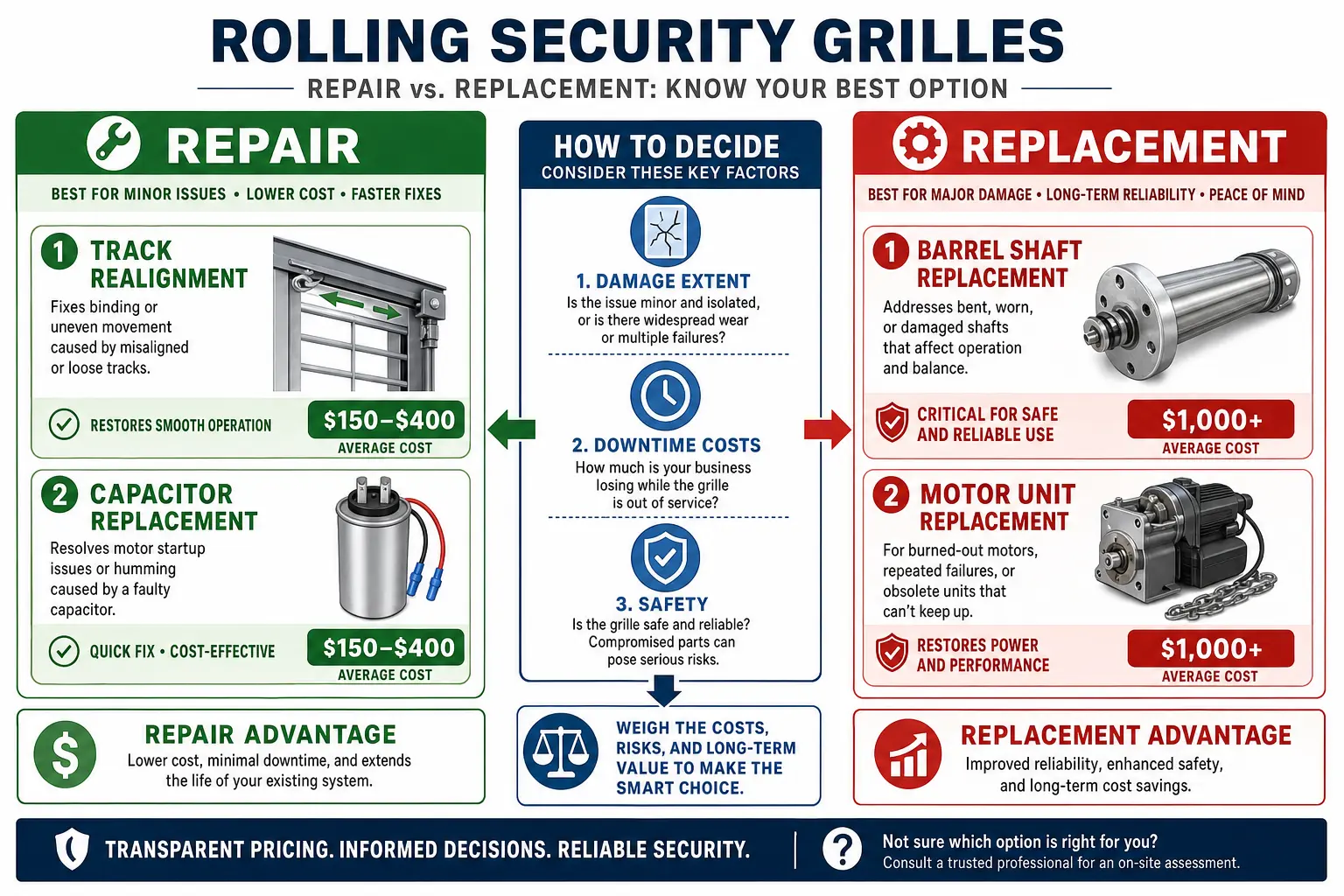
Evaluating service estimates requires comparing short-term labor against long-term reliability:
- Minor Track Realignment: Best choice when tracks are slightly misaligned but curtain links remain structurally sound.
- Motor or Limit Switch Replacement: Ideal when mechanical drives show electrical failure or slipping gearboxes. Optioning a same day garage door opener replacement resolves persistent motor breakdowns quickly.
- Full Assembly Replacement: Necessary when lattice link damage exceeds 30%, internal barrel shafts fracture, or equipment reaches end-of-life.
Frequently Asked Questions
How do I manually open an electric rolling security grille during a power outage?
Locate the manual release pull-cable near the motor drive. Pull the cable down to disengage the electric drive clutch, then use the manual hand chain or push-up handles to open the grille safely.
Why does my security grille motor hum without moving the curtain?
A humming motor typically indicates a failed starting capacitor, an engaged motor brake, or a severe track obstruction locking the curtain assembly. Turn off power immediately to avoid motor burnout.
Can facility staff safely adjust commercial rolling grille counterbalance springs?
No. Commercial counterbalance torsion springs store up to 200+ ft-lbs of dangerous torque. Attempting DIY spring adjustments can result in severe physical injury. Spring tensioning should only be performed by trained commercial door technicians.