Standing in your garage with a trapped vehicle is a highly stressful experience. Because a residential garage door is the heaviest moving object in your home—weighing between 150 and 400 pounds—a sudden mechanical failure is more than an inconvenience. According to the National Electronic Injury Surveillance System (NEISS), there are over 2,000 crushing injuries and 7,500 finger-pinching incidents reported annually from manual operations alone. Before you attempt to force it open, you must determine what is broken and whether it is safe to touch.
Addressing Mechanical Failures Preventing Garage Door Operation
Published: Sep 2, 2026
The Emergency Bypass Protocol
When your vehicle is trapped, your immediate reaction might be to pull the manual cord or force the door up. However, doing this without diagnosing the underlying mechanical failure can result in catastrophic damage or severe personal injury.
- Stop pressing the opener button: Forcing the motor to run when a door is physically jammed can burn out the drive gear or snap your lifting cables.
- Inspect the torsion spring: Look above your closed door. If you see a clear 2-inch gap in the coil, your spring has snapped, stripping the system of 100% of its counterbalancing force.
- The Safety Rule: If you must manually lift a door with a broken spring, never do it alone. You are deadlifting up to 400 pounds of deadweight. If you must proceed, consult professional tips on how to open garage door with broken spring safely and engage the garage door emergency release only when the door is fully stabilized to prevent it from slamming down.
The Diagnostic Matrix: Symptom-to-Failure Mapping
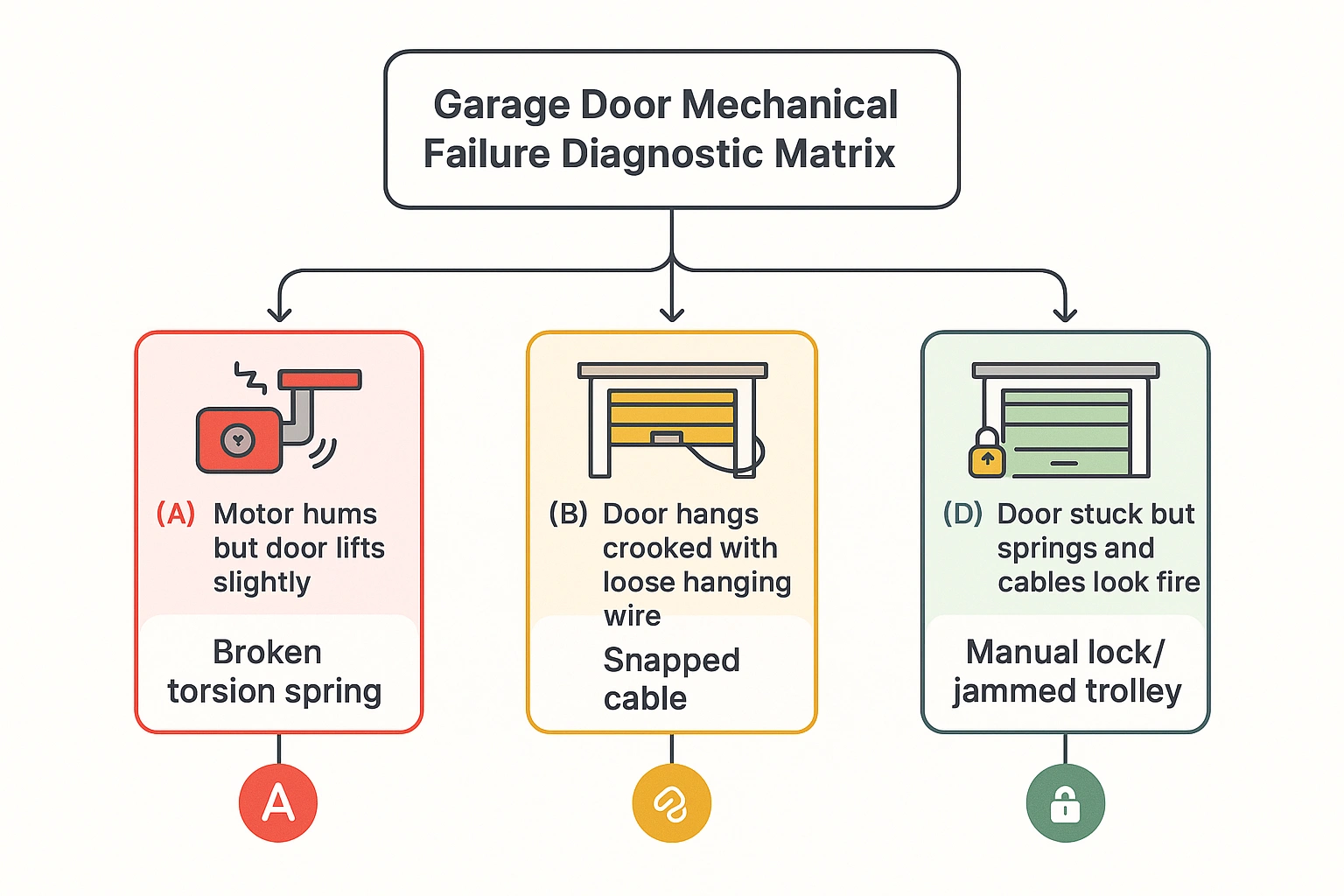
To choose the right course of action, match what you are seeing and hearing with this symptom-to-failure guide:
- Symptom 1: The motor hums and the door is completely stuck closed.
- Likely Cause: A seized torsion spring or engaged manual slide lock. Check if your garage door stuck because the lock was accidentally thrown.
- Symptom 2: The door hangs visibly crooked, and a steel cable is loose or frayed.
- Likely Cause: A snapped or slipped lifting cable. If so, do not operate the door, as the uneven weight distribution can bend the tracks.
- Symptom 3: Heavy grinding noises, and rollers have popped out of the tracks.
- Likely Cause: The door is off-track. Continuing to operate it can permanently damage your panels. See our professional guide on garage door off track repair cost to evaluate your next steps.
The Physics of Your Garage Door System
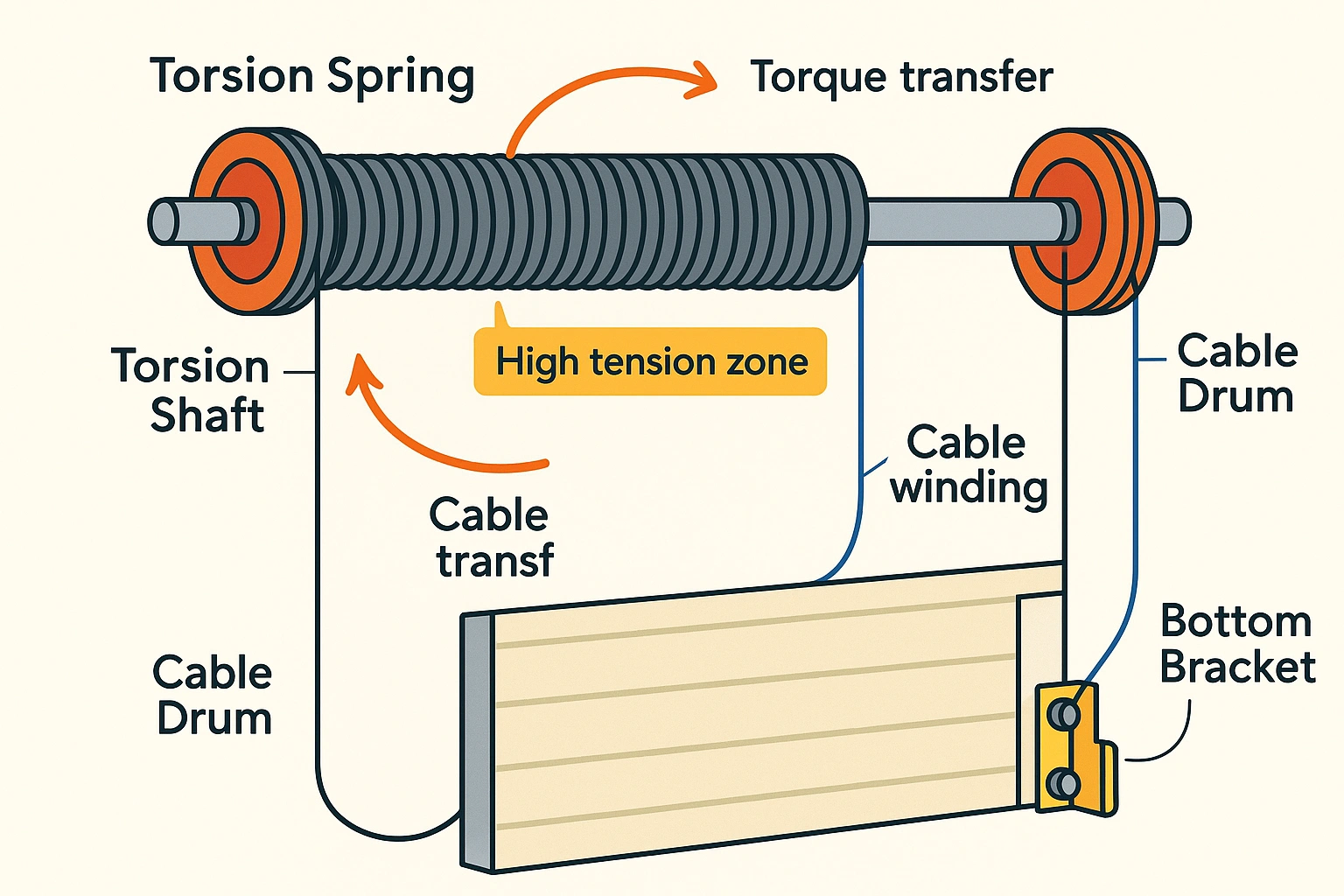
Your door relies on a balance of mechanical forces. The system’s power is concentrated in the torsion shaft assembly.
When your motor runs, the broken garage door springs (or properly tensioned ones) transfer torque through the shaft to the cable drums. This rotational force winds up the high-tension steel lifting cables. These cables connect directly to the bottom corner brackets, lifting the door’s substantial weight.
If a cable frays or a spring snaps, this balance instantly unravels. The remaining hardware is subjected to immense, unbalanced loads. Attempting a hasty DIY garage door cable replacement near me without understanding these forces is highly dangerous. Standard springs are designed for about 10,000 cycles (roughly 7–10 years of use). Once they reach this fatigue threshold, failure is sudden. To prevent a domino effect of damage across your garage door parts, immediate expert diagnosis is critical.
The DIY Safety Threshold
To avoid emergency room visits (accounting for roughly 35,000 injuries annually in the US), follow this simple risk matrix:
- 💚 Green (Safe DIY): Clearing debris from tracks, checking alignment sensors, and applying lubricant. Warning: Never use WD-40 on your tracks. WD-40 is a solvent and degreaser that attracts dirt and sawdust, gumming up the system. Use high-quality silicone or white lithium spray instead.
- 💛 Yellow (Proceed with Caution): Tightening loose hinge bolts or scheduling professional broken rollers repair to restore smooth movement.
- 💔 Red (Strictly Professional Only): Tensioning springs, correcting severe track damage with a bent track repair, or replacing structural lift cables.
Restoring Your Door Safely
A stuck garage door isn’t just an inconvenience; it’s a security and safety hazard. Protecting your home and family requires quick, safe action. At 24H Garage Doors, we provide honest, transparent, and prompt 24/7 service across Connecticut to get your door back on track safely. Contact us today for reliable mechanical repairs.
Frequently Asked Questions
Can I use my garage door opener if a spring is broken?
No. Operating the automatic opener with a broken spring can burn out the motor carriage, strip gears, and snap remaining components.
Why did my garage door cable slip off the drum?
This typically occurs due to a loss of cable tension, which happens when the door hits an obstacle while closing, or if a spring breaks, causing the cable to go slack and unwind from the drum.
What is the average lifespan of torsion springs?
Standard torsion springs last around 10,000 cycles. Depending on daily usage, this translates to roughly 7 to 10 years of reliable service.