main logo

How A New LED Bulb Can Break Your Garage Door Opener (And How to Fix It)


Published: Jul 23, 2026

You just did the responsible thing—you swapped out that old, energy-guzzling incandescent bulb in your garage door opener for a bright, efficient LED. You feel good about it. That is, until you get in your car, press the button on your remote, and… nothing happens. You press it again. Still nothing.

Did you just switch to a new, modern light bulb only to find your garage door remote suddenly stopped working? You're not alone, this isn't a coincidence, and there’s a simple scientific reason for it. Let's walk through why this happens and how you can fix it in minutes.

The Science in 60 Seconds: Why Your LED is Jamming Your Remote


It sounds bizarre, but the problem isn't the light itself—it's the electronics hidden inside the bulb's base. An LED bulb isn't just a filament that glows; it's a tiny, complex electronic device. It contains a component called a "driver" that converts your home's AC power into the low-voltage DC power the LED needs.
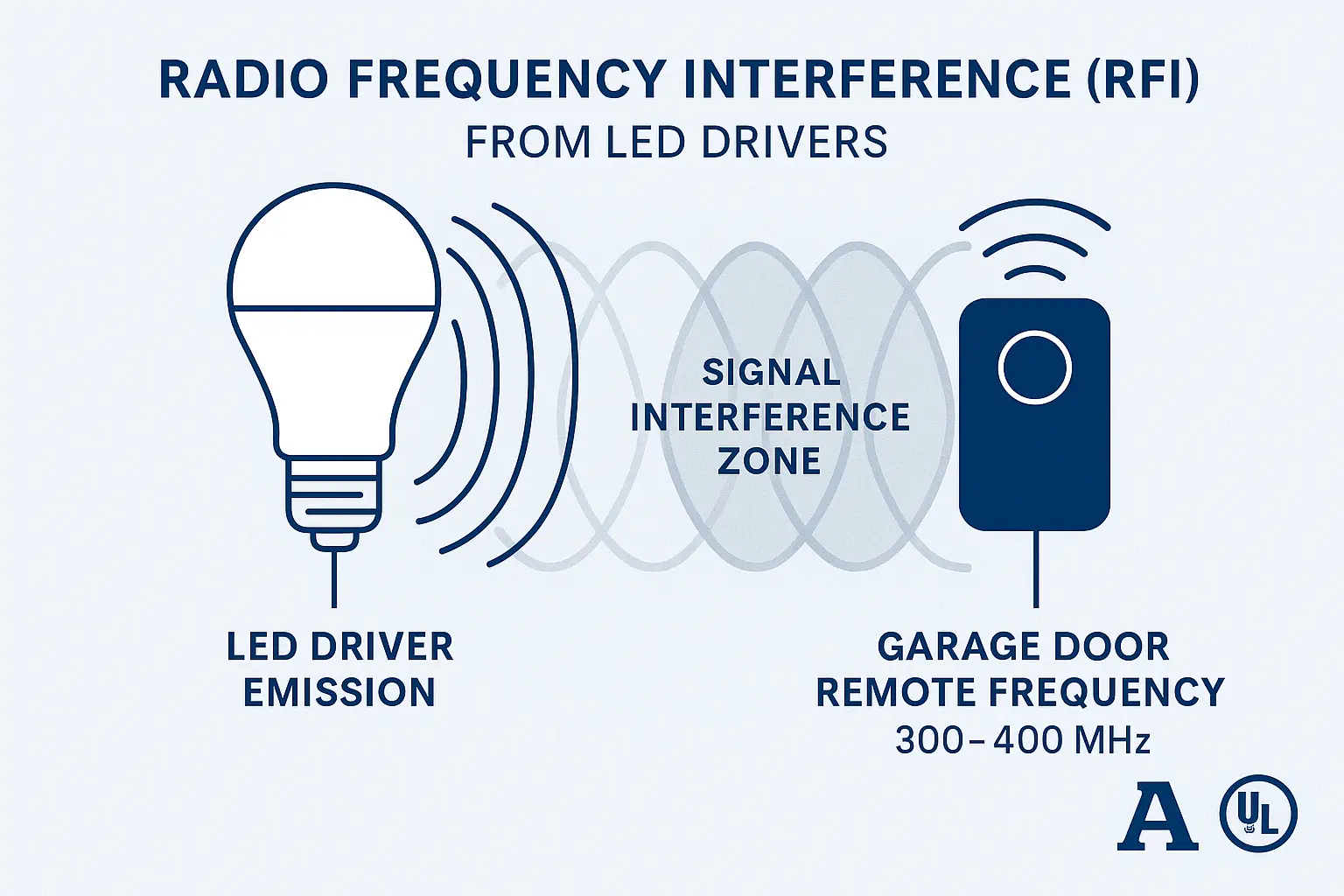
A diagram illustrating how radio frequency interference (RFI) from an LED bulb's driver can block the signal from a garage door remote to the opener.
The cheapest of these drivers regulate power by switching on and off thousands of times per second. This rapid switching creates an unintended side effect: a small field of radio interference, also known as Radio Frequency Interference (RFI).

Here's the "aha moment": Your LED bulb is accidentally acting like a tiny, noisy radio transmitter.

Unfortunately, the frequency of this electronic "static" often falls in the 300-400 MHz range, the very same frequency band your garage door remote uses to communicate with the opener. The bulb's noise is essentially shouting static, and your opener can't hear the remote's whisper over the racket.

A diagram illustrating how radio frequency interference (RFI) from an LED bulb's driver can block the signal from a garage door remote to the opener.

How to Diagnose the Issue in 2 Minutes


Before you start exploring solutions, let's confirm the bulb is actually the culprit. This simple test will give you a definitive answer.
A three-step flowchart for diagnosing LED interference. Step 1: Remove the LED bulb from the opener. Step 2: Test your garage remote. Step 3: If it works, the bulb is the problem; if not, check other issues.


1. Unplug the Garage Door Opener: For safety, always disconnect the power before touching any components.

2. Remove the LED Bulb: Carefully unscrew the bulb and set it aside.

3. Restore Power: Plug the opener back in. The light socket will be empty, but the unit will have power.

4. Test Your Remote: Step back to where you would normally open the door and press the button on your remote.

If your remote works perfectly now, you've found your problem. The RFI from your LED bulb was the cause. If the remote still doesn't work, the issue may lie elsewhere. In that case, troubleshooting garage door remote signal problems is your next best step.

A three-step flowchart for diagnosing LED interference. Step 1: Remove the LED bulb from the opener. Step 2: Test your garage remote. Step 3: If it works, the bulb is the problem; if not, check other issues.

Your Complete Toolkit of Solutions


Once you've confirmed the bulb is the issue, you have a few excellent options to resolve it, ranging from a simple swap to a quick DIY fix.

Solution 1: The Easy Fix (Recommended) - Switch to a Low-Interference Bulb

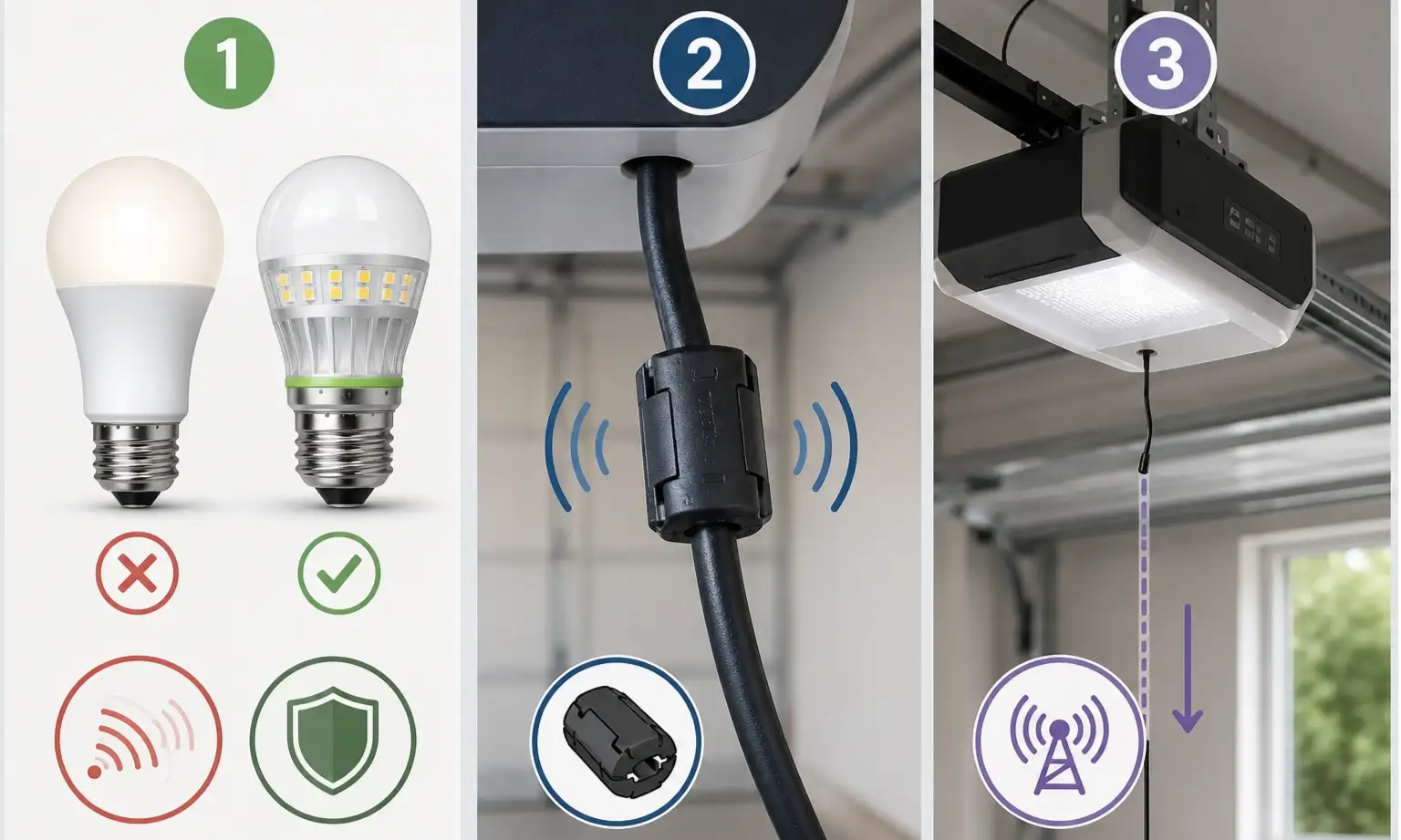
The simplest and most reliable solution is to use an LED bulb specifically designed for garage door openers. These bulbs are engineered with better internal components and shielding to minimize or eliminate RFI. They're built to be "quiet" on the radio frequency spectrum.

When shopping, look for packaging that explicitly says "garage door opener compatible," "low RFI," or "low interference." Major brands like Genie and Chamberlain (LiftMaster) produce their own lines of these bulbs, and they are widely available.
A side-by-side comparison of a standard LED bulb and a garage-door-opener-safe LED bulb, highlighting features like EMI shielding and a rugged design in the compatible bulb.

Solution 2: The DIY Fix - Add a Ferrite Bead (or Choke)

If you're attached to your current bulb or enjoy a simple DIY project, you can try to suppress the RFI at its source. A ferrite bead (also called a ferrite choke) is a small magnetic clamp that snaps around a power cord. It acts as a filter, absorbing high-frequency noise and preventing it from traveling along the wire and radiating into the air.

Simply clamp one or two of these beads around the garage door opener's power cord as close to the unit's housing as possible. It’s a low-cost experiment that often solves the problem.

Solution 3: The Range-Boosting Fix - Reposition the Antenna

Sometimes, the issue is a combination of weak signal and interference. Your opener has a small antenna—usually a single wire dangling from the motor unit. By simply repositioning this wire, you can sometimes improve reception enough to overcome minor RFI.

Make sure the antenna is hanging straight down and is not touching any metal. For more significant improvements, you can learn how to extend the garage door opener range by adding a small piece of wire to the existing antenna, allowing you to move it further away from the noisy motor and light bulb.

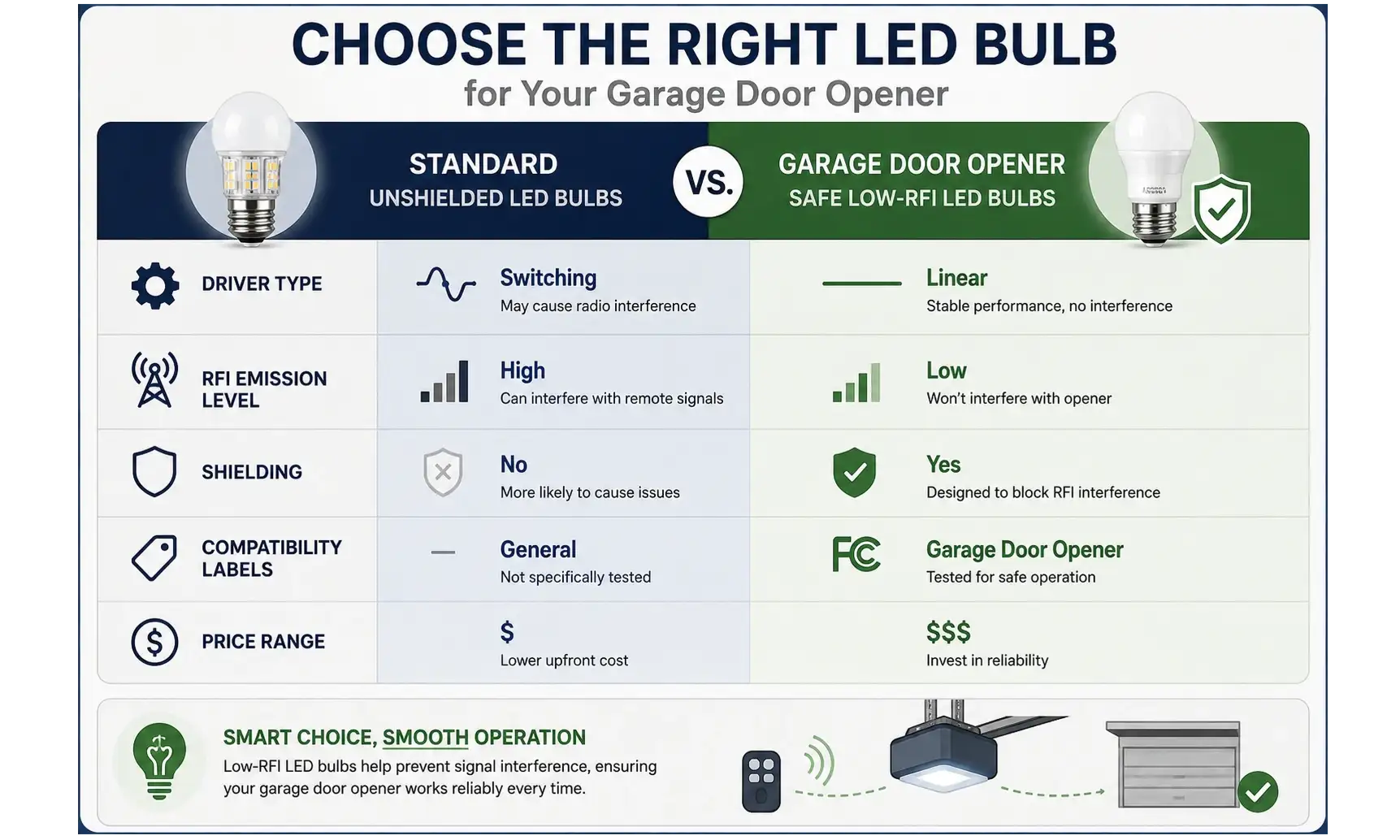
A side-by-side comparison of a standard LED bulb and a garage-door-opener-safe LED bulb, highlighting features like EMI shielding and a rugged design in the compatible bulb.

Prevention and Best Practices


To avoid this headache in the future, keep these tips in mind:

Look for the Label: Always prioritize bulbs labeled "low interference" or "garage door opener safe."

Avoid the Cheapest Option: Ultra-cheap, no-name LED bulbs are more likely to use poorly shielded drivers that cause RFI.

Beware of "Dimmable" Bulbs: While some work fine, the extra circuitry required for dimming can sometimes create more radio noise. Unless specifically rated as low-RFI, it's best to use a non-dimmable bulb.

By choosing the right bulb from the start, you can get all the benefits of LED technology without compromising the function of your garage door.

Frequently Asked Questions (FAQ)


What wattage LED bulb should I use in my garage door opener?

Most opener manufacturers recommend using a 60-watt equivalent (around 8-10 actual watts) A19-style bulb. Check your opener's manual for specific limitations, as some units have a maximum wattage rating to prevent overheating.

My garage door light is not working at all. Is it still an interference issue?

If the garage door light is not working whatsoever, the problem is likely with the bulb itself, the socket, or the opener's logic board. RFI only affects the remote's signal, not the light's ability to turn on.

Can other devices in my garage cause interference?

Yes. Anything with an unshielded electronic motor or power supply can be a source of RFI. Common culprits include shop lights, battery chargers, and even some smart home devices. If a new bulb isn't the problem, try unplugging other nearby electronics one by one to isolate the source.

What if I've tried all these fixes and my remote still doesn't work?

If you've ruled out interference, the issue could be with the remote itself (dead battery), the opener's receiver, or it may simply need to be reprogrammed. Learning how to program a universal garage remote or your car's built-in opener can be a helpful next step. In rare cases, a power surge could affect the garage door opener, requiring a professional assessment.

Your Path to a Smarter Garage


Understanding the hidden world of radio frequencies in your garage is the first step toward a seamless, frustration-free system. By simply choosing the right bulb, you ensure your modern, energy-efficient lighting and your trusty garage door opener can work together in perfect harmony.

As you continue to upgrade your home, exploring how smart lighting can integrate with garage doors can open up even more possibilities for convenience and security.

You may also like


blog photo

Optimizing LED Lighting for Garage Workshops and Detailed Tasks

You’ve done it. You went to the hardware store and bought the biggest, brightest LED fixture you could find. You mounted it right in the middle of your garage ceiling, flipped the switch, and basked in its 10,000-lumen glory. But the moment you lean over your workbench to measure a piece of wood or inspect an engine part, you're plunged into darkness—the shadow of your own head obscuring the very detail you need to see. If this sounds familiar, you’ve stumbled upon the most common myth in workshop lighting: that more brightness equals better light. The truth is, creating a truly functional, shadow-free workspace isn't about raw power. It’s about a strategic approach that considers the quality, quantity, and—most importantly—the placement of your light sources. This guide will walk you through the three pillars of effective workshop lighting, transforming your frustratingly dim space into a haven of clarity and precision.

blog photo

Your Garage is Tougher on Lights Than You Think. Here’s How to Choose LEDs That Last.

You flick the switch, and the familiar hum of your garage light is replaced by a sad, weak flicker. Or worse, nothing at all. If you’ve ever replaced a garage light bulb only to have it fail a year later, you’re not alone. It’s a common frustration, but the bulb might not be the real problem.The real culprit? Your garage itself.Uninsulated garages face a daily battle with fluctuating temperatures, condensation, and a constant barrage of dust. These aren't just minor inconveniences; they're silent killers for standard light fixtures. Before you buy another "super bright" LED that promises the world, it's time to understand the one feature that matters most for durability: its IP rating.Think of it as a resilience score. Getting this right means you stop replacing lights and start enjoying a bright, reliable garage for years to come.