Extension Spring Safety Cables: Why They Matter & How to Check Them Safely


Published: Nov 16, 2026

Every time your garage door closes, the extension springs above the horizontal tracks stretch to 100% of their relaxed length. This stores intense kinetic energy—enough to launch a heavy steel coil across your garage if a spring snaps or a mounting hook fails. According to data from the U.S. Consumer Product Safety Commission (CPSC), garage door hardware accounts for over 20,000 emergency room visits each year. High-velocity spring fractures contribute significantly to these severe lacerations, facial fractures, and structural property damages.

An extension spring safety cable serves as the primary defense against this structural hazard. Running directly through the center of each spring coil, this passive containment line catches breaking metal before it becomes a dangerous projectile.
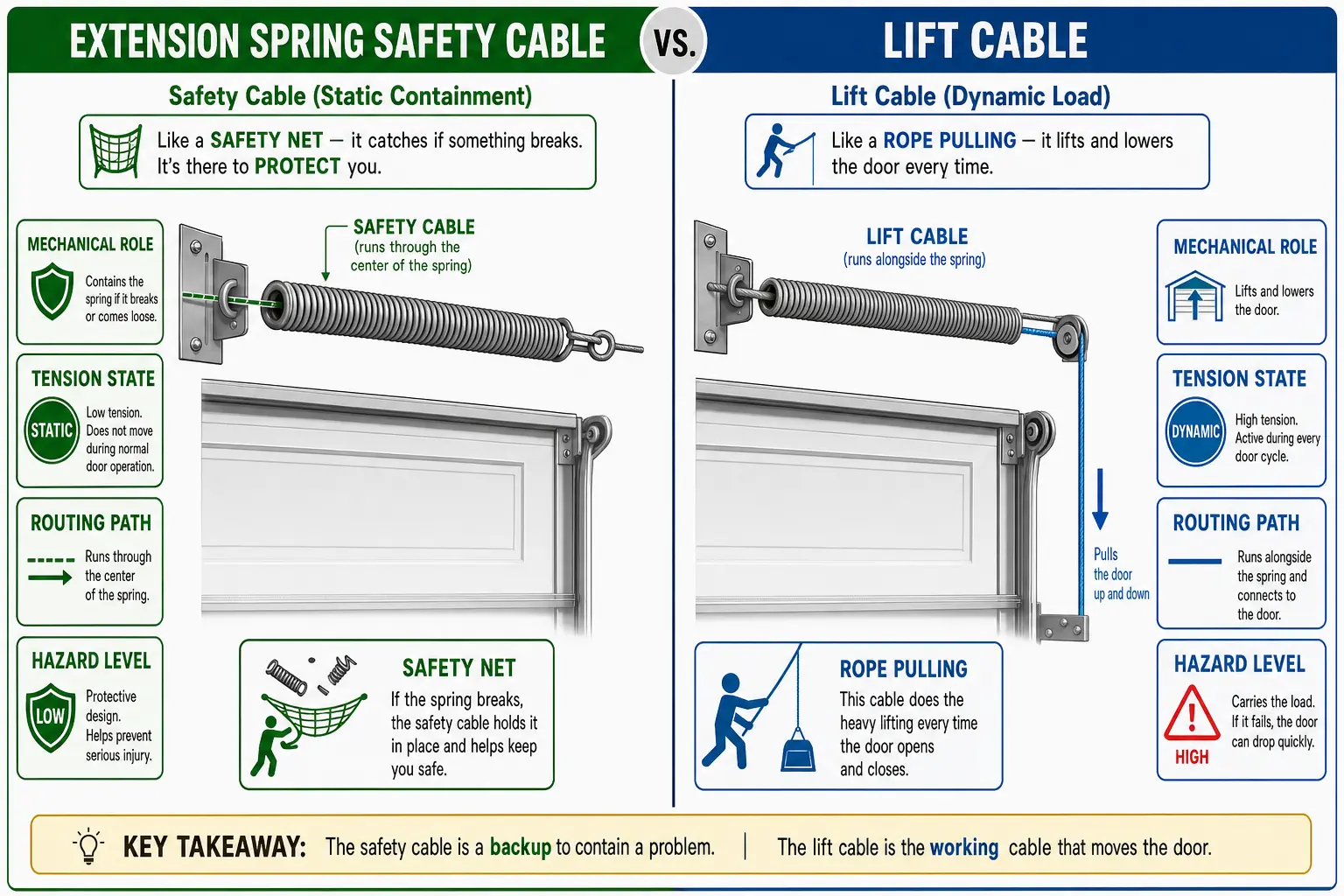
This diagram clarifies the mechanical and safety roles differentiating extension spring safety cables from lift cables, helping homeowners instantly understand why safety cables are critical containment devices—not load-bearing cables.

Safety Cable vs. Lift Cable: The Critical Difference


A common point of confusion during system evaluations stems from conflating lift cables with safety containment cables. Nearly three-quarters of online DIY guides mislabel these components, creating unnecessary confusion for homeowners inspecting their doors.

  • Lift Cables: These are dynamic, load-bearing components attached to the bottom brackets of your garage door. They run through pulleys to lift the door’s physical weight. If you’re analyzing a system setup like a garage door extension spring vs torsion configuration, lift cables are continuously active under tension whenever the door moves.
  • Safety Containment Cables: These are static, passive safety nets. They do not lift the door or carry active mechanical loads. Instead, one end anchors to the front track bracket, passes directly through the hollow center of the extension spring, and fastens to the rear ceiling support angle iron.

Recognizing this operational distinction helps prevent misdiagnosing common garage door cable problems during routine maintenance checks.

Still stuck? Get it fixed today.
24/7 emergency service from licensed local technicians.
Call (860) 362-3018

Why Extension Spring Safety Cables Are Essential


When an uncontained spring breaks, it releases over 150 lbs of kinetic force in less than 0.1 seconds. DASMA (Door & Access Systems Manufacturers Association) Technical Data Sheet #361 and ANSI/DASMA 102 standards mandate safety cables or containment devices on all residential extension spring systems to eliminate this structural hazard.

Professional-grade containment systems utilize 3/32″ or 1/8″ 7×7 aircraft-grade galvanized carbon steel wire rope. Engineered with a minimum breaking strength ranging between 920 lbs and 1,700 lbs, these cables safely absorb maximum impact velocity during sudden coil disintegration. Understanding these dynamic forces highlights why are garage door springs dangerous when proper safety mechanisms are missing or compromised, as an uncontained coil can lead to severe garage door spring injury.

Step-by-Step: How to Inspect Your Safety Cables


You can thoroughly evaluate your safety cables from ground level without touching high-tension components. Perform a visual assessment every six months using this non-contact diagnostic sequence.

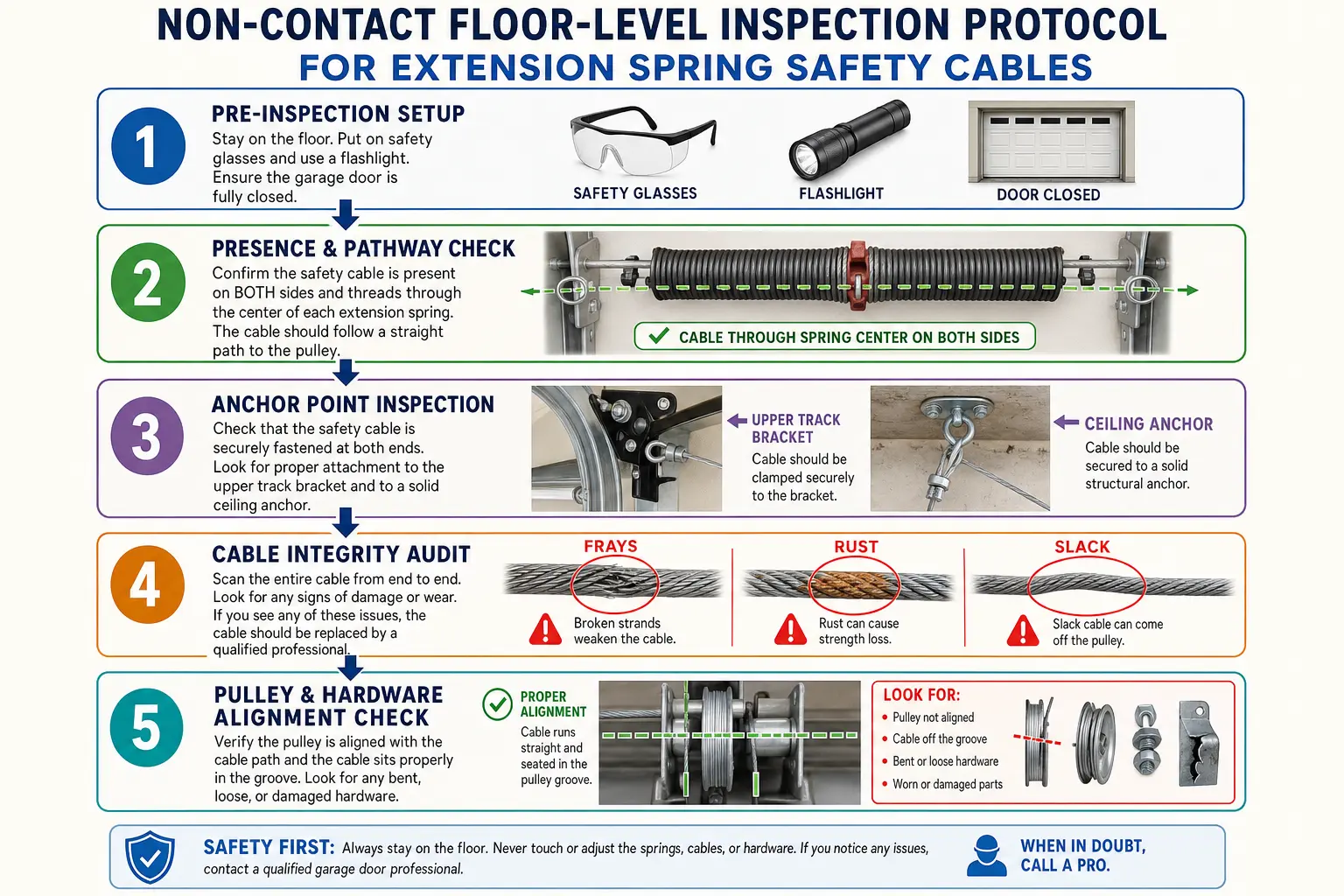
Follow this four-step non-contact inspection flowchart to safely evaluate your garage door extension spring safety cables without risk, ensuring presence, proper installation, and cable condition.

  1. Pathway Audit: Close the garage door completely to extend the springs. Stand at a safe distance and verify with a flashlight that a steel cable passes continuously through the center core of both the left and right extension springs.
  2. Anchor Point Verification: Trace the front of each safety cable to its attachment point on the vertical track jamb bracket. Then trace the rear end to ensure it is looped and securely bolted to the rear ceiling angle iron or stationary rear track support.
  3. Cable Integrity Assessment: Inspect the wire along its entire length. Look for individual strand fraying, reddish-brown surface rust, severe kinks, or sagging that allows the cable to drag across moving pulleys.
  4. Hardware Alignment: Check that the safety cable remains completely clear of the lift cable and pulley sheaves. It should never wrap around the moving lift cable or interfere with track rollers.

Incorporating these checks into a broader garage door safety inspection keeps your system operating dependably.

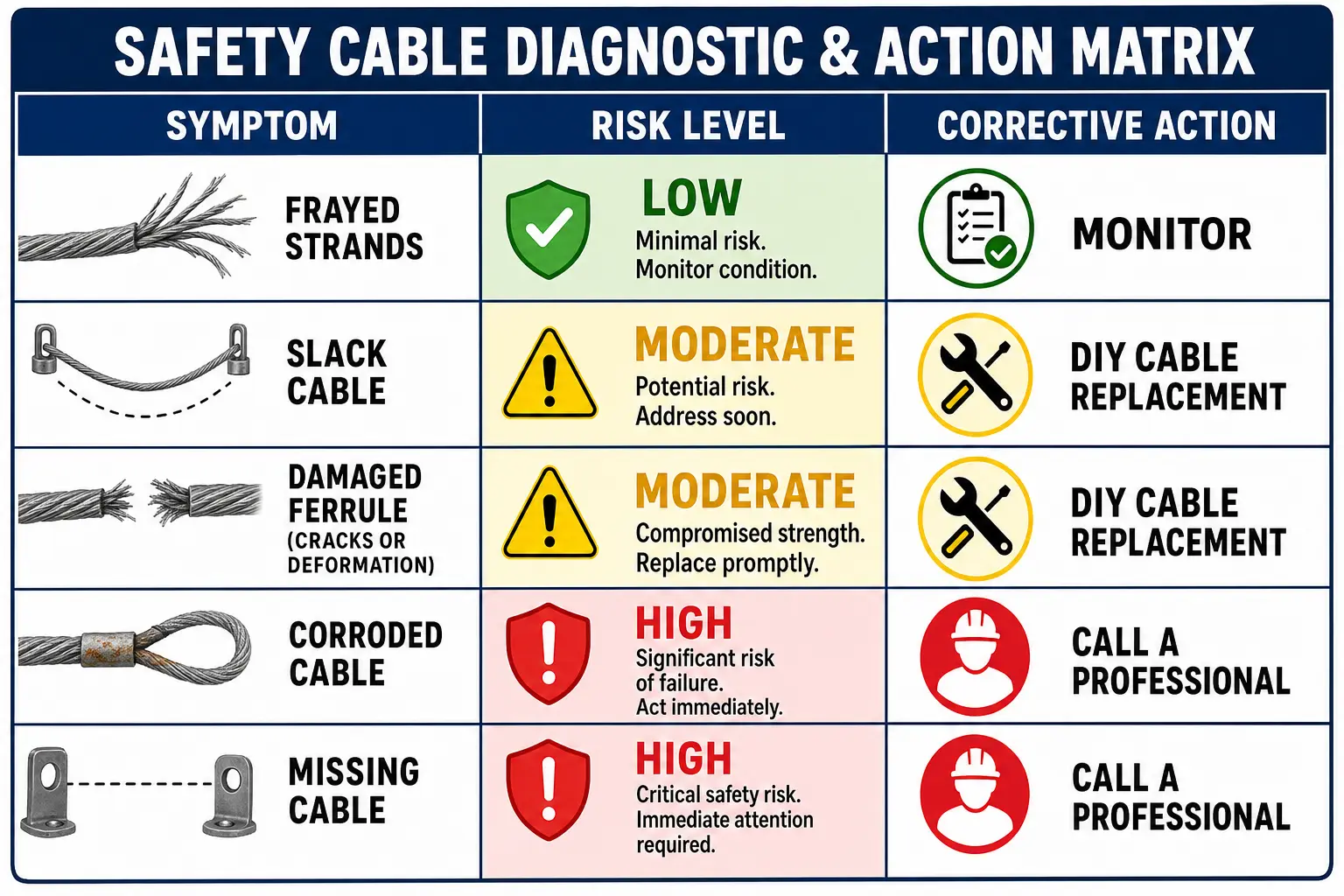
Diagnostic & Action Matrix: What Your Visual Check Reveals


This diagnostic and action matrix helps homeowners quickly associate observable safety cable issues with risk severity and clear next steps, supporting confident maintenance decisions.

Visual Observation Mechanical Status Hazard Level Recommended Action
No cable threaded through spring Missing containment line Critical Thread passive safety cables immediately while door is open and springs are fully relaxed.
Frayed strands or heavy rust Material fatigue High Replace safety cable pairs using 7×7 galvanized steel rated for your door height.
Cable wrapped around lift pulley Routing error Moderate Disengage door opener, open door manually to release spring tension, and reroute path.
Slight slack when door is closed Normal state Low No action required. Safety cables require mild play to prevent binding.

DIY Threading vs. Professional Repair: Knowing Your Safety Boundaries


Evaluating diy vs professional garage door repair: which is better comes down to distinguishing static containment tasks from high-tension mechanical work.

Safe DIY Task: Threading a new safety cable through an extension spring when the door is fully raised and secured with C-clamps. Under these conditions, extension springs are completely relaxed and carry minimal stored tension.

Professional-Only Task: If your inspection reveals worn lift cables, stretched springs, or damaged bottom corner brackets, do not attempt repairs yourself. Handling tensioned springs requires specialized equipment and training. In those situations, contacting a licensed specialist for a garage door cable replacement near me or a 24 hour garage door spring replacement protects your personal safety and preserves your door system. If a spring fails unexpectedly, schedule an emergency garage door service immediately to secure your property.

Frequently Asked Questions


Can I open my garage door if a safety cable is broken or missing?

Yes, the garage door can physically operate without safety cables because they do not lift weight. However, operating a system without safety cables leaves your garage unprotected against high-velocity spring failure. You should install replacement safety cables before resuming regular automatic door use.

Why is my safety cable slack when the garage door is open?

A small amount of slack is normal when the door is fully open. Because extension springs contract to their shortest physical length when relaxed, excess cable length rests loosely. As long as the cable remains threaded through the spring center and securely anchored at both ends, this slack will not impede safety containment.

Should safety cables be replaced at the same time as extension springs?

Yes. Safety cables experience ambient moisture, friction, and vibration over their lifespan. Replacing your safety cables alongside your extension springs ensures consistent structural integrity across all secondary containment components without incurring extra installation labor later.

Contact / Request a Call