Emergency Professional Garage Door Service: What to Expect


Published: Sep 1, 2026

When a garage door fails late at night or during a busy morning, anxiety naturally spikes. Is your home exposed to intruders? Is your vehicle trapped inside before a critical commitment? Facing an inoperable garage door places homeowners in a high-stress decision cycle: balancing the immediate need for security against the fear of after-hours price gouging.

This guide provides an authoritative roadmap to navigating a garage door emergency, helping you stabilize your home safely and choose a trustworthy local professional.
The 60-Second Emergency Safety & Stabilization Checklist


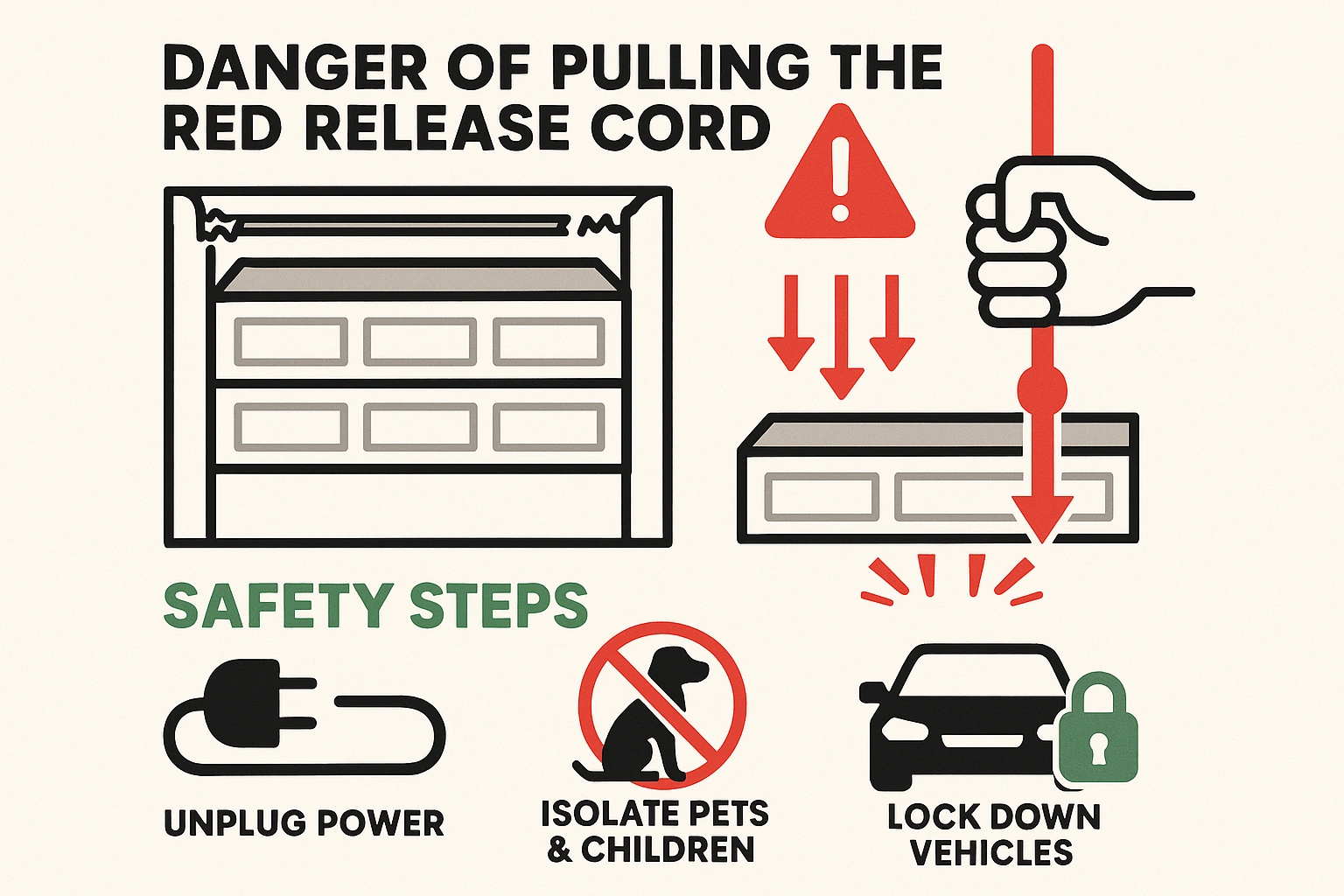
This infographic explains the critical safety steps homeowners must take immediately when facing a stuck garage door, emphasizing why pulling the red release cord can be catastrophic during spring failure.

Before you make a phone call, your immediate priority is safety. An estimated 20,000 to 30,000 people are injured in garage door accidents annually in the United States, with many suffering severe lacerations or fractures from high-tension components.

Follow these steps immediately to stabilize your garage:

  1. Do Not Pull the Red Release Cord: If your door is stuck open or has a broken spring, pulling the garage door emergency release can be catastrophic. Without the counterweight of an active spring, up to 400 pounds of deadweight can crash down instantly.
  2. Isolate the Power: Unplug your automatic opener from its ceiling outlet. This prevents anyone from accidentally activating the system via remote, which can burn out the motor gear or snap remaining hardware.
  3. Secure the Area: Keep children, pets, and vehicles away from the garage path.
  4. Avoid DIY Force: Never attempt to manually force a crooked door down. Over 1,600 emergency medical incidents occur annually during DIY garage door repair attempts. Trying to wrestle high-tension components without professional tools is a major safety risk. To learn more about these hazards, read about common DIY garage door spring mistakes.

Is It a Real Emergency? (The Classification Matrix)


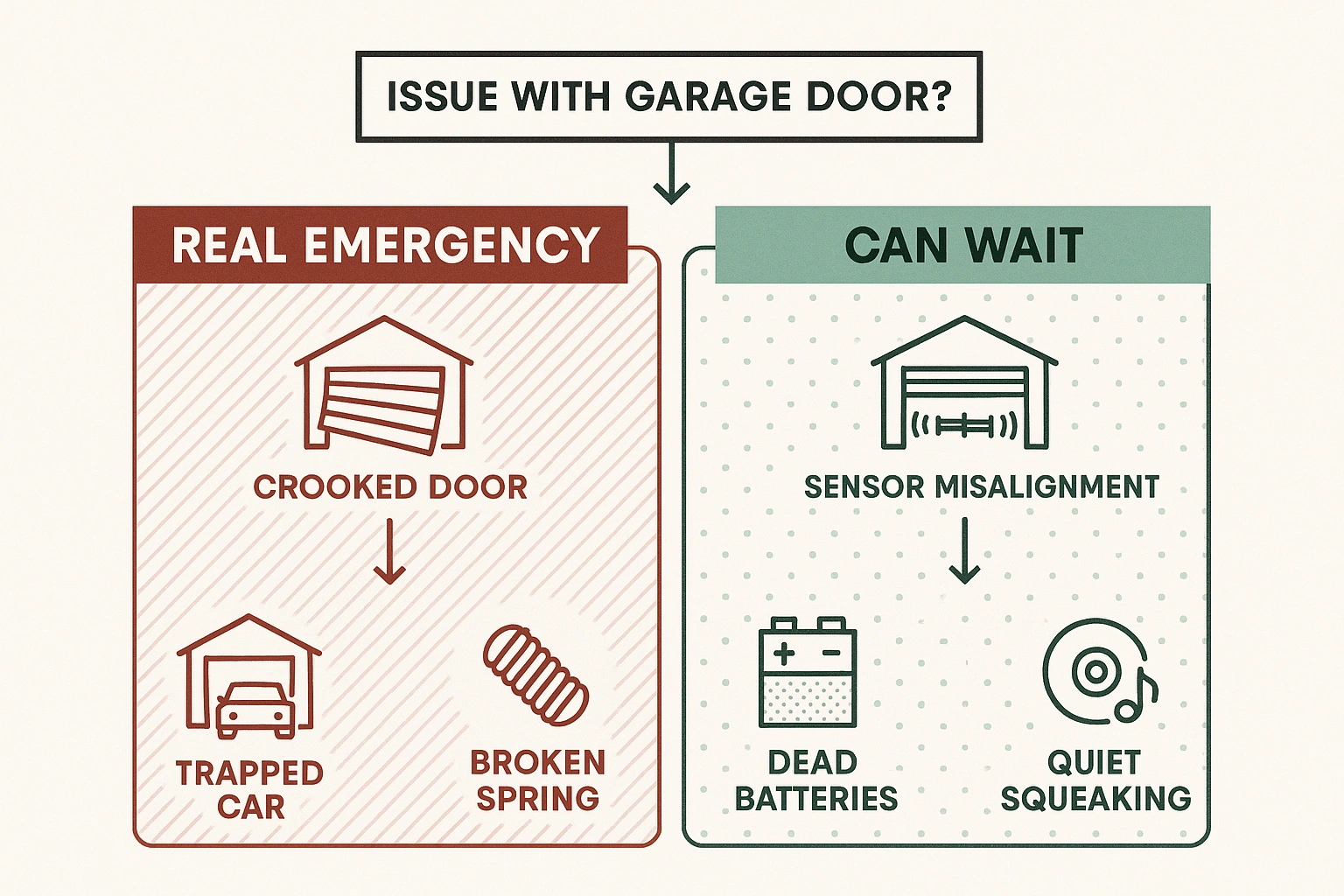
This matrix helps homeowners quickly assess whether their garage door issue demands immediate emergency service or can be scheduled for routine repair, reducing confusion and anxiety during stressful moments.

Not every malfunction warrants an after-hours dispatch fee. Determining whether your situation is an active emergency or a routine repair can save you significant time and money.

If your garage door stuck in an awkward position, check the classification matrix below to make an informed decision:

True Emergency (Requires Immediate 24/7 Dispatch)

  • Door Stuck Open or Crooked: This creates an immediate security breach, exposing your home and family, while leaving the door vulnerable to structural collapse.
  • Trapped Vehicle: Your car is locked inside when you have an urgent medical, personal, or professional obligation.
  • Snapped High-Tension Cables: Snapped cables leave the entire weight of the door unguided, posing severe physical danger.
  • Active Crushing Hazards: Reversing-sensor failures or physical track warping that prevents the door from closing.

Routine Service (Schedule During Normal Business Hours)

  • Sensor Misalignment: The photo-eye lights are blinking, and the door only closes if you hold down the wall button continuously.
  • Dead Accessory Batteries: Keypads or handheld remotes fail to respond, but the wall station works perfectly.
  • Operational Squeaking: The system runs completely but makes loud, irritating noises.

If you are experiencing a true security or safety risk, contacting a responsive, local emergency garage door repair service is the safest next step.


The Cost of Emergency Garage Door Repair


Financial anxiety is a common barrier to calling for professional help. To protect yourself from predatory pricing, it helps to understand standard benchmark rates for common parts alongside typical emergency surcharges.

When budgeting, be highly alert to the practice of “stacked fees.” Predatory operators often advertise low trip fees, only to stack an emergency fee, an after-hours multiplier, and mileage charges on top of the actual parts. Reputable companies provide a flat, upfront trip and diagnostic fee that remains consistent regardless of the hour, with repairs billed at clear, standard rates.

During an emergency call, a technician will focus on critical structural parts:


What to Expect During the Emergency Service Visit


A professional emergency service call follows a highly structured, logical sequence designed to minimize risk and restore security efficiently.

  1. The Professional Phone Dispatch: A reputable dispatcher will clearly state their emergency dispatch fees and confirm that their service trucks are fully stocked with a wide variety of commercial and residential parts to maximize first-visit resolution rates.
  2. Comprehensive On-Site Diagnosis: Upon arrival, the technician will complete a structural evaluation of your system. Research shows that over 65% of emergency calls reveal secondary, heavily worn components—such as frayed cables or worn rollers—that failed alongside the primary point of failure.
  3. The Itemized Written Estimate: Before any tools touch your door, you should receive a complete, written estimate detailing all parts, labor, and emergency fees.
  4. Immediate Mechanical Restoration: The technician replaces the damaged components, safely releasing and resetting the high-tension systems.
  5. System-Wide Inspection: A dedicated professional will conduct a thorough garage door multi-point inspection to ensure other parts haven’t been damaged by the sudden failure.
  6. Safety & Balance Testing: The repair finishes with a physical balance test and an operational check of the opener’s auto-reverse systems. For complex motorized issues, the tech will run a detailed garage door failure analysis to guarantee long-term safety.

Vetting Your Emergency Dispatcher


To protect your home and wallet late at night, ask these five vetting questions before agreeing to a dispatch:

  • “Is your emergency trip fee a flat rate, or does it stack with extra hourly fees?”
  • “Are your technicians background-checked W-2 employees of your company, or independent subcontractors?” (Working with dedicated company employees ensures accountability and higher service standards.)
  • “Will I receive a written, all-inclusive estimate before the physical work begins?”
  • “Are your trucks fully stocked to handle torsion spring and cable replacements in a single visit?”
  • “If I choose not to proceed with the repair after the diagnosis, what is my exact financial obligation?”

For homeowners seeking dependable local assistance, choosing a trusted, established provider of new haven garage door repair ensures prompt, professional, and transparent service when you need it most.


Emergency Service FAQs


Will homeowner's insurance cover emergency garage door repairs?

Generally, homeowner’s insurance covers garage door damage if it was caused by a covered peril, such as a vehicle collision, severe storm, or vandalism. It typically does not cover wear-and-tear failures, such as a spring snapping due to age.

Can I manually close my garage door if the spring is broken?

We strongly advise against this. Without an active torsion spring acting as a counterweight, the door is incredibly heavy and physically unstable. Attempting to move it manually can warp the tracks, damage the door panels, or cause severe personal injury if the door slips.

How long does an emergency repair visit typically take?

A standard emergency repair—such as replacing a pair of torsion springs or resetting cables—is usually completed in 1 to 2 hours once the technician arrives on-site, assuming their truck is fully stocked with the correct parts.

Contact / Request a Call