
Why Are Garage Door Springs Dangerous: Think Before DIY


Published: Sep 21, 2026

You are looking at your broken garage door, thinking about the $200 to $400 a professional repair might cost, and wondering if you can handle it yourself. You have likely watched a ten-minute YouTube tutorial where a smiling handyman swaps out a spring in what looks like real-time simplicity. It is easy to think: Is the warning about garage door springs real, or is it just a scare tactic to get me to pay for professional service?

Before you order parts online and reach for a set of winding bars, it is critical to look past the simplified video tutorials and examine the actual physics, medical data, and mechanics of garage door tension.
Debunking the "42 Injuries" Myth: The True Scale of the Danger


Many standard home improvement and competitor blogs repeat a highly understated statistic: that there are only “42 garage door injuries per year” in the United States, often misattributing this data to the U.S. Census Bureau.

This figure is off by a factor of nearly 1,000. The U.S. Census Bureau does not track emergency room admissions; the Consumer Product Safety Commission (CPSC) does.

According to verified data from the CPSC’s National Electronic Injury Surveillance System (NEISS), there are actually between 20,000 and 30,000 emergency-room-treated injuries associated with garage doors annually. Within this total:

  • Approximately 2,000 are crushing injuries caused by heavy doors falling when a spring fails or is unsafely released.
  • Over 7,500 are severe pinching, laceration, or amputation injuries, which frequently happen when fingers get caught in active spring coils, drums, or cables.

If you suspect your system is compromised, understanding how to tell if garage door spring is broken is the first step toward handling the situation without becoming another statistic.


The Clinical Reality: What an "Open Globe Injury" Actually Is


When homeowners think of DIY danger, they usually think of a bruised knuckle. They do not think of permanent blindness.

A 15-year retrospective clinical study conducted by Massachusetts Eye and Ear and published in the medical journal Ophthalmology (2023) documented the devastating impact of Open Globe Injuries (OGIs) directly caused by DIY garage door spring repairs.

An OGI occurs when the outer wall of the eye is completely ruptured by a high-velocity impact. In these documented cases, patients suffered traumatic eye ruptures, orbital facial fractures, and intraocular foreign bodies (metal shrapnel embedded deep inside the eye) when springs snapped or winding bars slipped. Many of these patients required emergency ocular surgery and suffered permanent, irreversible vision loss. This is why prioritizing proper garage door spring safety is not just a recommendation—it is a medical necessity.


The Physics of Torsion: Why Garage Springs Store "Car Crash" Energy


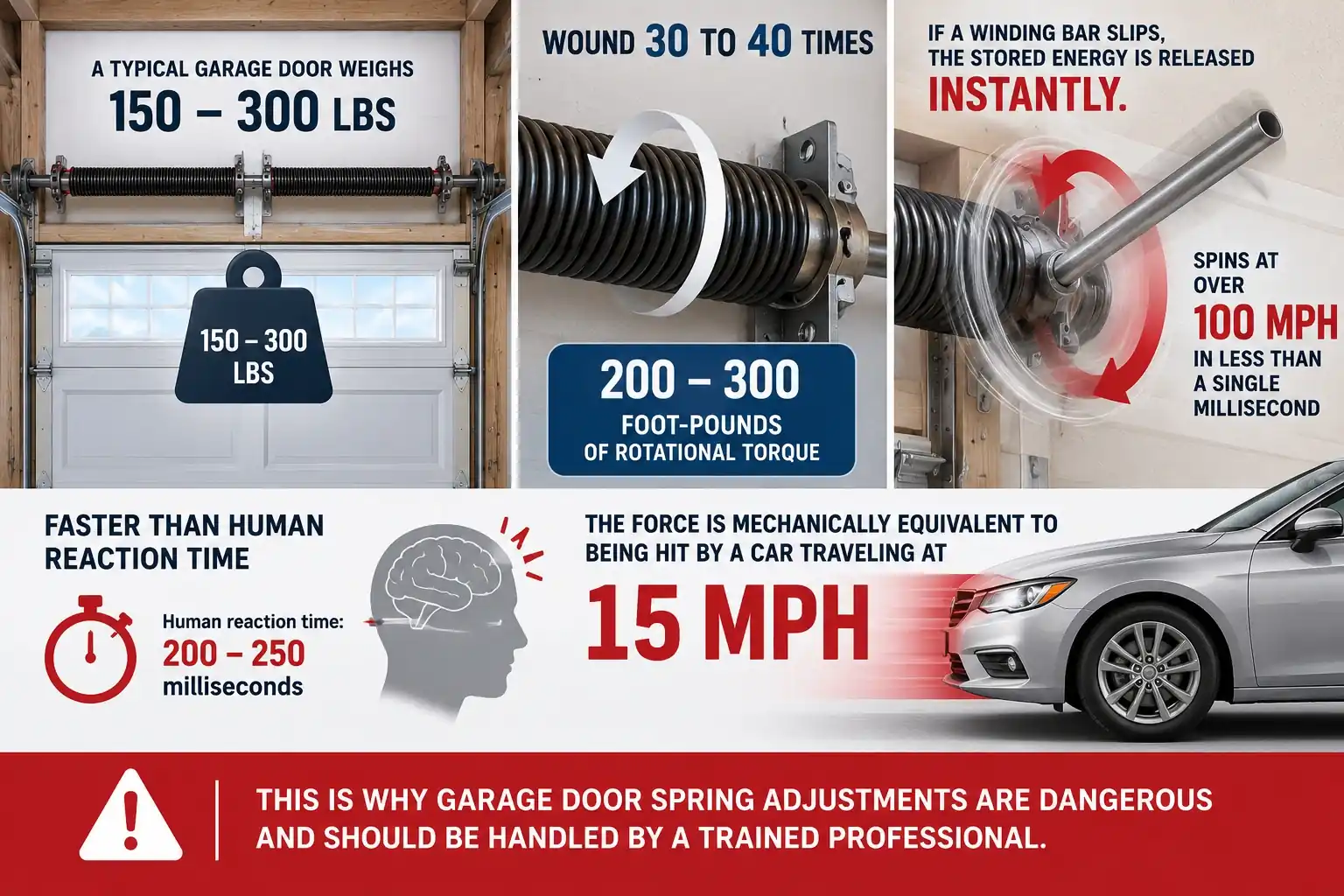
Garage Door Spring Safety Infographic

To understand why these injuries are so severe, you have to understand the physics of the system. A standard residential garage door weighs anywhere from 150 to over 300 pounds. To lift this weight manually or with a small electric motor, the torsion spring must store an equal and opposite force.

When a torsion spring is wound 30 to 40 times, it holds roughly 200 to 300 foot-pounds of rotational torque.

If a DIY winding bar slips during adjustment, that stored energy is released instantly. The solid steel winding bar will spin at speeds exceeding 100 mph in less than a single millisecond. This is faster than human reaction time; you cannot let go or move out of the way. The force of that spinning steel bar striking your hands, jaw, or skull is mechanically equivalent to being hit by a car traveling at 15 mph.


Why YouTube Tutorials are a Dangerous Trap


Online tutorials create a false sense of security because they show repairs performed under ideal conditions.

  • The Rusty Component Reality: Tutorial videos use brand-new, clean shafts and hardware. They do not show what happens when a rusted winding cone, seized to the shaft by years of moisture, suddenly breaks free with unpredictable force.
  • The Physical Load: Videos rarely convey the intense physical strength required to hold two winding bars steady under full load while standing balanced on a ladder.
  • Incorrect Tools: Many DIYers attempt to use screwdrivers, rebar, or pliers instead of dedicated, cold-rolled steel winding bars. Using improper tools dramatically increases the risk of slipping.

While some resources explain how to rewind a garage door spring, doing so without professional-grade safety gear and specialized training exposes you to immense physical risk.


Torsion vs. Extension Springs: Which One is the "Ticking Time Bomb"?


Both spring types carry distinct mechanical hazards:

  • Torsion Springs (Rotational Torque): Mounted on a metal shaft directly above the closed door header. The danger lies in the high rotational torque. Slipping winding bars cause rapid facial and hand fractures.
  • Extension Springs (Linear Tension): Mounted parallel to the upper tracks. These stretch out like giant rubber bands. When an extension spring snaps without a safety containment cable installed, it acts like high-velocity shrapnel, capable of tearing through drywall, denting car hoods, or causing severe injury.

Whether your system uses torsion mechanics or requires safely installing garage door springs and cables, both systems demand extreme caution.


The Ultimate Cost-Benefit Matrix: DIY vs. Professional Replacement


When evaluating whether to repair this yourself, it helps to compare the actual balance of risks:

  • The DIY Path: You might spend $100 on springs and specialized tools. However, you risk thousands of dollars in emergency room bills, zero warranty protection on your labor, and the potential of permanently damaging your garage door frame or automatic opener.
  • The Professional Path: A standard residential replacement typically costs between $150 and $400. This includes professional calibration, a parts and labor warranty (often lasting 5 to 10 years), a full system balance check, and complete physical safety for you and your family.

How to Safely Handle a Broken Spring Right Now


If your garage door spring has just snapped, take these immediate safety precautions:

  1. Do Not Touch the Emergency Release Cord: If the door is open, pulling the red release cord can cause the heavy door to crash down instantly like a guillotine.
  2. Do Not Run the Opener: Trying to force the door open with your automatic opener can burn out the motor, strip the gears, or bend the top door panels.
  3. Keep Clear: Keep children and pets away from the garage area until the high-tension components have been secured.

The Safe Path Forward


A broken garage door spring does not have to disrupt your week or put your physical safety at risk. Choosing professional service ensures that your heavy door is balanced, safe, and backed by a reliable warranty.

If you are dealing with a broken spring, contact our team today for a safe, reliable, and prompt 24 hour garage door spring replacement. Let our experienced professionals handle the heavy lifting and high tension safely.

Frequently Asked Questions


Can a broken garage door spring fall and hit my car?

Yes. If an extension spring breaks without safety cables, or if a torsion spring snaps while the door is in motion, the door can drop instantly, causing severe damage to any vehicle or person underneath.

How long do garage door springs typically last?

Standard residential springs are rated for approximately 10,000 cycles (one cycle is the door opening and closing once). For an average family, this equates to roughly 7 to 10 years of regular use.

Can I replace just one spring if only one is broken?

It is highly recommended to replace both. Garage door springs are manufactured to endure the same wear and tear. If one has snapped, the other has reached the end of its lifespan and will likely fail shortly after.


Contact / Request a Call