The single biggest mistake homeowners make when purchasing replacement garage door parts is falling into the “nominal sizing” trap. If you measure your garage door track, see that it is 2 inches wide, and purchase a roller with a literal 2-inch wheel diameter, the roller will bind, seize, and ruin your door’s alignment.
To guarantee compatibility, you must use actual engineering dimensions:
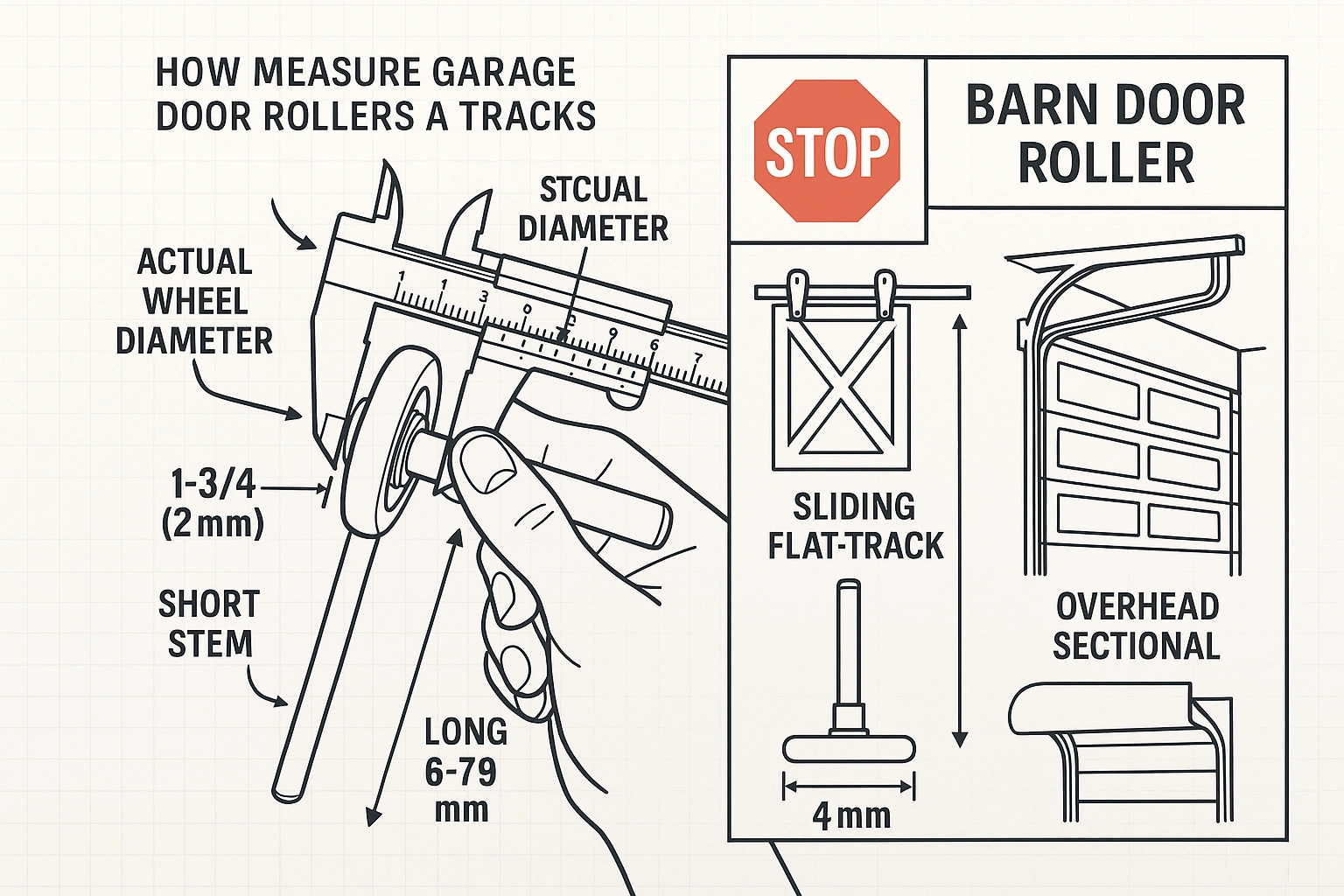
- 1-Inch Nominal Roller: The actual wheel diameter is 13/16 inches.
- 2-Inch Nominal Roller (found in 99% of residential homes): The actual wheel diameter ranges from 1-3/4 inches to 1-7/8 inches to allow for running clearance inside a standard track.
- 3-Inch Nominal Roller (used in industrial or heavy commercial applications): The actual wheel diameter is 2-3/4 inches.
Beyond wheel diameter, stem sizing is critical. The standard residential stem diameter is 7/16 inches (0.437″). However, stem lengths vary depending on your door’s reinforcement:
- Short Stems (4 inches): Designed for standard single-hinge side mounts.
- Long Stems (7 to 9 inches): Mandatory for doors equipped with wind-load struts, double-hinge commercial fixtures, or heavy wooden carriage doors that require extra support, in compliance with ANSI/DASMA 115 wind-load criteria. Proper garage door track alignment relies heavily on matching these exact stem specifications.
(Please note: This guide is dedicated exclusively to overhead sectional garage door hardware. It does not apply to flat-track, exposed-wheel interior sliding barn door systems, which rely on entirely different tracking mechanics.)