Garage Door Strut Installation and Retrofit Guide


Published: Aug 21, 2026

When a garage door begins to sag in the open position, or emits a sharp popping sound as it navigates the curve of the track, it is signaling structural fatigue. If you are evaluating how to correct this deflection, you are likely deciding between a simple reinforcement strut installation or a complete door replacement.

This guide breaks down the engineering specifications, material gauges, and logistics workarounds to help you make a highly informed, cost-effective decision.

Real-World Diagnosis: Is Your Door Salvageable?


Before purchasing reinforcement hardware, you must diagnose the severity of the panel fatigue.

The popping noise you hear occurs because the tongue-and-groove joints between horizontal sections are misaligned due to bowing. When the door travels through the track radius, these misaligned joints rub and bind before snapping back into place.

  • Minor Bowing (1 to 3 inches of deflection): This structural bend can be permanently resolved by installing strategic horizontal reinforcement struts.
  • Severe Creasing or Metal Tears: If the steel has a visible crease line, split seam, or torn hinge stiles, a strut will not suffice. Operating a creased door risks complete track derailment. In these scenarios, you must secure a professional broken garage door panel repair or source garage door replacement panels to guarantee safe operation.

The Anatomy of a Strut: Materials, Gauges, and Specifications


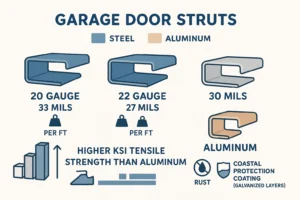
Visual guide comparing steel 20, 22, and 24-gauge garage door struts by thickness, weight per foot, and tensile strength to help choose the right reinforcement based on door size and environment.

Garage door reinforcement struts are long, cold-rolled U-bars engineered to distribute horizontal wind forces and prevent vertical gravity sag.

To ensure longevity in high-humidity garages or coastal locations, struts should be manufactured from hot-dipped galvanized steel conforming to ASTM A653 standards (ideally G60 or G90 ratings). The architectural strength of a strut is determined by three variables:

  1. Steel Gauge: Struts are typically manufactured in 20-gauge (heavy-duty/commercial), 22-gauge (standard residential builder-grade), or 24-gauge (light-duty retail). Understanding 24 vs 25 gauge steel skin dynamics reveals why pairing thick, rigid 20- or 22-gauge struts with lightweight doors offers the best structural balance.


  1. Profile Height: Standard residential struts feature a 2-1/4 inch profile. Wide-span double doors (16 to 18 feet) or commercial applications require a deeper 3-inch profile to resist twisting forces.
  2. KSI Tensile Rating: Kilopounds per square inch (KSI) measures the steel’s yield strength. High-KSI steel allows a lighter-gauge strut to deliver equivalent rigidity to thicker, heavier, low-KSI steel, preventing unnecessary weight additions.

The Strut Selection Decision Matrix (Universal Fit Guide)


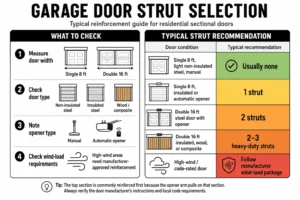
Step-by-step decision matrix for selecting the proper garage door strut configuration based on door width, material, opener presence, and wind-load requirements for optimal reinforcement and compliance.

A critical factor in deciding how many struts to install is your door’s insulation style. Injected polyurethane foam creates a highly rigid, chemical bond between interior and exterior steel skins. Conversely, polystyrene panels provide thermal resistance but offer minimal structural rigidity, requiring heavier external reinforcement.

Your physical geographic location also dictates your needs. Under ANSI/DASMA Standards 102 and 108, garage doors must withstand localized wind pressures. If you reside in hurricane-susceptible zones, securing a certified wind rate garage door setup often means utilizing one strut per horizontal panel section, complemented by a dedicated bottom strut to anchor the door securely against negative pressure.

The Freight Shipping Hack: Strut Junction & Connector Kits


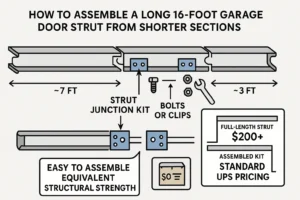
Visual explanation of using strut junction kits to assemble multiple short strut sections into one long brace, bypassing expensive freight fees while maintaining full structural strength.

If you are sourcing materials for a 16-foot double-car garage door, shipping single-piece steel struts triggers an “over-the-road” freight surcharge of $200 to $300.

To eliminate this shipping cost, use structural Strut Junction and Connector Kits. Rather than shipping a solid 16-foot bar, these kits feature shorter, parcel-shippable sections (such as two 7.11-foot end segments) that slide into a heavy-duty, 3-foot center connector sleeve. Once bolted together, the overlapping double-steel center section provides exceptional stiffness right where the garage door is most vulnerable to bowing, without the freight cost penalty.

Placement, Installation, and Spring Safety warnings


Strategic installation ensures the strut works in harmony with your mechanical operating system.

Precise Mounting Locations

Struts must be placed directly beneath horizontal panel hinges, in alignment with the roller carriers. If you are completing a new garage door opener installation, you must install a vertical 12-gauge operator reinforcement bracket to connect the opener arm to the top strut. This vertical-horizontal bridge prevents the center stile from bowing when the opener pulls the door upward. Secure all hardware with self-drilling 7/16-inch hex-head Tek screws, keeping screw patterns slightly offset to avoid splitting the steel grain.

The Torsion Spring Weight Equation

Adding steel struts to your door adds dead weight. A standard 2-1/4″ strut weighs approximately 10 ounces per foot (0.625 lbs/ft). Adding three struts to a 16-foot door adds nearly 30 pounds of steel.

Exceeding a 15- to 20-pound weight addition shifts your door’s balance point. If ignored, an unbalanced door will burn out your automatic opener’s internal gears. To prevent this, you must adjust the garage door torsion spring winding to increase lifting force and balance the weight. Always learn how to balance a garage door manually post-installation: the door should hover effortlessly at the midpoint when disconnected from the automatic opener.

Frequently Asked Questions


Why does my garage door pop loudly when opening?

Popping sounds occur when structural sag bends the horizontal panels out of plane. As they roll through the curved track, the tongue-and-groove joints rub, bind, and snap loudly. For comprehensive diagnostics, review our guide on how to fix a noisy garage door.

How does my door’s R-value affect strut requirements?

Polyurethane-injected doors have excellent natural rigidity because the foam acts as a structural core. If you look at garage door insulation r value specifications, higher-end double-skin polyurethane doors rarely require multiple mid-section struts compared to hollow single-skin steel models.

Can I install struts myself?

Yes, using parcel-shippable strut junction kits and self-drilling screws makes DIY installation highly manageable. However, if the added weight requires re-tensioning your torsion springs, you should hire a trained technician, as winding springs under high torque carries severe safety risks.

Contact / Request a Call