When it comes to this task, “good enough” isn’t good enough. Using the wrong tools is the single most common cause of catastrophic failure and serious injury. This isn’t a place to improvise.
Why Screwdrivers and Rebar are a Recipe for Disaster
You might see a hole and think anything that fits will work. This is a life-threatening mistake. People have tried using screwdrivers, pieces of rebar, or large ratchet extensions, often with devastating consequences.
Here’s the “aha moment”: The force exerted on the tool in a winding cone isn’t just a simple push. It’s immense rotational force, or torque. A screwdriver shaft is designed to resist twisting, not the massive shearing force of a torsion spring. Using one is like trying to stop a rolling car with a broomstick—the tool will bend or snap, launching itself with incredible velocity.
Proper winding bars are made of hardened steel, designed specifically to withstand this unique type of force without deforming.
Selecting and Testing Your Winding Bars
Your most important tools will be a pair of solid steel torsion spring winding bars. Here’s what you need to know:
- Diameter: The standard is 1/2 inch.
- Length: A length of 18 to 24 inches provides the necessary leverage to control the spring safely.
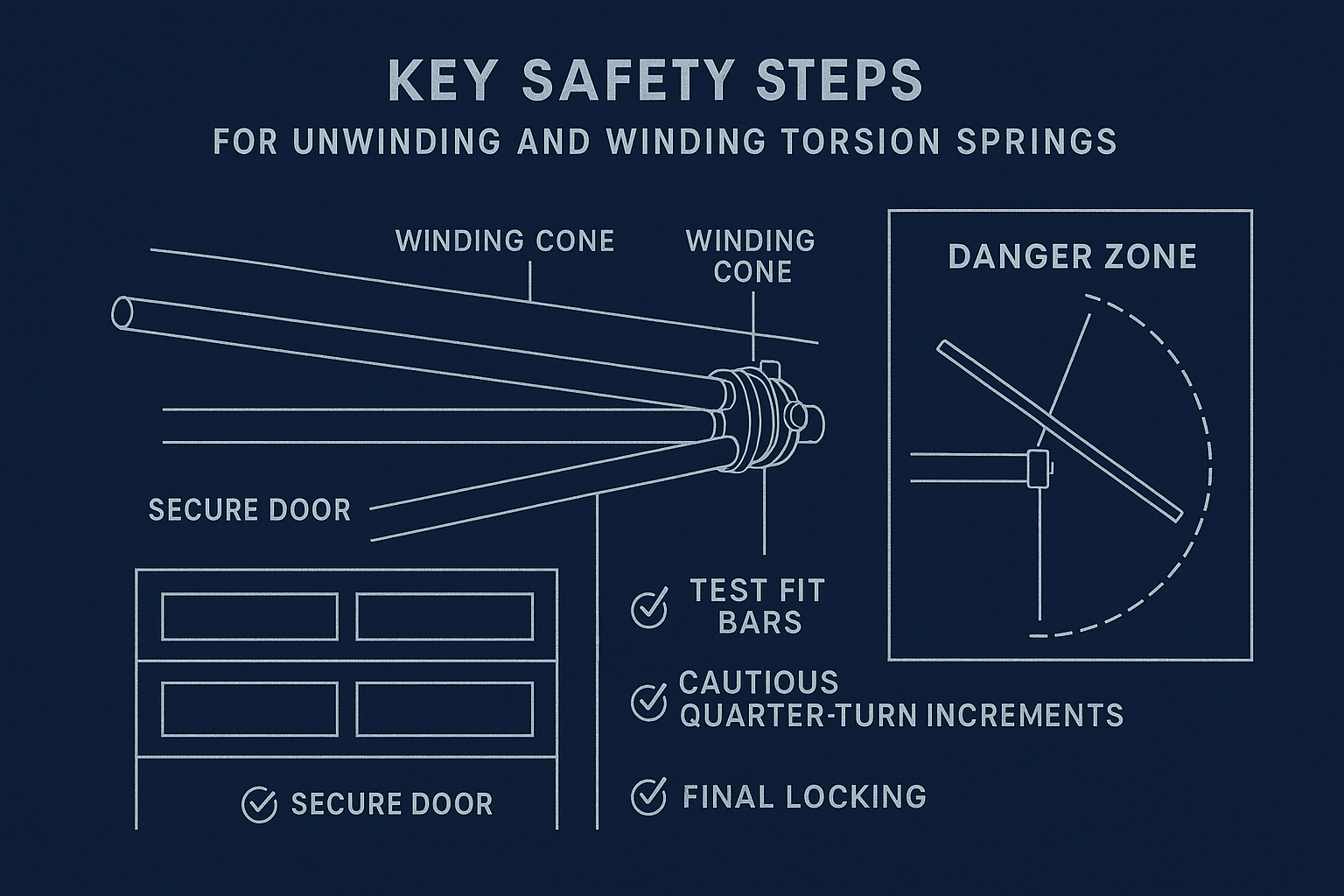
The Critical Fit Test: Before you even begin, you must check the fit of your winding bars in the winding cone. A bar with too much “play” or “wobble” can slip out under tension.
- Insert one winding bar into a hole on the winding cone.
- Gently wiggle it. It should feel snug, with very minimal movement.
- If the bar feels loose or sloppy, do not proceed. You may have the wrong size bar or a worn-out cone.