The Complete Old Garage Door Structural And Mechanical Inspection Guide


Published: Aug 17, 2026

When evaluating a home for purchase, planning a major renovation, or reviewing the safety of your current property, the garage door is often overlooked. As the largest and heaviest moving object in most households, an aging garage door system can hide serious mechanical wear and structural decay.

This comprehensive guide provides a systematic, component-by-component diagnostic framework. Designed for home buyers, renovators, and homeowners alike, this guide helps you assess the integrity of an older door so you can confidently decide whether to repair individual parts or invest in a modern replacement.

Anatomy of an Aging System: Identifying Your Hardware


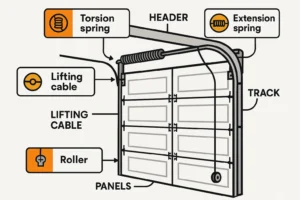
This schematic clarifies the physical components of old garage doors, illustrating legacy versus modern hardware to build foundational understanding before inspection.

Before beginning any inspection, you must identify the mechanics of your system. Older properties typically use one of two main spring configurations: torsion springs (mounted on a metal shaft directly above the closed door header) or extension springs (stretched horizontally above the horizontal tracks).

Identifying obsolete garage door parts is crucial because older hardware often lacks the integrated physical safety features mandated in modern engineering designs.

The Spring Safety Audit: Torsion vs. Extension Mechanics


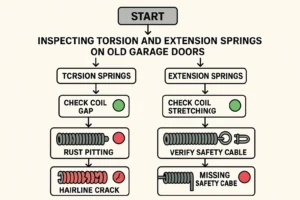
This flowchart guides readers through the critical spring inspection steps, helping assess wear and safety hazards to decide if immediate repairs or replacements are necessary.

Garage door springs store massive elastic energy to counteract the physical weight of the door. Standard residential springs are rated for approximately 10,000 cycles (one cycle constitutes a single open-and-close action). For a door that has been in service for ten or more years, the metal is statistically nearing or past its fatigue limit.

Torsion Springs

Examine the coiled steel for micro-stress fractures, heavy rust scaling, or physical gaps between the coils. If you see clean, vertical gaps, the spring’s inner core has likely snapped, leaving the door completely unbalanced and dangerous to operate.

Extension Springs & The Safety Cable Rule

Extension springs lose their structural elasticity over time, visible as uneven spacing between the coils. The most critical safety hazard to look for is the presence of a safety cable.

According to the U.S. Consumer Product Safety Commission (CPSC), a snapping extension spring without a safety cable can travel with enough velocity to pierce walls, damage vehicles, or cause fatal injuries. Ensure a heavy steel safety cable is threaded directly through the center of the spring and anchored securely to the track support. If missing, consult our detailed garage door springs guide to understand the safety implications.

The "Rust-Fretting Zone": Inspecting Lifting Cables & Bottom Brackets


The bottom six inches of an older garage door system function as a high-risk corrosion zone. Moisture, road salt, and debris pool here, accelerating galvanic corrosion on galvanized steel cables and fasteners.

Inspect the lifting cables closely near the bottom bracket. If you spot frayed steel fibers, bulging strands, or heavy rust scaling, the cable is compromised and could snap under load.

CRITICAL WARNING: The bottom brackets are under active, high-tension spring loads. Do not attempt to loosen these bolts yourself, as sudden release can cause catastrophic injuries. For safe management and replacement, refer to our detailed manual on garage door cable and spring repair.

Tracks, Alignment, and Roller Wear Patterns


Over time, foundation settling and operational vibration can warp steel tracks out of parallel alignment. Use a level to ensure the tracks are plumb and check that the mounting brackets are anchored tightly to the wall framing.

Next, evaluate the rollers:

  • Steel Rollers: Look for missing ball bearings, wobbly stems, and out-of-round wear patterns.
  • Nylon Rollers: Check for cracking, flat spots, or nylon separation from the central steel stem.

Perform the “Play Test”: gently wiggle the roller stem inside its hinge bracket. If you observe more than 1/4 inch of lateral movement, it is a clear indicator of when to replace garage door rollers to prevent the door from slipping off-track.

Assessing Panel Integrity & Wind-Load Resistance


Structural panel damage directly affects both building security and weather resistance.

  • Wood Panels: Use a flathead screwdriver to gently probe the bottom rails for soft spots caused by wood rot. Check for joint separation and delamination of face veneers.
  • Steel Panels: Look for horizontal stress creases on the top section of the door. This damage typically occurs when an automatic opener pulls on a heavy, uninsulated panel without an operator reinforcement strut, often requiring specialized garage door panel repair.

Evaluating the Opener & Safety Sensors: The 1993 UL 325 Line


Under federal mandate 16 CFR Part 1211, all residential garage door openers manufactured or installed after January 1, 1993, must include non-contact photoelectric sensors or constant-contact reverse mechanisms. If an older property has a pre-1993 opener, it lacks these vital safety features and represents a significant safety liability.

To verify the operation of your garage door safety sensor, perform these dual safety checks:

  1. The Photo-Eye Test: Start closing the door and wave an object (like a broom handle) through the path of the infra-red safety beam. The door must reverse instantly.
  2. The Mechanical Contact Test: Place a 1.5-inch thick block of wood flat on the garage floor beneath the door’s path. Activate the door to close. Upon contact with the block, the door must automatically reverse within two seconds.

For an extensive step-by-step diagnostic on these safety tests, read our complete guide on performing a garage door safety inspection. Keep in mind that older homes may also fail regional compliance standards—such as California’s SB 969, which mandates active battery backup systems during home sales.

Interactive Diagnostic Decision Matrix: Repair vs. Replace


Use this systematic checklist to evaluate your diagnostic findings and plan your next steps:

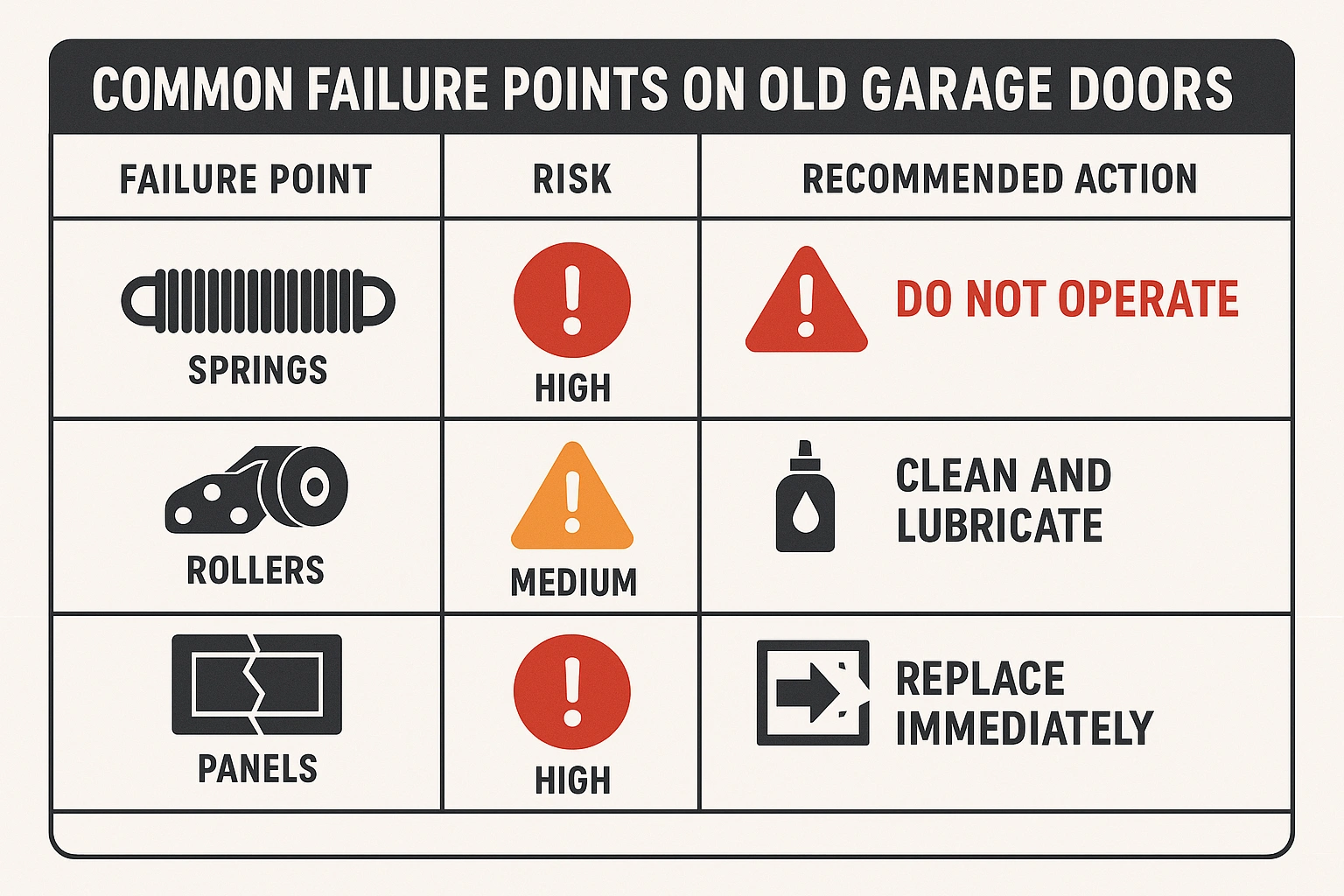
This decision matrix serves as a memory anchor, helping readers quickly recall key safety risks and make informed repair versus replacement decisions when inspecting old garage doors.

If your system displays multiple critical or high-risk failure points, standard garage door maintenance will not suffice. Upgrading to a modern, insulated door system is the safest and most cost-effective path forward.

Professional Guidance for Your Home


Evaluating an older garage door is an important step in protecting your home’s safety, security, and energy efficiency. If your self-inspection reveals structural panel decay, frayed cables, unbalanced springs, or an obsolete opener, you don’t have to navigate these safety-critical repairs alone.

The team at 24H Garage Doors (operating under Y & A Garage Doors LLC) provides reliable structural assessments, emergency repairs, and high-quality installations across Connecticut. Contact us today to schedule a professional inspection and ensure your home’s entry points are safe, secure, and fully compliant.

Frequently Asked Questions (FAQ)


Can I install safety cables on my extension springs as a DIY project?

While safety cables are critical, installing them requires working near high-tension extension springs. If the spring is old or damaged, any accidental release of tension can cause severe physical injury. Professional installation is highly recommended.

How do I check if my old garage door is properly balanced?

With the door fully closed, pull the red emergency release cord to disconnect the opener. Manually lift the door halfway. A balanced door should remain in place or drift down very slowly. If it slams shut or shoots upward rapidly, the spring tension is incorrect and requires professional calibration.

Is a pre-1993 garage door opener illegal to use?

While existing installations are typically grandfathered in under local building codes, they represent a significant safety hazard. These legacy units will fail modern home inspections during real estate transfers and should be replaced with modern, UL 325-compliant openers.

Contact / Request a Call