Torsion Spring Snapped at 2 A.M. With Your Car Trapped Inside: Emergency Extraction & Decision Guide


Published: Nov 5, 2026

A sudden, gunshot-like 90 to 100 dB bang echoing from your garage at 2 A.M. is an unsettling sound. When you investigate and find your vehicle physically trapped behind a motionless overhead door, cognitive overload sets in. You have an early morning commute, an airport run, or a medical emergency, and your garage door won’t budge.

Most online advice offers two unhelpful extremes: rigid disclaimers telling you to touch nothing under any circumstance, or dangerous DIY winding tutorials that risk severe hand injury. You need a pragmatic emergency vehicle extraction protocol paired with clear cost metrics to decide whether to pay for a late-night service dispatch or extract your car safely and wait until standard business hours.
2 A.M. Emergency Crisis Protocol


When a torsion spring fractures, the stored counterbalance energy instantly dissipates, leaving the entire weight of the door unmitigated. Your immediate priority is stabilizing the situation and preventing costly collateral damage.

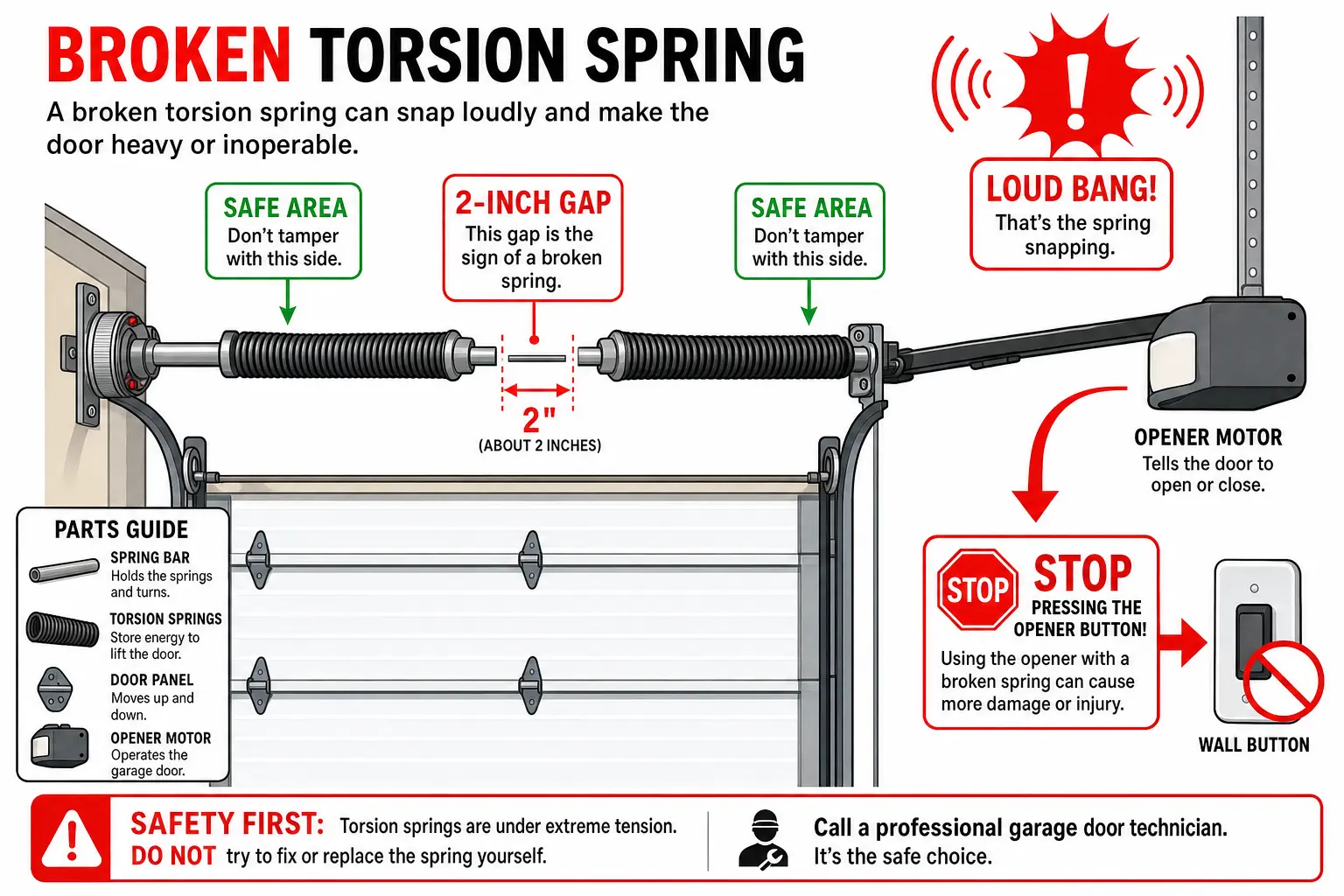
Visual identification of a snapped torsion spring: notice the 2-inch coil gap and the urgent instruction to avoid pressing the opener button to protect your garage door motor.

First, stop pressing the wall button or remote immediately. An automatic garage door opener is designed to push and pull a balanced load of roughly 10 to 15 pounds. It is not engineered to lift uncounterbalanced dead weight. Repeatedly triggering the motor will strip the internal nylon drive gears or burn out the main logic board, turning a simple spring job into a $350 to $650 motor replacement. Look up at the metal torsion bar above the closed door panel. If you see a distinct two-inch gap in the coiled spring steel, your torsion spring has broken.

Still stuck? Get it fixed today.
24/7 emergency service from licensed local technicians.
Call (860) 362-3018

Dead Weight & Opener Motor Risk Assessment


Understanding the sheer mechanical weight of your overhead door helps put the lifting effort into perspective. Without the assistance of a functional torsion spring system, you are attempting to lift raw, uncounterbalanced structural materials:

  • Standard Single Car Door (8×7 ft): 100 to 130 lbs of dead weight.
  • Standard Double Car Door (16×7 ft): 180 to 250 lbs of dead weight.
  • Insulated / Carriage House Wooden Door (16×8 ft): 300 to 450+ lbs of dead weight.

While modern openers feature force-limit safety switches, forcing an opener against this weight causes immediate stress on the drive belt or chain assembly. Learning to spot early signs of wear can help homeowners prevent garage door repairs before complete mechanical failures occur at inconvenient hours.

Step-by-Step Emergency Vehicle Extraction Guide


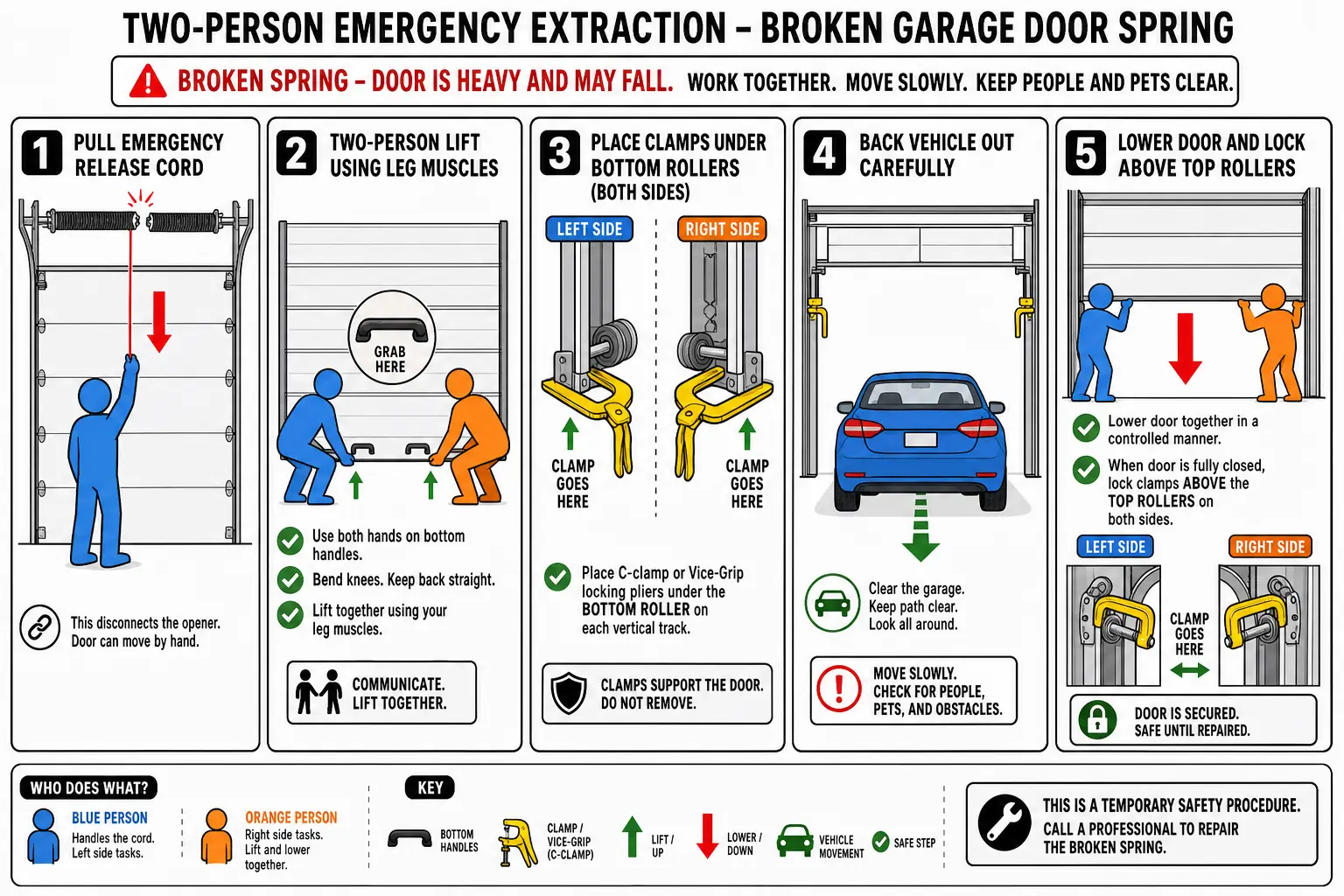
If you must get your car out immediately, follow this two-person extraction procedure safely. Do not attempt to lift a double-car or carriage house door alone.

A clear, safe procedure for two people to manually unlock and lift a garage door with a broken torsion spring, use clamps to secure tracks, and extract the car without damage or injury.

  1. Disengage the Opener: Pull the red emergency release cord down and back toward the motor unit to disconnect the carriage trolley from the opener rail.
  2. Execute a Two-Person Ergonomic Lift: Station one person on each side of the door. Bend at the knees, grip the bottom lift handles or panel frame, and lift straight up using your leg muscles.
  3. Lock the Track (Crucial Security Step): Once the door is fully raised above the opening height, keep it held firmly while a second action is completed: snap locking Vice-Grip pliers or heavy-duty C-clamps directly onto both vertical tracks immediately underneath the bottom rollers. This prevents gravity from crashing the door down while backing your car out. If a roller binds or slips during manual operation, consult our guide on garage door off track repair to fix binding issues.
  4. Back the Car Out & Lower Safely: Drive your vehicle clear of the garage frame. Remove the clamps, control the manual lowering of the door back to the floor with two people, and reinstall the C-clamps directly above the top rollers on both sides to physically lock the door shut overnight.

MOFU Decision Matrix: 2 A.M. Call vs Morning Repair


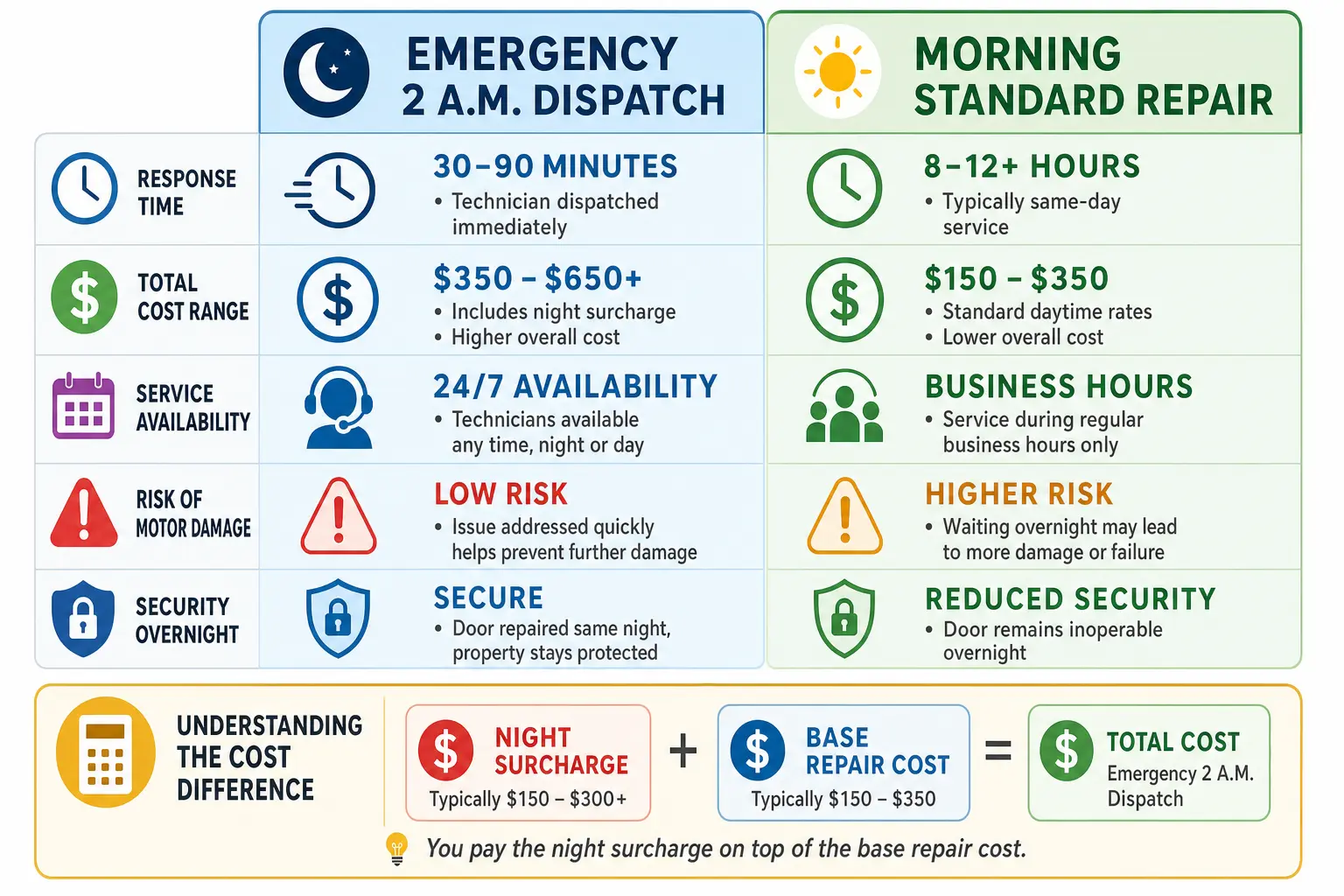
Once your vehicle is safely outside, you face an economic choice: pay for immediate 2 A.M. emergency dispatch fees or wait until standard morning office hours?

A quick financial and practical overview helping homeowners decide whether to pay emergency fees for late-night garage door repair or safely wait until morning, highlighting cost, risk, and convenience factors.

Decision Factor Option A: 2 A.M. Emergency Dispatch Option B: Self-Extract & Call at 8 A.M.
Total Estimated Cost $350 – $650 (Standard repair + $150–$250 night fee) $200 – $400 (Standard component repair)
Response Time 45 minutes to 2 hours Scheduled morning arrival window
Garage Security Fully resolved before morning Securely clamped shut overnight
Best Suited For Severe weather, un-extractable vehicle, high-risk security Successfully extracted vehicle, budget protection

If you require immediate professional intervention, booking a verified 24 hour garage door repair technician ensures your home remains secure without unnecessary delays.

Permanent Repair Evaluation: Springs, Cycles & ROI


When the technician arrives, you will need to choose your replacement hardware.

  • Dual vs. Single Spring Replacement: Standard double garage doors utilize two torsion springs engineered to share torque load equally. Because both springs experience identical cycle wear, replacing only the broken spring leaves the remaining spring highly vulnerable to failure within weeks. Replacing both simultaneously saves $150+ in redundant future labor service charges.
  • Standard (10,000 Cycles) vs. High-Cycle (25,000+ Cycles): DASMA rating standards dictate cycle lifespan (1 cycle = 1 open and 1 close). A standard 10,000-cycle spring lasts 6.8 to 7 years at 4 cycles per day. Upgrading to high-cycle springs adds roughly $30 to $50 to total hardware costs but extends operating life to 15–20 years. Maintaining smooth operations long-term also requires routine garage door maintenance and periodic checking of your garage door track alignment.

Vetting Late-Night Emergency Contractors


To avoid predatory late-night dispatch call centers, verify four key points before authorizing service:

  1. Upfront Pricing: Require a clear breakdown of the emergency call-out fee versus part replacement pricing.
  2. Physical Address: Ensure the contractor operates a verifiable local business rather than an out-of-state call center.
  3. Non-Destructive Entry: True overhead technicians never need to drill out intact door locks or replace opener motors for simple spring breaks.
  4. Hardware Warranty: Demand written warranties covering both new torsion springs and installation labor.

Frequently Asked Questions


Can I open a garage door with a broken torsion spring using the electric opener?

No. Operating an automatic opener with a broken torsion spring risks burning out the motor logic board or stripping the internal drive gears. The opener is designed to lift balanced weight, not raw dead weight ranging from 100 to over 300 pounds.

How much does an emergency garage door spring replacement cost?

A standard morning spring replacement typically costs between $200 and $400 for parts and labor. Requesting an emergency 2 A.M. dispatch usually adds an After-Hours fee of $150 to $250, bringing total late-night costs to $350–$650.

Should I replace both garage door springs if only one broke?

Yes. Both springs undergo identical cycle fatigue over their lifespan. When one spring snaps, the second spring has reached the end of its operational integrity and will typically fail within a few weeks, leading to duplicate service call charges.

Contact / Request a Call