Replace One Torsion Spring or Both? How Technicians Decide


Published: Nov 23, 2026

When a loud bang signals a broken spring, homeowners immediately face a crucial financial and mechanical choice: replace only the broken spring to minimize initial costs, or pay extra to replace both springs at once.

It is natural to question whether replacing both springs is a legitimate mechanical necessity or an upsell. A technician-level evaluation reveals that replacing both springs is the correct engineering decision in over 95% of residential cases. Understanding the physics, economics, and safety factors behind this decision helps homeowners evaluate quotes with complete confidence.
The Mechanics: How Torsion Springs Work in Pairs


Garage door torsion springs operate under extreme rotational tension, converting mechanical torque into the lifting force needed to move doors weighing 150 to 300+ pounds. When comparing a torsion spring vs extension spring, torsion systems distribute weight across a heavy-duty center shaft.

Standard residential springs are engineered for 10,000 cycles (one cycle equals one full opening and closing). For an average family operating their door 4 times daily, that equals 1,460 cycles per year, reaching the steel’s fatigue limit in approximately 6.8 years.

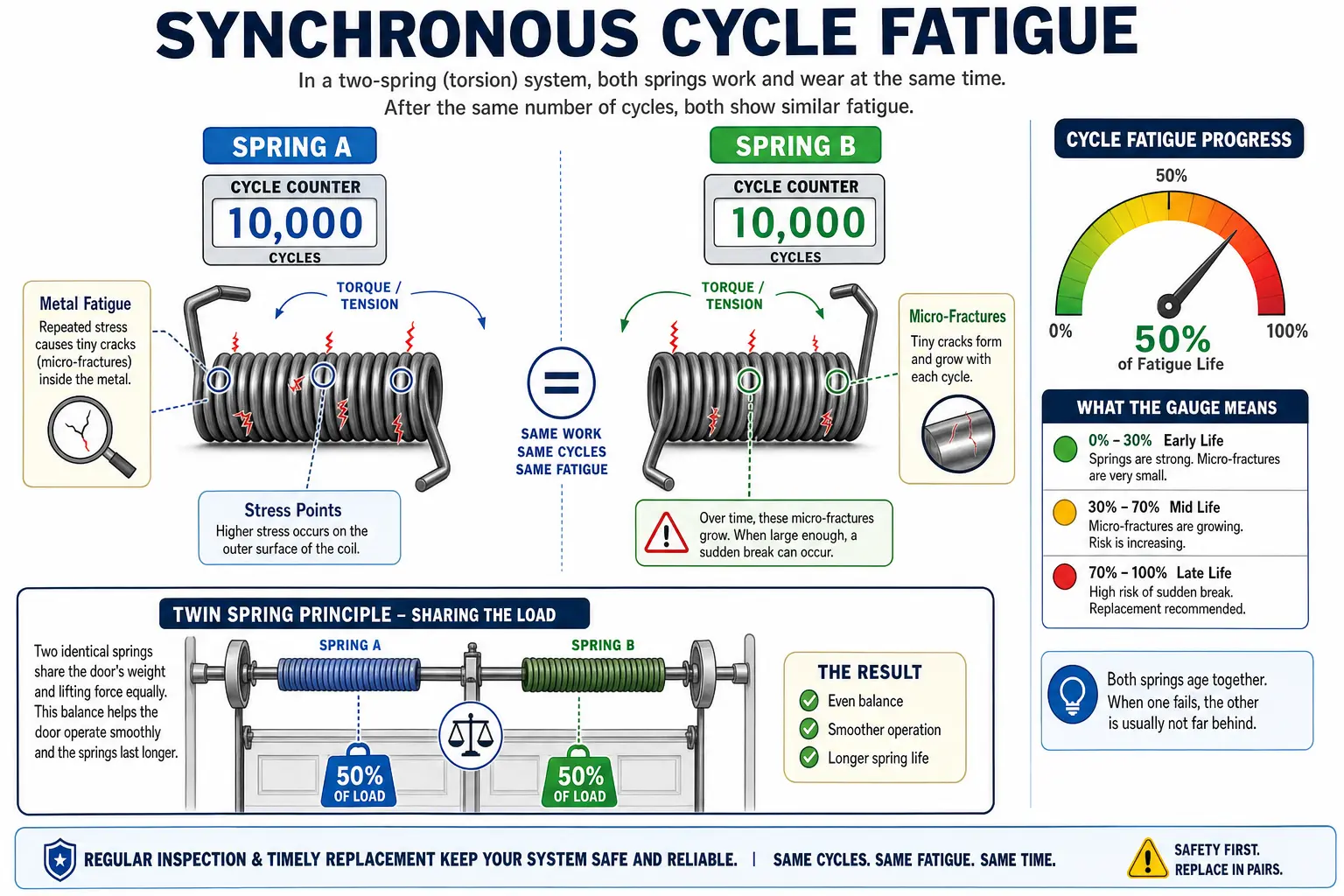
Because paired springs undergo identical stress cycles, when Spring A breaks from metal fatigue, Spring B has experienced the exact same mechanical workload. Statistically, an intact twin spring is within 3% to 7% of failure when its partner snaps.

This infographic visually explains how torsion springs installed together experience nearly equal mechanical fatigue due to shared cycles, highlighting why replacing both springs is often necessary.

Still stuck? Get it fixed today.
24/7 emergency service from licensed local technicians.
Call (860) 362-3018

The Diagnostic Framework: How Technicians Decide On-Site


Professional technicians rely on objective diagnostic criteria rather than guesswork when assessing a broken spring system.

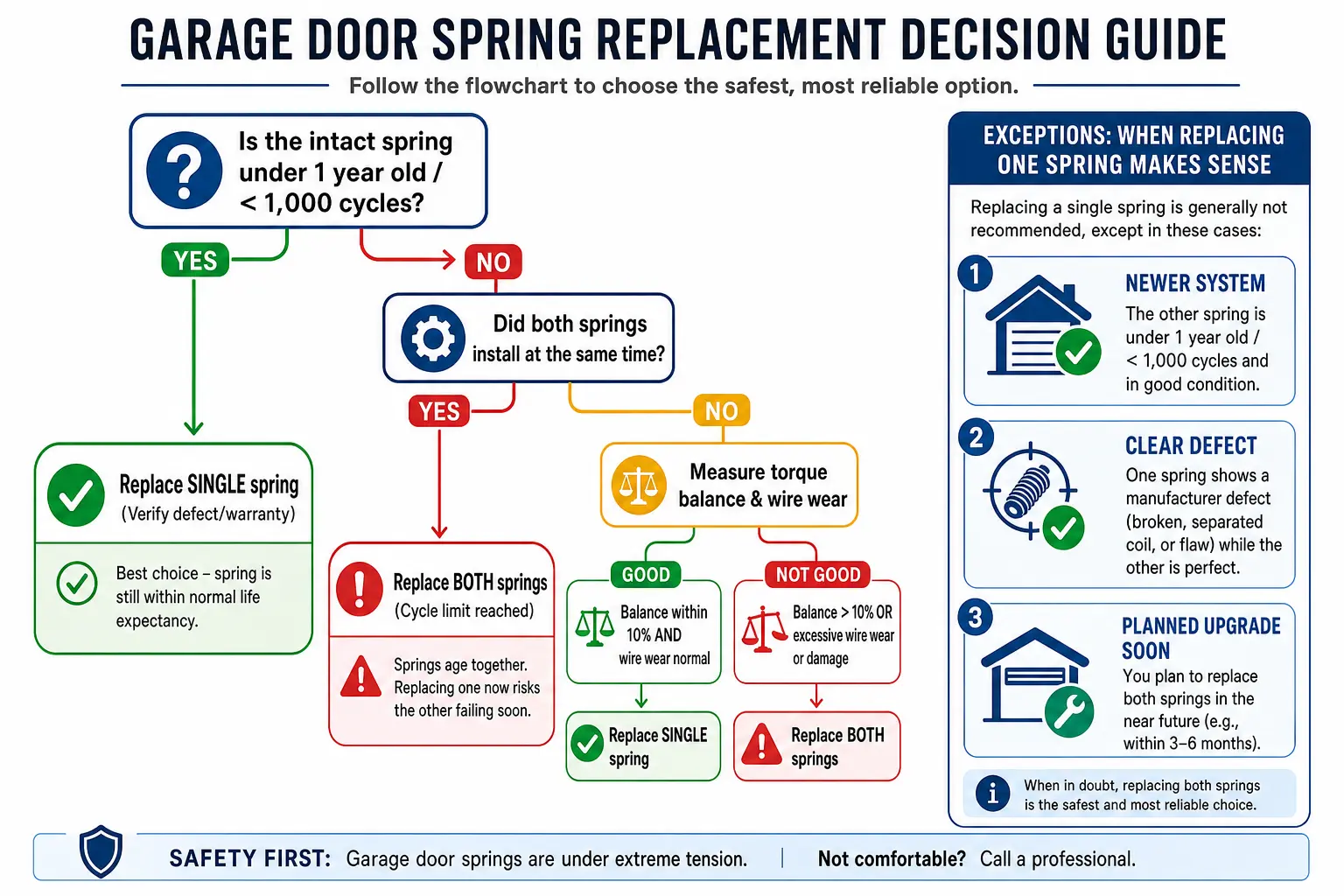
This flowchart models the real technician decision process for evaluating whether to replace one or both torsion springs, making complex diagnostics accessible to homeowners.

During an on-site inspection, a technician measures wire gauge, inner diameter, coil length, and tension history. There are only three rare scenarios where replacing a single spring is mechanically permissible:

  1. Premature Manufacturing Defect: The intact spring is under 12 months old (under 1,000 cycles) and was verified during a recent 24 hour garage door spring replacement.
  2. External Physical Impact: One spring suffered localized damage from an external force while the second spring remains virtually new.
  3. Single-Spring Door Systems: Smaller single-car doors designed around a single central torsion spring.

In all other circumstances, replacing both springs protects against immediate secondary failure.

Financial Analysis: Single vs. Both (The True Math)


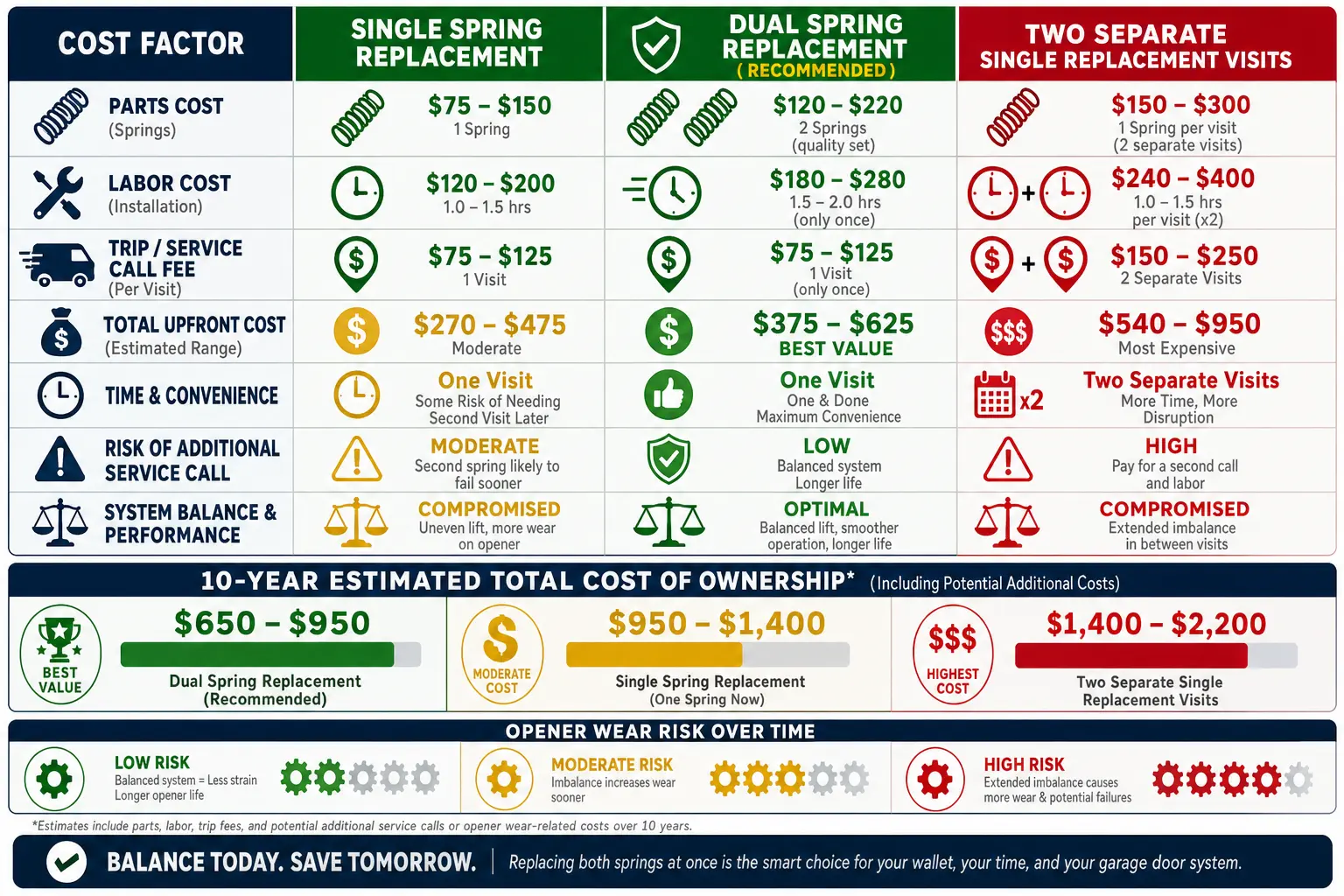
Labor and trip fees represent 60% to 75% of a standard repair bill. Paying for two separate service calls within a few months significantly increases total out-of-pocket costs.

The financial comparison matrix presents a clear side-by-side analysis of upfront costs and long-term savings, helping homeowners visualize why replacing both torsion springs often yields the best total value.

  • Single Spring Replacement: $175 – $275 upfront (1 trip fee + labor + 1 spring).
  • Dual Spring Replacement: $275 – $425 upfront (1 trip fee + labor + 2 springs).
  • Two Separate Visits: $350 – $550+ over 6 to 12 months (2 trip fees + 2 labor charges + 2 springs).

Investing an extra $60–$100 during the initial visit prevents a second emergency callout. Furthermore, upgrading to high-cycle springs (25,000 to 50,000 cycles) adds minimal upfront cost while more than doubling system lifespan.

Mechanical Risks of Replacing Only One Spring


Pairing a new spring (100% torque capacity) with an aged, fatigued spring (15% to 20% torque loss due to plastic deformation) creates an asymmetrical torque differential across the door shaft.

This imbalance pulls the door unevenly during movement, leading to severe secondary damage:

  • Opener Strain: The motor absorbs up to 40 lbs of uncounterbalanced deadweight, stripping nylon drive gears in over 60% of unmaintained openers and requiring costly garage door opener repair.
  • Cable Derailment: Unequal lift speed creates slack on one side, requiring immediate garage door cable replacement near me to prevent the door from coming off its tracks.
  • Structural Binding: Roller tracks bind under uneven lifting force. Learning how to balance a garage door shows why equal spring tension is essential for smooth operation.

Scheduling an emergency spring replacement for both springs restores total system balance and protects connected hardware.

Making a Confident Maintenance Decision


Replacing both torsion springs during a single service visit is a proven engineering practice that prevents sudden secondary failures, protects your opener motor, and delivers the lowest total cost over time. If your garage door is down and requires emergency garage door spring repair, requesting a complete balance evaluation ensures long-term reliability and peace of mind.

Frequently Asked Questions


Can I replace just one torsion spring myself to save money?

Replacing garage door springs DIY is highly dangerous. Torsion springs store immense rotational energy, and incorrect handling during garage door torsion spring winding can cause severe injury or property damage. Additionally, miscalculating wire torque creates structural imbalances. Professional installation ensures correct spring sizing, winding tension, and safety.

How do I know if my garage door spring is actually broken?

Recognizing common garage door spring broken symptoms includes a visible 2-inch gap in the spring coil above the door, cables snapping off drums, or an automatic opener lifting the door only a few inches before stopping. If you suspect a break, stop using the door immediately to prevent gear damage.

Should I get a complete tune-up when replacing springs?

Yes. Replacing springs changes how tension applies across cables, drums, rollers, and tracks. Performing a comprehensive garage door tune up alongside spring replacement ensures correct cable alignment, track lubrication, and force adjustment, maximizing the lifespan of your new springs.

Contact / Request a Call