Off-Track Garage Door After a Wind Gust: What Not to Do


Published: Oct 22, 2026

A sudden wind gust can exert over 50 pounds per square foot (psf) of positive force or negative suction against a residential garage door. At wind speeds as low as 20 to 35 mph, standard non-reinforced panels begin to deflect. When this force pops rollers out of their tracks, the door becomes an unstable, suspended hazard weighing anywhere from 150 lbs (single-car) to over 400 lbs (insulated double-car).

According to Consumer Product Safety Commission (CPSC) data, garage door accidents account for 20,000 to 30,000 emergency room visits annually. When evaluating whether to attempt a quick fix or hire a professional after a storm event, avoiding critical mistakes in the first few minutes is vital to prevent catastrophic door collapse, structural home damage, or severe injury.

Emergency Action Protocol: The First 60 Seconds


Before evaluating repair options, perform these immediate triage actions to secure the area:

  1. Unplug the Ceiling Opener Unit: Disconnect power immediately to prevent automated activation or accidental remote triggers.
  2. Establish a 10-Foot Safety Perimeter: Keep family members, pets, and vehicles away from the opening.
  3. Conduct a Distance Visual Inspection: Check if high-tension cables are slack, unspooled, or snapped without stepping directly under the door paths.

The "What NOT to Do" Protocol: 7 Fatal Post-Gust Mistakes


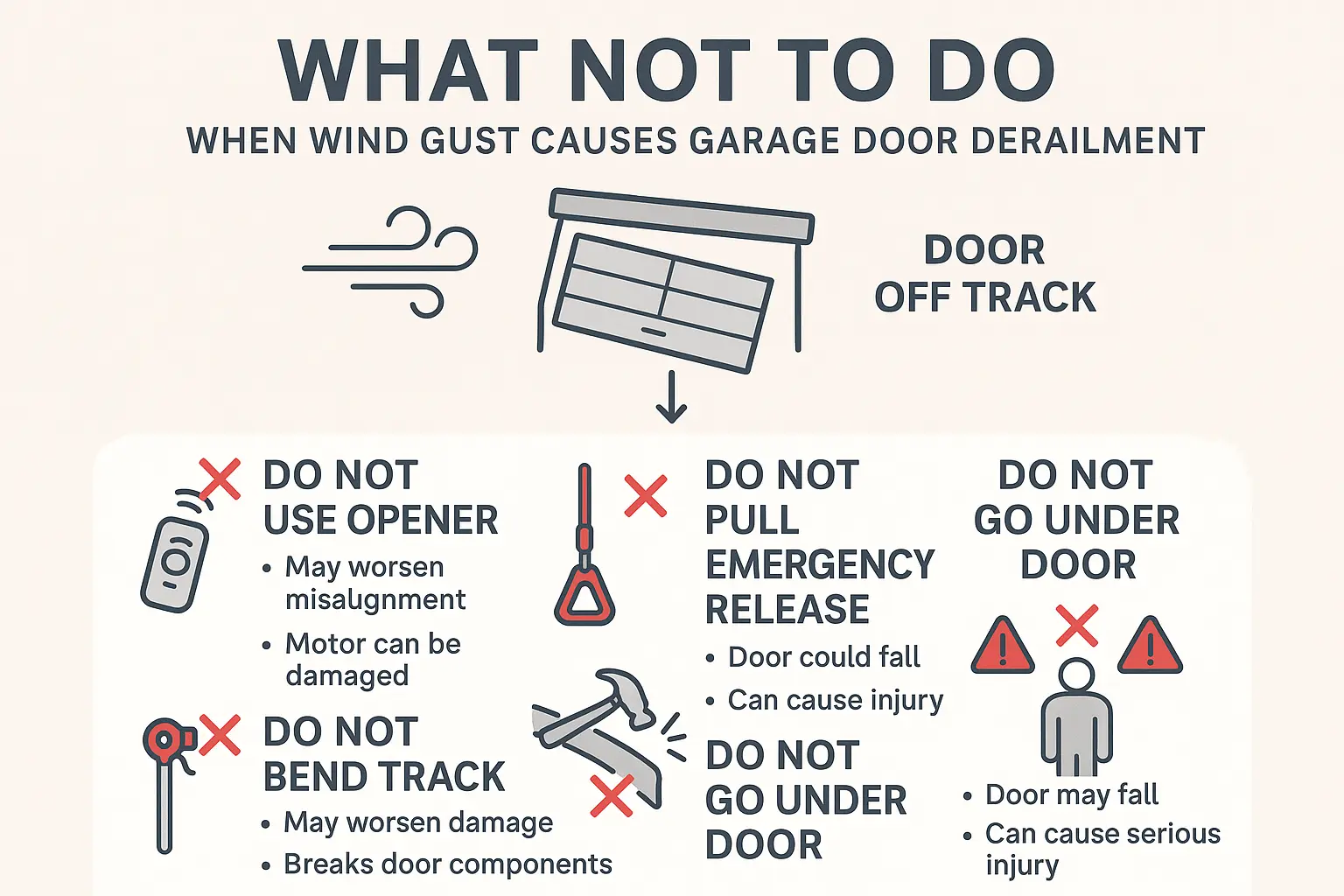
Visual 'What NOT to Do' emergency protocol highlighting seven fatal mistakes that increase safety risks and door damage after wind-induced derailment.

1. Never Press the Opener Remote

An electric motor delivers 1/2 to 1.25 HP of lifting force. Attempting to run an off-track system will tear the operator arm off the stile, bend door panels, or burn out drive gears, leaving your garage door opener not working completely.

2. Never Pull the Emergency Release Cord

Disengaging the carriage removes the secondary anchor holding the door. If asymmetric wind tension has skewed the frame, pulling the cord can trigger an immediate freefall of the entire 400-pound assembly. If you need guidance later on how to safely handle mechanical disconnects, learn how to reattach garage door systems properly.

3. Never Hammer Bent Steel Tracks Straight

Pounding wind-twisted tracks with a mallet fractures cold steel galvanization and weakens structural integrity. Alignment must be precise to within 1/16th of an inch; manual hammering ruins track geometry.

4. Never Stand Directly Beneath a Crooked Door

Asymmetric weight distribution means one cable carries immense tension while the other is slack. Shifted weight can cause remaining rollers to pop out instantly.

5. Never Force Rollers Back Into Track Under Cable Tension

Attempting professional-grade maneuvers without relieving torsion forces causes severe binding, potentially snapping lift cables at high speed. Seek professional garage door off track repair rather than forcing components.

6. Never Ignore Panel Bowing and Cable Damage

Wind deflection causes stress fractures in internal end-stiles and fraying along lift cables. Ignoring these leads to sudden failure later. Review common garage door cable problems to spot early warning signs.

7. Never Tamper with Bottom Brackets or Torsion Springs

Bottom rollers bolt directly to cable brackets connected to high-tension torsion springs. Disassembling these brackets releases extreme rotational torque. Avoid severe risks by understanding critical emergency garage door repair protocols.

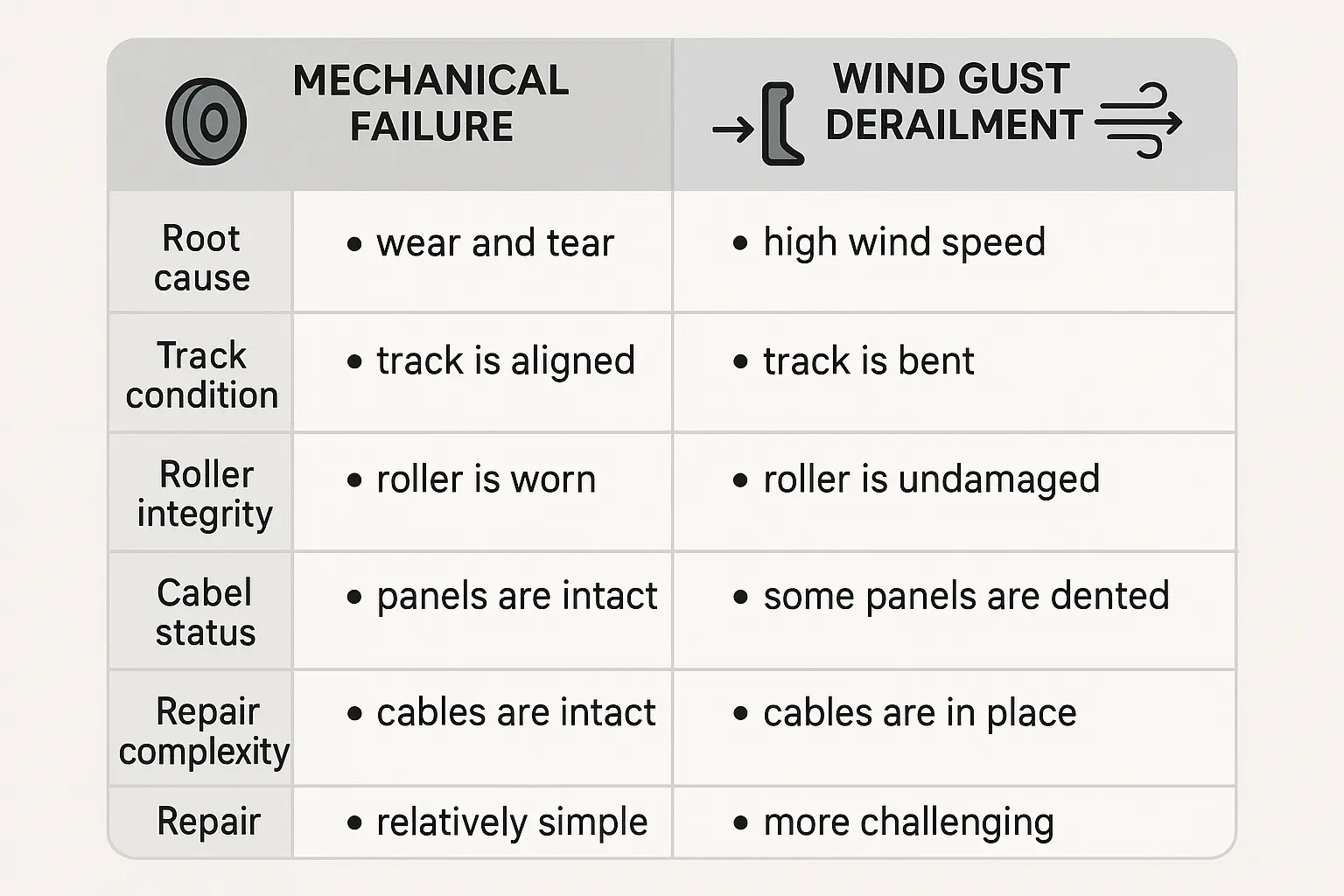
Diagnostic Matrix: Wind Gust Derailment vs. Standard Wear


Diagnostic matrix clarifying how wind gust damage differs from regular wear and tear, guiding readers to correctly assess the severity and type of garage door failure.

Wind force creates distinct structural damage patterns compared to daily mechanical wear. Use this matrix to evaluate your situation:

Diagnostic Feature Standard Mechanical Wear Wind Gust Derailment
Primary Root Cause Worn bearings, loose bolts, dry track sections. Positive pressure deflection or negative suction vacuum.
Track Condition Minor vertical track spread. Severely bent tracks, twisted jamb brackets, sheared wall anchors.
Roller Status Worn or seized roller wheels. Bent roller stems pulled entirely out of hinges.
Panel Condition Flat, intact section panels. Horizontal creasing along joints, cracked end-stiles.
Cable Integrity Uniform tension or age fraying. Unspooled, tangled, or snapped lift cables.
Typical Costs $125 – $200 (minor reset) $200 – $350+ (track/cable replacement + structure check)

Evaluation & Decision Framework: DIY vs. Emergency Repair


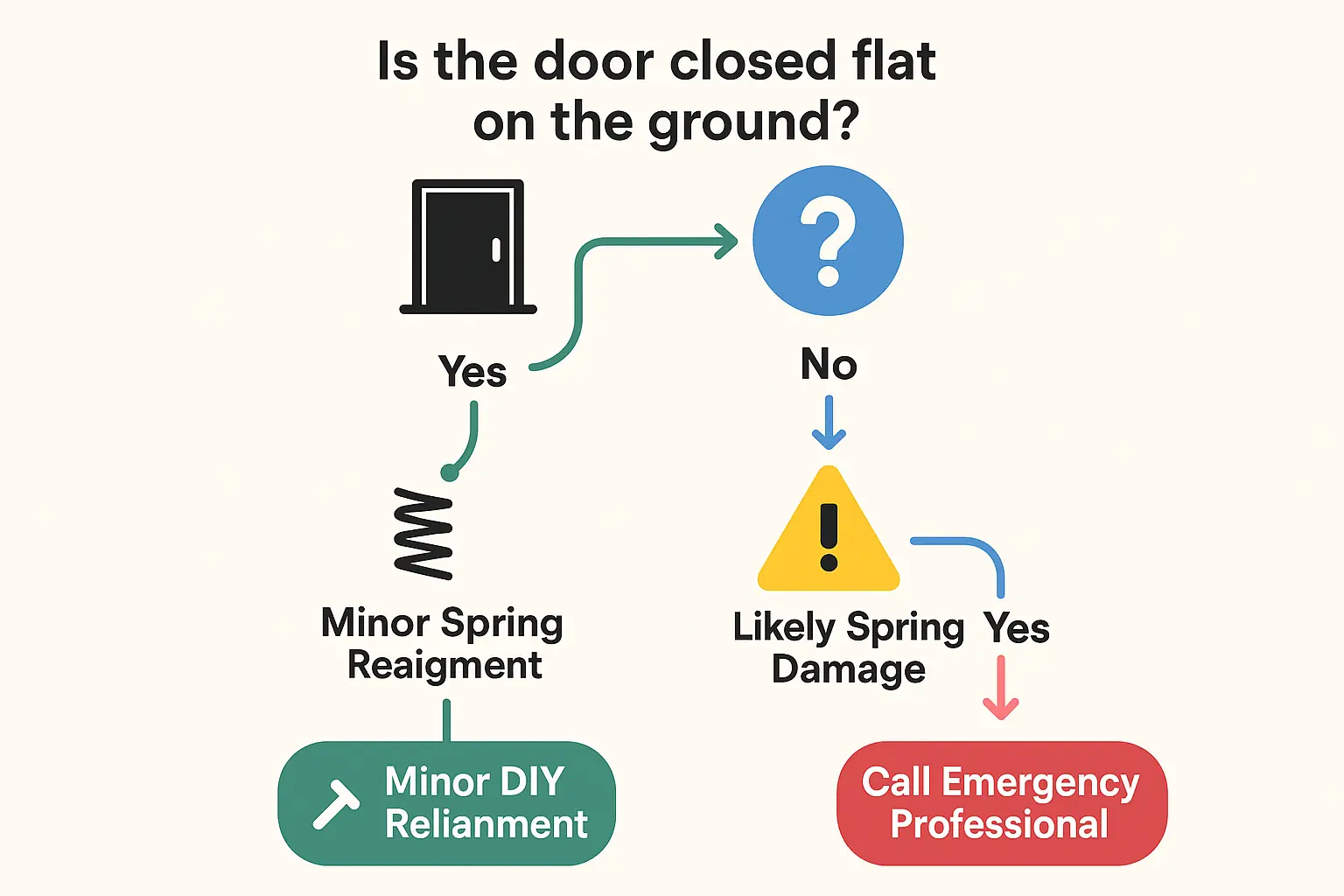
Post-wind gust repair decision tree that simplifies complex safety assessment into clear yes/no steps, boosting homeowner confidence and reducing risk.

Evaluating overall costs helps determine the best path forward:

  • Minor Alignment & Roller Reset: $125 – $200
  • Roller & Cable Replacement: $150 – $250
  • Track Replacement & Frame Re-alignment: $200 – $350+
  • Emergency Callout Fee: +$50 – $150
  • Check localized pricing details for standard garage door off track repair cost.

Insurance and DASMA Compliance

Wind storm damage is generally covered under homeowners insurance policies. Photograph all damaged tracks, creased panels, and wind-blown debris before repairs begin.

Ensure your repair technician complies with DASMA TDS-183 standards. Substituting non-OEM track brackets or non-certified parts voids original wind-load ratings and risk insurance claim denials during future storm events. Review detailed insights on structural impacted garage door risks.

How to Secure Your Garage and Home Tonight


If your door is wedged open post-storm:

  1. Lock Interior Entry Doors: Secure the door leading from the garage into your home with deadbolts.
  2. Track Locking: If the door is resting on the floor, place C-clamps or locking pliers on the tracks directly above the lowest rollers to block manual lifting.
  3. Weather Barrier: Secure heavy-duty tarps across exterior openings using masonry weights if panels are displaced, especially when your garage door won’t open light flashing signals hardware lockouts.

Emergency Contractor Vetting Checklist


When hiring a technician, ask four critical questions:

  1. Are your technicians certified by IDEA (Institute of Door Dealer Education and Accreditation)?
  2. Do you carry minimum $1,000,000 general liability insurance and worker’s compensation?
  3. Will you provide a written, itemized safety inspection covering torsion balance before starting?
  4. Do replacement parts meet DASMA wind-load standards for local building codes?

Long-Term Wind Resistance Upgrades


To protect against future wind derailments and prevent garage door repairs:

  • Install Reinforcement Struts: Steel bars bolted horizontally across panels prevent flexing under high pressure.
  • Upgrade Track Gauge: Replace standard 18-gauge residential steel tracks with heavy-duty 14-gauge steel and reinforced jamb brackets.
  • Wind-Rated Doors: Upgrade to doors rated for 115–130+ mph winds compliant with DASMA 115 standards.

Frequently Asked Questions


Can I manually push my garage door back onto the track after a wind gust?

No, pushing a wind-damaged door back into its track is extremely dangerous. Wind gusts distort the steel track alignment and alter tension on the lift cables. Forcing the door manually can cause the heavy assembly to slip off remaining rollers, resulting in an immediate drop that can cause structural damage or severe injury.

Will homeowner's insurance cover garage door repairs caused by wind gusts?

Yes, windstorm damage to garage doors is typically covered under standard homeowner’s insurance policies. However, you must document the damage thoroughly with clear photos before any repairs take place. Ensure your repair contractor uses original equipment manufacturer (OEM) parts compliant with DASMA TDS-183 to maintain your door’s wind-load certification and policy compliance.

How much does it cost to fix a garage door that came off its track due to wind?

Minor track realignments and roller resets typically cost between $125 and $200. If the wind gust twisted the vertical tracks or unspooled high-tension cables, repairs range from $200 to $350 or more. Emergency after-hours service calls may add an extra $50 to $150 to the final bill.

Contact / Request a Call