Troubleshooting LiftMaster Garage Door Remote Problems: The Expert Diagnostic Guide


Published: Jul 31, 2026

Standing in your driveway with a door that refuses to budge is a frustrating scenario. However, industry data shows that roughly 65% of reported “broken openers” are actually minor electrical, synchronization, or lock-out issues that can be fixed without replacing any major hardware. Before you assume your opener is completely dead, let’s step through a professional diagnostic process to find the exact root cause.

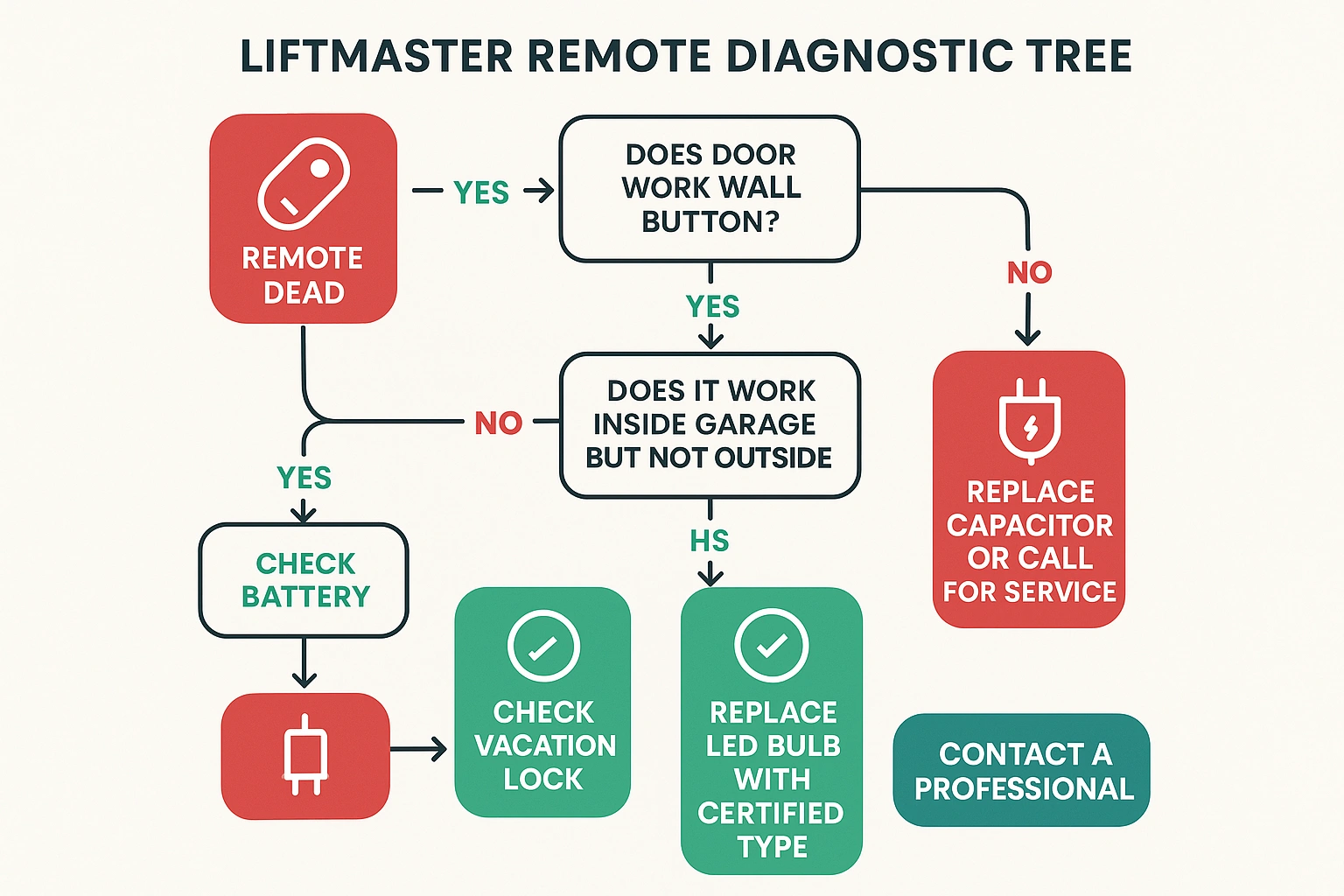
Liftmaster Remote Diagnosting

If your garage door remote not working continues to stall your daily routine, evaluating your hardware’s security generation is your crucial first step.


The LiftMaster Learn Button Rosetta Stone


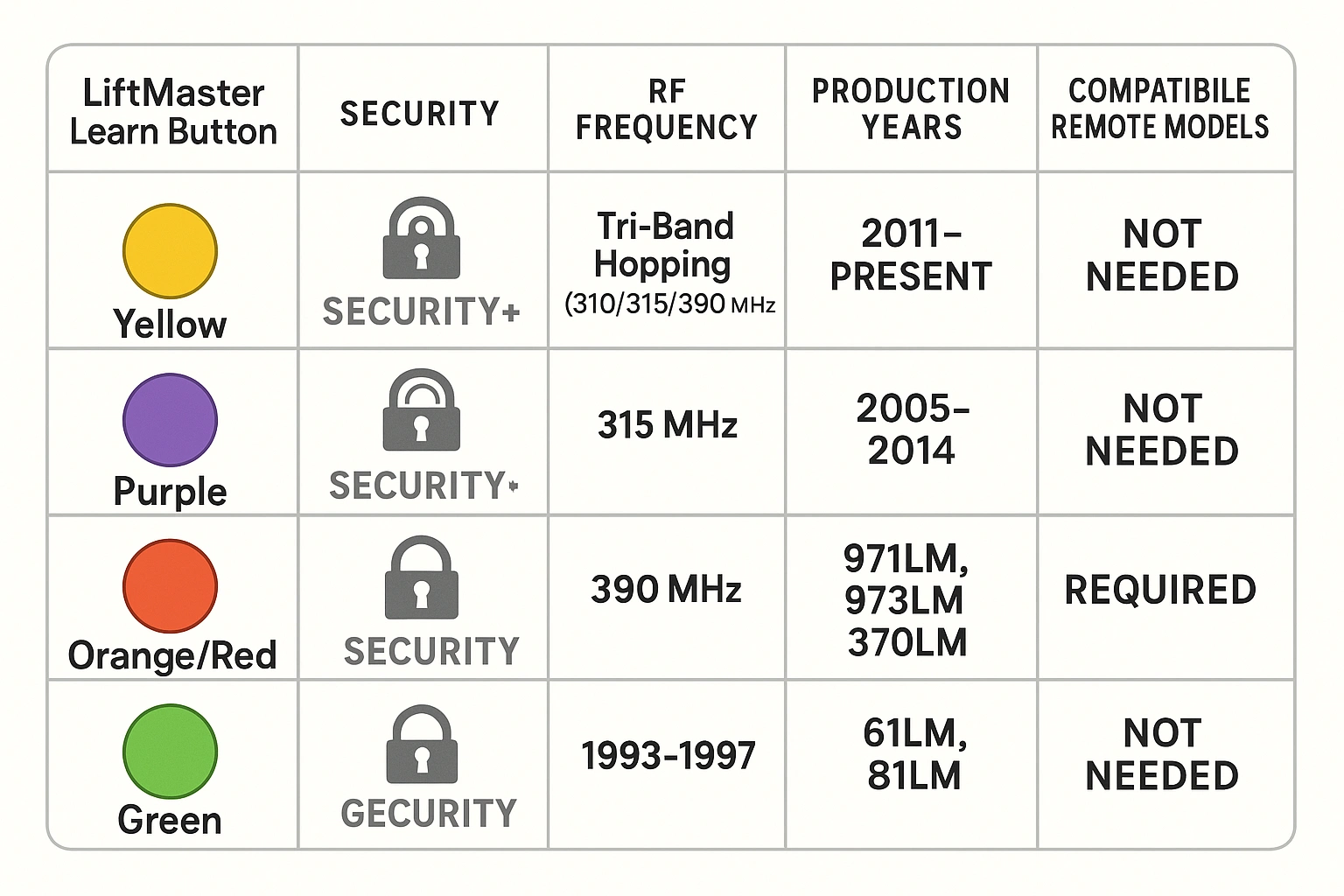
Programming a remote successfully depends entirely on matching its communication frequency with your specific receiver unit. LiftMaster utilizes color-coded Learn buttons to identify their operating frequencies and security protocols. Knowing where is the learn button on garage door opener units is essential to matching them to the right remotes:

  • Yellow Button: Features Security+ 2.0 with tri-band frequency-hopping (310, 315, and 390 MHz). Compatible with 891LM, 893LM, 893MAX, and 878MAX remotes.
  • Purple Button: Employs Security+ 315 MHz protocol (2005–2015). Compatible with 371LM, 373LM, and 893MAX.
  • Orange / Red Button: Employs Security+ 390 MHz rolling codes (1997–2005). Compatible with 971LM, 973LM, and 893MAX.
  • Green Button: Uses Billion Code 390 MHz system (1993–1997). Compatible with 81LM and 893MAX.

Meanings Of Different LiftMaster Colors

This chart clarifies LiftMaster remote compatibility by decoding Learn Button colors, helping users understand which remotes and security protocols match their garage door opener.

To re-sync, read our detailed step-by-step guide on how to program liftmaster garage door opener units safely.


Fixing the 5 Invisible Jammers (Signal Interference)


When a remote functions perfectly inside your garage but completely fails from the driveway, you are likely dealing with active environmental signal blockages.
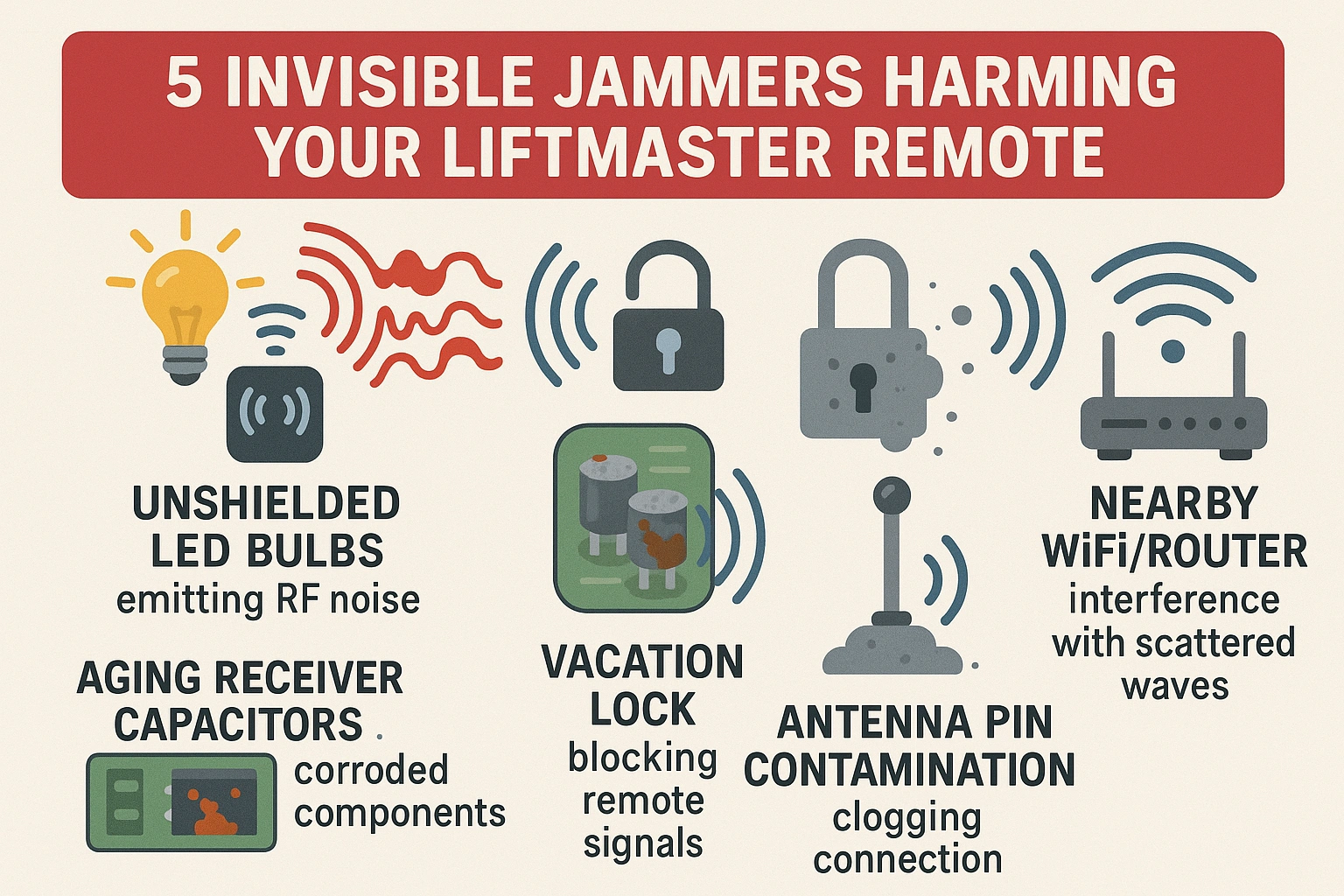
Signal Interference FactorsFive common invisible factors that reduce LiftMaster remote range or cause intermittent operation, helping users recall and troubleshoot invisible signal blockers.

1. LED Bulb RF Jamming

Standard household LED bulbs produce electromagnetic interference in the 300–400 MHz spectrum. Since older LiftMaster units function on 315 MHz or 390 MHz, active unshielded LEDs can cut your operational range by up to 80%. Swapping to FCC Class B certified, garage-safe LED bulbs immediately solves this.

2. Extreme Weather Battery Voltage Drops

At freezing temperatures (below 32°F), standard alkaline batteries suffer a 60% voltage drop. Swapping to high-performance lithium coin cells preserves 95% of their capacity down to -40°F, preventing dead-keypad lockouts. Check our resources on how to change battery in garage door keypad to ensure a steady current.

3. The Silent Vacation Lockout

If the LED on your interior wall control console is flashing rapidly and no remotes are working, your Vacation Lockout is engaged. Know how to turn off lock button on garage door opener systems to clear this security lock instantly.

4. Router and Smart Home Frequencies

Modern dual-band routers placed near the garage ceiling can crowd the 390 MHz band. Moving your router or straightening the receiver antenna wire can re-establish your path.

5. Aging Receiver Capacitors

On openers older than 10 years, receiver logic board capacitors gradually drift in frequency. This weakens physical reception, requiring a professional board replacement.

Solving the HomeLink In-Car Pairing Divide


Integrating a built-in car garage door opener with newer Security+ 2.0 LiftMaster systems often presents compatibility issues.

Vehicles manufactured before 2012 send a fixed or single-frequency code. They cannot speak directly to modern Yellow Learn Button openers that use tri-band frequency-hopping signals. If your car garage door opener not working is causing head-scratching, you likely need a HomeLink Compatibility Bridge (Model: HOMELINKRPTR) to translate the signal.


Hardwired Backup Systems & Professional Boundaries


If wireless RF interference is a constant problem in your neighborhood, installing a secondary hardwired access control keypad wired directly to your opener terminal ports bypasses the airwaves completely.

Before performing a factory reset on your machine, read our guide on how to reset garage door opener systems to protect your custom settings. If resetting doesn’t resolve your issue, it often indicates a mechanical failure, such as an off-track door or broken parts. Trying to operate an unbalanced door with a remote can burn out your motor. If you suspect structural damage, securing professional garage door torsion spring repair connecticut is critical to avoiding severe physical injuries.


Frequently Asked Questions


Why does my LiftMaster keypad flash but the door won't budge?

A flashing keypad usually indicates a PIN entry mismatch or critically low battery voltage. In freezing winter weather, swap out alkaline 9V batteries for lithium equivalents to restore performance.

Can I bypass RF interference with a wired outdoor keypad?

Yes. You can bypass wireless signals completely by routing a direct wire from your opener’s terminals to a dry-contact hardwired outdoor entry station.

What should I do if none of my remotes are working but the wall console works?

Ensure your Vacation Lockout mode isn’t active on your wall station, which disables radio signals. If the button’s light is flashing, hold the Lock button down for two seconds to restore remote communication. If this fails, professional liftmaster garage door opener repair is recommended.


If troubleshooting your LiftMaster remote reveals deeper mechanical issues, get in touch with local professionals to schedule immediate, expert diagnostic assistance today.

Contact / Request a Call