The Pet-Safe Home And Garage Blueprint: Openings, Overheads, and Interior Guarding


Published: Aug 18, 2026

For many homeowners, the garage serves as a multi-functional transition zone—a home for vehicles, a workshop, or even the designated area for pet feeding and litter boxes. However, managing pet independence while maintaining home safety poses complex mechanical, legal, and structural challenges. Making unguided modifications can unknowingly compromise your family’s physical security and violate building safety codes.

To make informed decisions, you must understand how home transitions, physical door materials, and overhead mechanical systems interact with your pet’s natural behaviors.


The Attached Garage Fire-Code Reality Check


Many feline owners install DIY pet flaps on the door leading from the house to the garage to allow easy access to litter boxes. While convenient, this simple modification is often a serious residential safety violation.

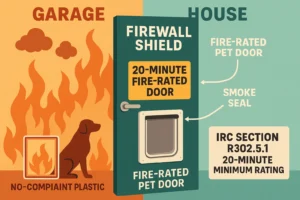
This infographic visually anchors the critical legal requirement of IRC Section R302.5.1 mandating fire-rated doors between attached garages and homes—helping pet owners remember why standard pet doors often violate fire safety codes.

According to the International Residential Code (IRC) Section R302.5.1, the opening between an attached garage and a residence must act as a protective fire barrier. The law requires this threshold to be equipped with a solid wood door not less than 1-3/8 inches thick, a solid or honeycomb-core steel door not less than 1-3/8 inches thick, or a 20-minute fire-rated door.

Cutting a hole into this door to install a standard plastic pet flap completely voids its fire rating. In the event of a garage fire, toxic carbon monoxide and flames can bypass the breached barrier and enter living spaces within minutes, potentially invalidating your home insurance policy.

The only code-compliant method for establishing interior pet access is installing a self-closing, UL-listed, 20-minute fire-rated pet door assembly equipped with active smoke seals. Alternatively, choosing a integrated pedestrian door can offer safe passageways without compromising structural safety.


Sectional Overhead Garage Doors – The Physics of Pet Hazards


Modifying the moving panels of a sectional overhead door presents even greater structural and physical risks.
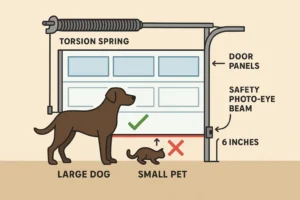
This diagram clarifies how standard garage door safety sensors at 6 inches can miss smaller pets, creating a dangerous 'blind spot,' and how modifications to door panels impact torsion spring balance and mechanical safety.

The Torsion Spring Balance

Sectional residential garage doors operate on a delicate counterbalance system. The weight of the door panels is calibrated precisely against high-tension springs. If you add a heavy industrial pet door (which can weigh 15 to 25 pounds) or cut out a section of a panel to insert a flap, you alter this balance. This modification subjects the system to uneven strain, accelerating motor wear-out, causing track misalignment, or requiring a professional garage door torsion spring repair to recalibrate the assembly. Homeowners should never attempt garage door torsion spring winding themselves due to the extreme mechanical tension involved.

The 6-Inch Safety Sensor Blind Spot

Under Federal Law (UL 325), automatic garage door openers must feature an optoelectronic safety reversal system. These safety “photo-eyes” project an invisible infrared beam across the door opening. However, standard regulations state these sensors must be mounted no higher than 6 inches above the floor.

This height creates a dangerous blind spot for small dogs, puppies, and cats, whose shoulder heights are often under 6 inches. A small pet can easily crawl beneath the safety beam undetected. If the door is closing, the system will not register the pet’s presence unless it physical strikes them, posing serious risk of blunt force or crushing trauma.

To mitigate this risk, you can invest in a modern, childproof garage door opener equipped with advanced secondary sensors, or install auxiliary photo-eyes positioned at a lower 2-inch height.

The UL 325 Safety Reversal & Sensor Calibration Guide (DIY Testing)


To ensure your automated systems protect every family member, perform this three-step safety audit monthly:

1. The 1.5-Inch Contact Reversal Test

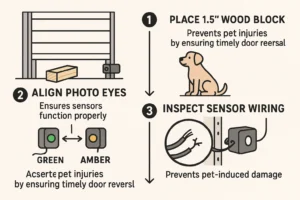
To verify your opener’s safety limits, place a 1.5-inch solid wood block (like a flat 2×4) on the garage floor directly under the door’s path. Activate the door to close. Upon contact with the wood block, the door must automatically reverse within 2 seconds. If the door stops but does not reverse, or continues to push against the block, you must perform a garage door opener adjustment to recalibrate the force and travel limits.

This infographic guides pet owners through essential safety tests to ensure garage door sensors and auto-reverse mechanisms function correctly, helping prevent accidents involving pets.

2. The Photo-Eye Alignment and Sweeping Check

Check the physical condition of your safety sensors. Verify that the garage door sensor green light not on issue is resolved, as a flickering or dark LED indicates alignment errors, dirty lenses, or vibration-induced displacement. Clean the lenses with a dry microfiber cloth and tighten the mounting brackets. Understanding how do garage door safety sensors work helps you keep the invisible beam path clear of dust and debris.

3. Emergency Release Verification

Ensure that your garage door emergency release cord is accessible and functional. Pulling this red cord disconnects the opener trolley from the drive chain or belt, allowing you to lift the door manually in the event of an electrical failure or sensor malfunction.


Premium Pet Door & Materials Evaluation Matrix


When upgrading your home transitions, selecting high-durability, safety-rated materials is essential.

Specialty Pet Door Comparison

Manufacturer & Model Fire-Rating Status Material & Flap Build Best Use Case
FireSafe Pet Doors UL-Certified 20-Min Steel casing, self-closing fire-barrier seals Mandatory for attached house-to-garage walls
Patio Pacific (Endura Flap) Non-Fire-Rated Flexible polyolefin elastomer, magnetic seal Best for thermal efficiency & draft prevention
Hale Pet Doors Non-Fire-Rated Heavy-gauge extruded aluminum, double flap High chew-resistance for exterior wall installs
PlexiDor Electronic Non-Fire-Rated Rigid composite panel with RFID collar key Restricting unauthorized pests or stray animals


Selecting Safe Home Materials

  • Window and Patio Screens: Standard fiberglass screens tear easily under cat claws, which can lead to accidental falls. Upgrade to screens made from PVC-coated polyester yarn, such as Phifer PetScreen, which delivers a breaking strength of over 400 lbs under ASTM D5034 testing.
  • Interior Rugs: Avoid looped fibers (like Berber), which act as claw traps and can cause painful nail injuries. Opt for low-pile, flat-woven rugs made from synthetic polypropylene or polyester, which resist liquids and allow for regular sanitization.
  • Outdoor Decking: Choose capped composite decking instead of chemically treated natural wood. Composite surfaces are splinter-free and easy to clean, though you should select lighter colors to minimize heat retention and protect sensitive paw pads.

Securing Your Home Transition Zone


Protecting your pets around your garage and home transitions requires balancing daily convenience with structural engineering and local building codes. If you are unsure about your garage door’s balance, safety sensor heights, or mechanical calibration, consulting an experienced specialist is the safest choice. Contact 24H Garage Doors today to schedule a professional inspection and ensure your garage remains safe for your entire family.

Frequently Asked Questions


Can I install a pet door directly onto a garage door panel?

No. Cutting into sectional overhead door panels damages their structural integrity and unbalances the torsion spring system. This can lead to rapid motor failure or catastrophic door collapse, posing serious risk to pets.

What should I do if my garage door sensors fail to detect my small pet?

You can install secondary safety sensors at a lower height (2 to 3 inches above the floor) to eliminate the blind spot, or transition your pet’s entry point to a dedicated wall-mounted pet door.

How does an unbalanced door affect pet safety?

An unbalanced door places extra weight on the opener. If the automatic reversal mechanism fails, the door may not reverse upon contact, which can result in severe crushing injuries.


Contact / Request a Call