
Garage Door Opener Hums but Won’t Move: Start Capacitor Failure Guide


Published: Nov 24, 2026

When a garage door opener hums without lifting the door, electrical power is reaching the motor housing, but a mechanical blockage, disconnected drive component, or failed start capacitor is stopping torque from moving the door. For Connecticut homeowners experiencing sudden opener stalls, isolating whether the issue stems from a disengaged trolley, a broken counterbalance spring, or a weak start capacitor prevents unnecessary motor burnout and helps restore safe operation.

Quick Checks Before Calling for Service:

  • Verify manual and wall locks: Confirm that interior slide bolts and wall-console lock switches are disengaged so the door is free to travel.

  • Inspect the emergency release trolley: Check if the red release cord was pulled, uncoupling the carriage from the opener rail; re-engage the trolley latch with the door fully closed.

  • Test manual door balance: With the door down, pull the emergency release cord and lift the door by hand—if it feels unusually heavy or binds in the tracks, a spring or hardware failure is likely.

Primary Mechanical & Electrical Culprits:

  • Faulty start capacitor: A worn or bulging motor capacitor cannot deliver the initial electrical surge needed to spin the motor shaft, causing a steady hum without rotation.

  • Snapped torsion or extension spring: Without functional springs to counterbalance the door’s weight, the opener motor stalls under excessive load.

  • Stripped internal drive gear or jammed carriage: Sheared nylon gears inside the opener unit or a trolley wedged against a stop bolt allow the motor to run without transferring motion to the door.
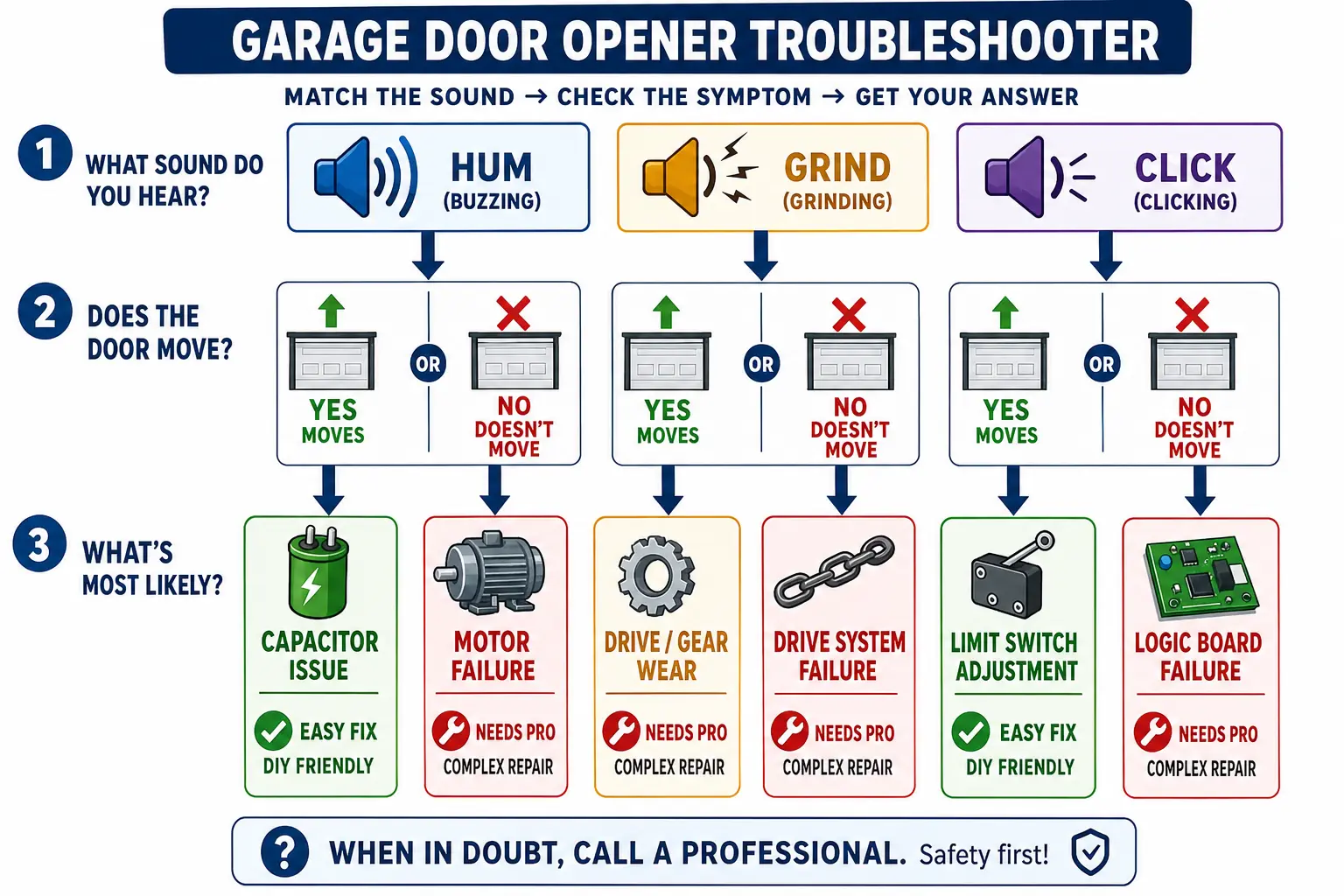
30-Second Diagnostic Triage: Is It a $20 Capacitor or a Broken $500 Opener?


Before purchasing replacement parts, quickly rule out alternative mechanical failure points using symptom matching:

Quick visual diagnostic triageQuick visual diagnostic triage: distinguish between a humming start capacitor failure and other mechanical faults in under 30 seconds to save time and money.
  • Loud Hum with Zero Trolley Movement: The single-phase motor attempts to run but lacks initial rotation torque. Classic start capacitor failure.
  • High-Pitched Whine with Motor Spinning: Indicates stripped nylon drive gears inside the housing.
  • Single Click with No Motor Sound: Control board relay failure. See our breakdown when your garage door opener clicked but wont open for logic board diagnostics.
  • Heavy Door when Lifted Manually: Points to counterweight issues requiring an emergency spring replacement to restore balance.

To isolate the issue, pull the manual release cord. If the door glides open smoothly by hand, your tracks, rollers, and springs are balanced, confirming an electrical issue in the motor start circuit.

Still stuck? Get it fixed today.
24/7 emergency service from licensed local technicians.
Call (860) 362-3018

Understanding Start Capacitor Failure and Mechanical Isolation


Single-phase AC garage door opener motors require a phase-shifted electrical boost to start rotating under heavy initial door load. A motor start capacitor stores energy and releases it in a rapid burst into the motor start windings. Although residential openers run on 120V household current, internal inductive voltage spikes require capacitors rated between 220VAC and 330VAC with capacitance values of 50 µF to 70 µF (microfarads).

Thermal heat cycles in unconditioned garages cause electrolyte breakdown over time. Most capacitors degrade or fail between years 8 and 12.

The Safe Manual Helper Nudge Test

Confirm capacitor failure without special tools using this simple check:

  1. Disengage the door from the trolley using the emergency pull cord.
  2. Press the wall console button.
  3. While the motor hums, carefully give the exposed motor pulley or shaft a manual turn in the opening direction.
  4. If the motor catches and spins normally, the capacitor has lost its start torque capacity while the primary motor windings remain fully intact.

Before attempting electrical fixes, evaluate your comfort level using our guide on whether diy vs professional garage door repair: which is better.

Master Brand Compatibility & Capacitor Specification Chart


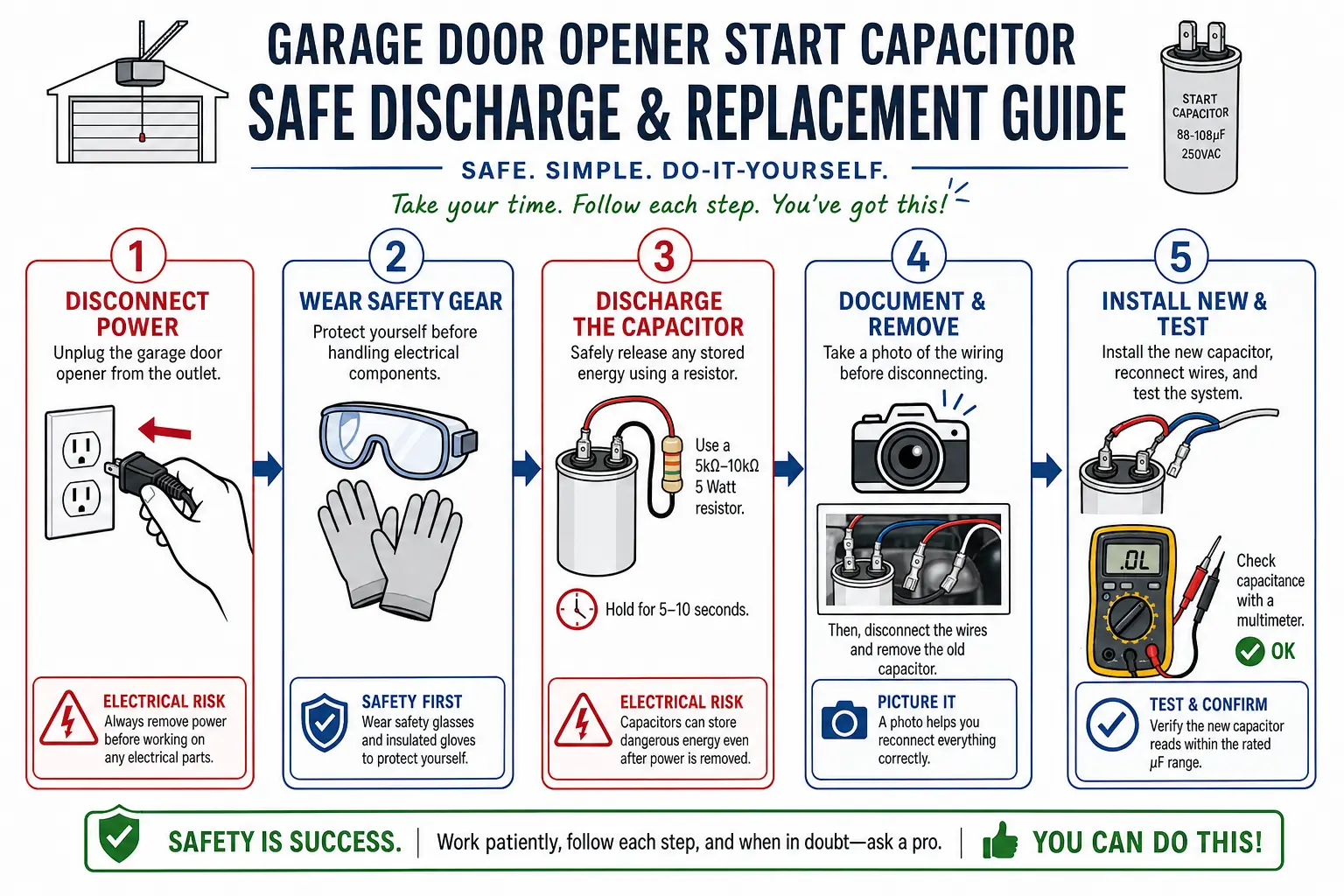
Matching correct microfarad (MFD/µF) and voltage ratings prevents motor overheating or logic board damage.

Memorize and quickly reference start capacitor specsFor brand-specific maintenance support, review our specialized services for liftmaster garage door repair.
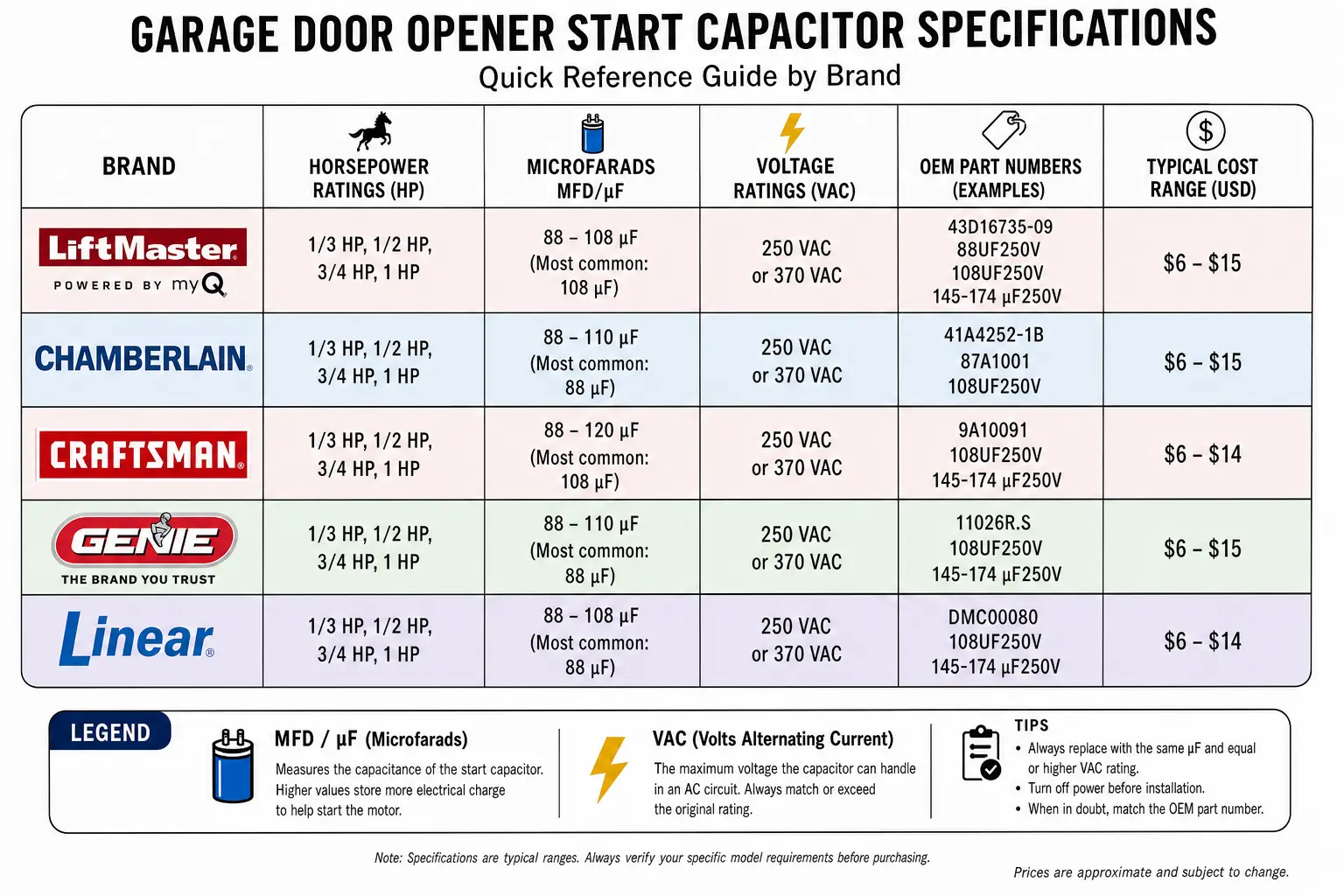
Step-by-Step DIY Replacement & Safety Discharge Protocol


Replacing a start capacitor requires 15 to 30 minutes. Always follow strict safety discharge procedures.

Follow this clear, safety-first step guideFollow this clear, safety-first step guide to confidently replace your garage door opener’s start capacitor and avoid electrical hazards.

  1. Power Lockout: Unplug the opener power cord from the ceiling outlet.
  2. Access & Safe High-Voltage Discharge: Remove the light lens and motor housing cover. Touch an insulated-handle screwdriver blade across both capacitor spade terminals simultaneously (or bleed through a 20k-ohm 5W resistor) to discharge residual electrical energy and protect the circuit board.
  3. Terminal Mapping: Take a clear photograph of wire placement, disconnect spade connectors, unbolt the mounting bracket, and insert the new unit.
  4. Capacitance Verification: If i have a multimeter ready, set it to microfarads (µF) to test the old unit. A reading lower than 5% beneath nominal rating confirms component breakdown.

Frequently Asked Questions


Can I use a higher microfarad (MFD) capacitor than the original?

You should stay within ±10% of the original MFD rating. Installing a significantly higher microfarad rating delivers excess current into the start windings, causing motor overheating and potential logic board failure. Always match original manufacturer specs.

Why does my garage door opener hum if modern openers do not use capacitors?

Older single-phase AC motor openers rely on external capacitors to initiate rotational torque. Modern DC motor garage door openers use solid-state electronic control boards with variable-speed drives instead. If a DC unit hums without moving, the fault typically lies in a stripped drive gear or damaged circuit board.

Will a blown capacitor damage the opener's logic circuit board?

In most cases, a failed capacitor simply loses capacitance without damaging surrounding electronics. However, if the capacitor ruptures or leaks conductive electrolyte onto internal wiring, it can short out the main logic board, requiring circuit board replacement or a complete unit upgrade.

Contact / Request a Call