Center Bearing Plate Failure on Torsion Springs: Signs and Repair


Published: Nov 20, 2026

When a garage door starts grinding, jerking, or depositing fine black powder across the top panel, homeowners often assume a spring is about to snap. However, diagnostic evidence frequently points to a less obvious culprit: the Center Bearing Plate (CBP).

Evaluating whether your system requires a simple hardware upgrade or immediate technical intervention comes down to understanding how this core component functions, recognizing failure markers early, and calculating the safety risks involved.
What is a Torsion Spring Center Bearing Plate & How Does It Work?


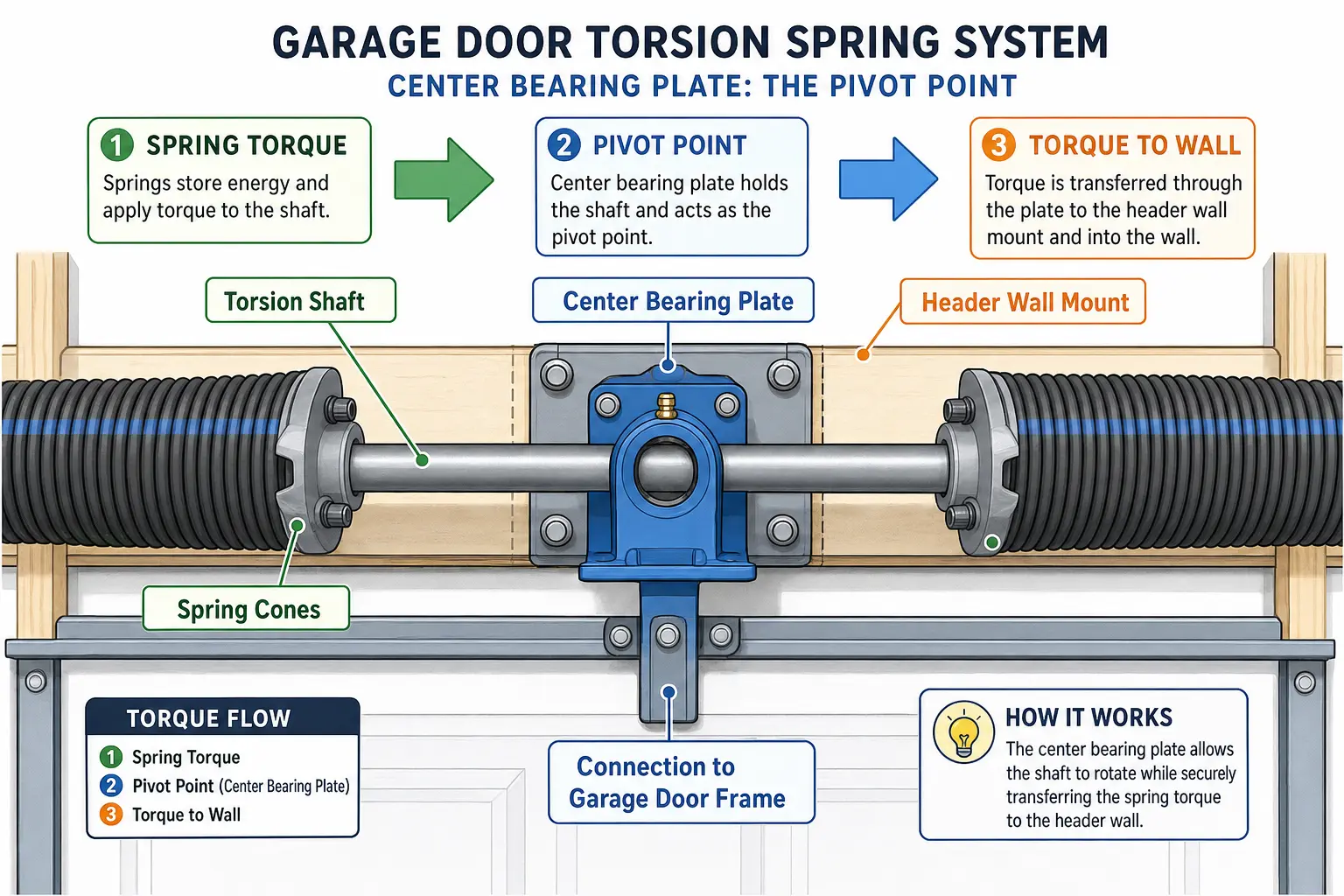
The center bearing plate serves as the primary structural anchor for your garage door’s counter-balance system. Mounted directly to the header wall above the door opening, this heavy-gauge steel bracket secures the stationary cones of the torsion springs while supporting the rotating center of the 1-inch steel torsion shaft.

This diagram clarifies the central mechanical role of the center bearing plate in anchoring the torsion shaft to the garage header, illustrating how torque from the springs is transmitted to the wall.

Understanding how a garage door spring works requires recognizing that stored rotational energy must be safely anchored. The center plate transfers hundreds of pounds of counterbalance torque into the structural framing of your home while allowing the shaft to spin smoothly on internal bearings.

Still stuck? Get it fixed today.
24/7 emergency service from licensed local technicians.
Call (860) 362-3018

5 Telltale Signs of Center Bearing Plate Failure


Recognizing specific diagnostic markers prevents minor bearing wear from cascading into severe hardware damage.

  1. Black Metal Powder / Filings: When internal ball bearings fail or plastic factory bushings wear through, the rotating steel shaft contacts the raw steel plate directly. This metal-on-metal friction generates fine black steel shavings that accumulate on top door struts and spring cones.
  2. Metallic Grinding at Top Center Header: Unlike squeaks caused by dry coils, a seized center bearing creates a dry, rhythmic metallic grinding concentrated directly above the center of the door frame. If you are performing noisy garage door repair, isolate this sound to the center header bracket.
  3. Visible Torsion Shaft Wobble or Sag: Wear within the bearing race creates vertical play. As the shaft rotates, it bows or wobbles visibly rather than spinning on a true central axis.
  4. Door Binding and Opener Force Reversals: A completely seized center bearing increases operational torque drag by 35% to 45%. This extra friction triggers automatic safety reversals on garage door openers and strips drive gears.
  5. Separation of Stationary Cones or Loose Mounting Bolts: Severe bearing vibration gradually backs out lag screws from header framing, allowing stationary spring cones to pull away from the center bracket.

Diagnostic Matrix: Center Bearing Plate vs. End Bearing Plates vs. Broken Springs


Isolating mechanical failures prevents unnecessary part replacements. Use this comparison framework to confirm your diagnosis:

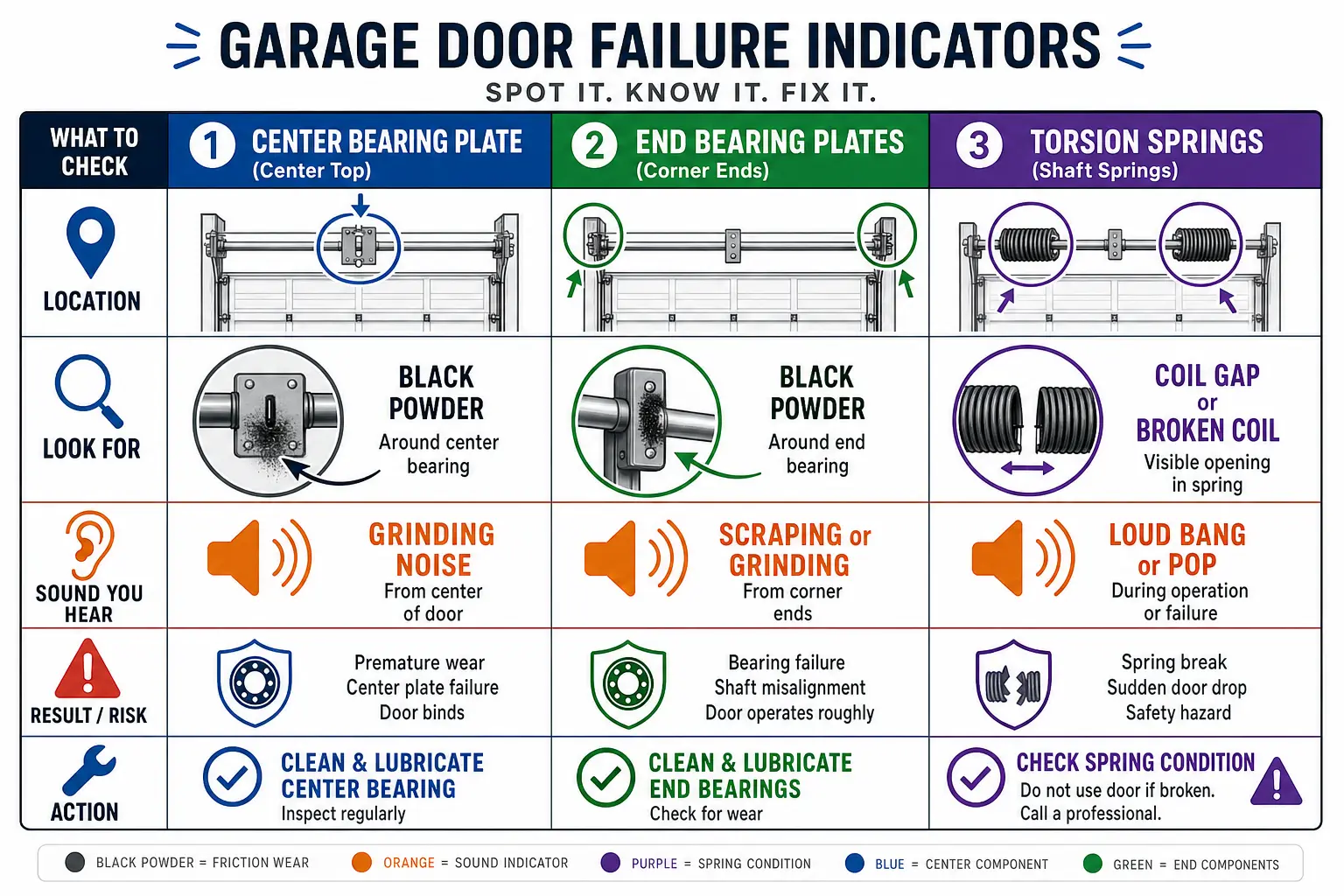
This diagnostic matrix visually anchors the key differences in symptoms and locations between center bearing plate, end bearing plate, and spring failures—crucial for accurate garage door troubleshooting.

  • Center Bearing Plate: Located at top-center header wall. Symptoms include rhythmic center grinding, black powder buildup, and center shaft bow.
  • End Bearing Plates: Positioned at far left and right track tops. Symptoms include squealing near corners, cable drum wobble, and cables coming loose leading to a garage door off track situation.
  • Torsion Spring Failure: Located wrapped around the shaft. Characterized by a loud bang explosion followed by a 2-inch visible gap in the coil and heavy manual lifting.

Root Causes, Material Upgrades, and Shaft Damage Inspection


Builder-grade center plates utilize non-sealed nylon bushings or light stamped steel rated for roughly 10,000 cycles (7–10 years) per DASMA standards. Upgrading to heavy-duty, sealed precision steel ball bearing plates extends assembly lifespans to 50,000–100,000 cycles, comfortably outlasting multiple spring sets.

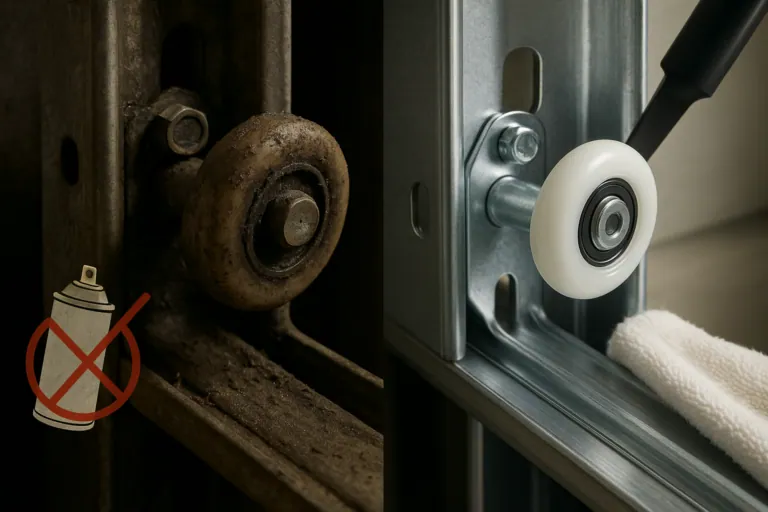
Neglecting maintenance accelerates failure. Applying the best lubricant for garage door springs prevents coil corrosion, but center bearing plates require non-tacky silicone sprays rather than heavy greases that trap abrasive grit.

If a center bearing seizes entirely, friction can wear down a standard 1-inch 14-gauge hollow steel torsion tube by 0.05 to 0.08 inches within 30 to 60 days.

Shaft Scoring Threshold: Inspect the shaft beneath the bearing plate during repair. If metal wear exceeds 1/32 inch in depth, the structural integrity of the tube is compromised, requiring a full shaft replacement to prevent sudden shearing under spring torque.

DIY vs. Professional Replacement: Safety and Financial Analysis


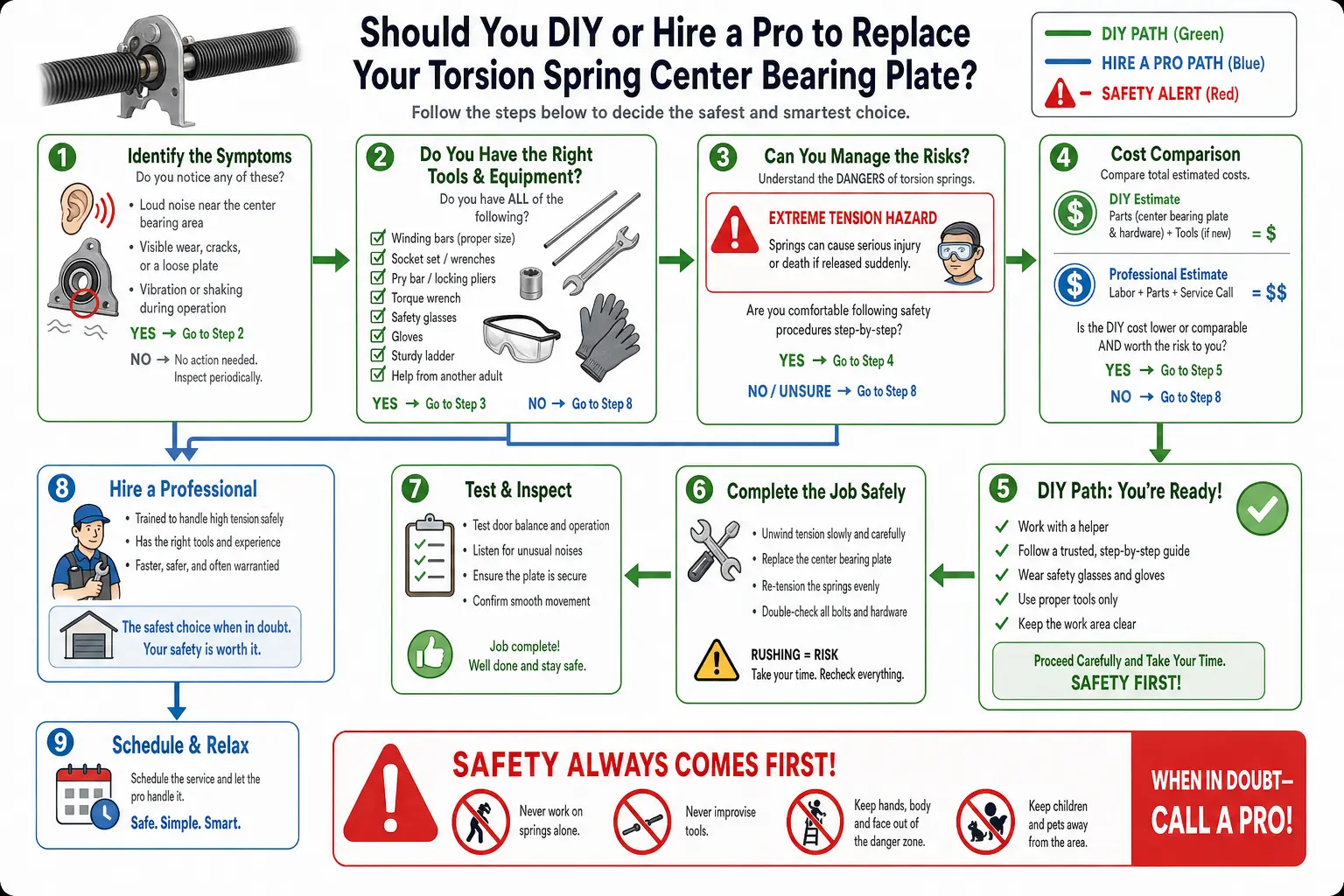
This flowchart educates homeowners on evaluating their capability and risk tolerance for performing center bearing plate repairs themselves versus hiring a professional, emphasizing safety and cost factors.

Replacing a center bearing plate requires unwinding stored spring tension (150 to 300+ lbs of rotational force). DIYers must weigh a $20–$40 part cost against severe impact hazards that require winding bars, vice grips, and precise safety protocols.

From an economic perspective, timing matters. Replacing a center bearing plate as a standalone professional service incurs labor charges due to complete spring unwind requirements. However, replacing the center bearing plate during a scheduled dual-spring replacement adds $0 to $35 in total labor, making component bundling the most cost-effective path. If you encounter active binding, contact a technician experienced in 24 hour garage door repair.

Frequently Asked Questions


Can I spray lubricant on a grinding center bearing to fix it?

Lubrication only provides temporary quiet if the internal bearing race is dry. If the bearing has disintegrated or worn into the shaft, spraying grease will not restore structural integrity and can trap grit, accelerating wear.

How do I know if I need to replace the torsion shaft along with the center plate?

Inspect the shaft surface where it sits inside the bearing. If you feel deep grooves or if the metal scoring depth exceeds 1/32 of an inch, the shaft has lost structural strength and must be replaced.

Is it safe to replace a center bearing plate without unwinding the springs?

No. The center bearing plate acts as the central anchor for stationary spring tension. Attempting to unbolt the center bracket while springs are wound can release stored rotational energy instantly, causing severe hardware destruction and personal injury.

Contact / Request a Call