Side Slide Lock Left Engaged: Opener and Door Damage Guide


Published: Nov 19, 2026

It is one of the most frustrating moments a homeowner can experience: you press your garage door wall button or remote, hear a sudden loud bang or grinding noise, and watch your garage door buckle or freeze mid-lift. Operating an automatic opener while a manual side slide lock (interior track lock) remains fully engaged triggers a catastrophic mechanical failure within seconds.

When evaluating garage door security and opener performance, understanding how these mechanical systems conflict is critical to diagnosing damage, controlling repair costs, and choosing safe locking alternatives.

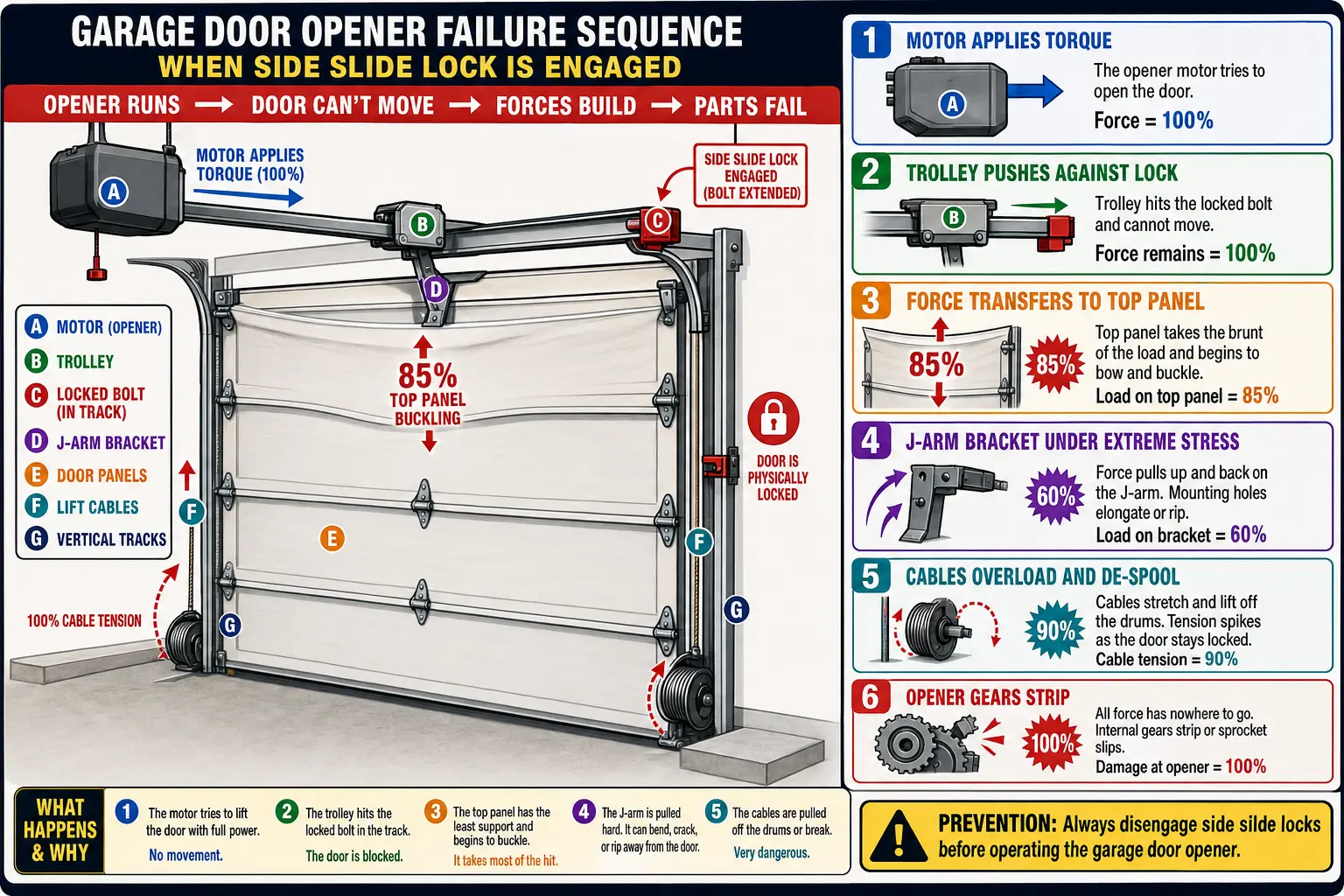
Visualizing the sequence of mechanical failures triggered by operating an automatic garage door opener while the manual side slide lock remains engaged helps homeowners understand why severe door and opener damage happens instantly.

The Anatomy of a Lock-Engagement Disaster


Modern garage door openers (ranging from 1/2 HP to 1-1/4 HP) generate 300 to over 600 pounds of instantaneous upward torque. When a 1/4-inch steel slide bolt locks the door to the vertical track, that upward lifting force has nowhere to go. Even if you regularly adjust garage door pressure sensor settings, built-in force limits rarely react fast enough to prevent structural distortion.

When an opener pulls against a locked side bolt, failure occurs in a rapid cascade:

  1. Top Section Creasing (85% Probability): The drawbar pulls hard on the top section bracket while the bottom sections remain immobile, causing the top panel to bend inward or buckle.
  2. J-Arm Bracket Separation (70% Probability): Tow bracket fasteners shear directly out of unreinforced steel section frames.
  3. Cable De-spooling & Jumping (60% Probability): As asymmetrical tension builds on one side of the door, lift cables lose equal track tension and jump off their aluminum drums.
  4. Internal Gear Shearing (45% Probability): In AC motor systems (Chamberlain, Craftsman, LiftMaster), the internal nylon helical drive gear strips completely to protect the motor circuit from burning out.
Still stuck? Get it fixed today.
24/7 emergency service from licensed local technicians.
Call (860) 362-3018

Assessing the Damage: 5 Critical Components to Inspect


If your door was engaged against a slide lock, execute a visual assessment across these five core structural areas before attempting to operate the system again:

  • Top Panel & Section Alignment: Inspect the top section for horizontal creases or v-shaped buckling. If structural damage is isolated to a single section, pursuing broken garage door panel replacement connecticut is significantly more cost-effective than replacing the entire door.
  • J-Arm Tow Bracket: Check whether the operator bracket has pulled away from the panel frame or torn the underlying sheet metal.
  • Opener Drive Gears: If the motor runs or hums without turning the drive belt or chain, your internal drive gear has likely sheared. In cases where the garage door opener clicked but wont open, internal component inspection is required.
  • Torsion Cables and Drums: Check if either cable is slack, tangled, or thrown off the drum. If cable tension is unequal, call a professional immediately to handle garage door cable replacement near me safely.
  • Tracks and Roller Alignment: Look for twisted track brackets or rollers popped out of their channels. Structural track misalignments will require specialized garage door off track repair cost evaluations.

How to Lock Your Garage Safely Without Risking Opener Failure


Homeowners looking for secondary physical security do not have to compromise their automated opener systems. Evaluating safe locking mechanisms helps eliminate human error while preserving physical door security.
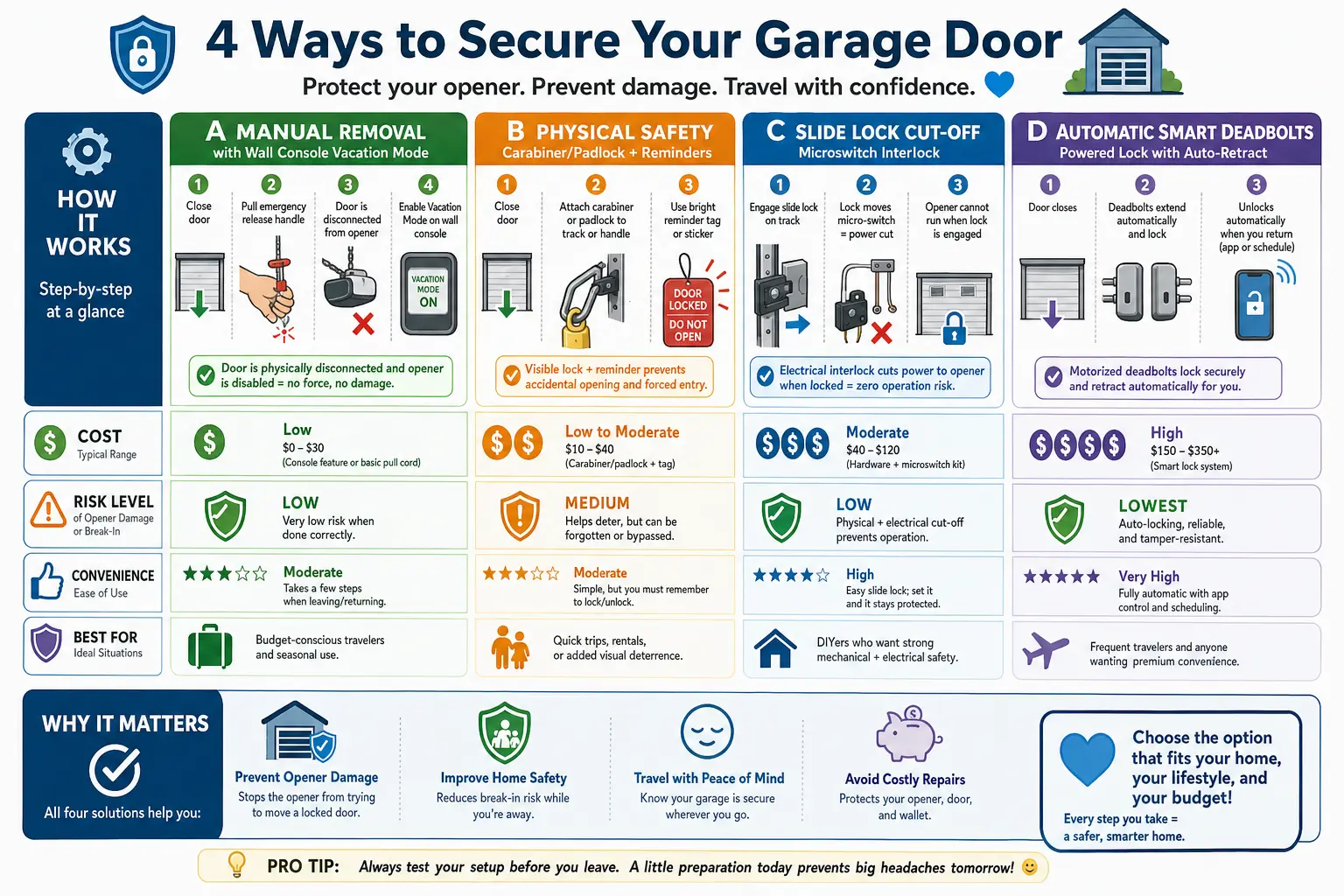
This solution evaluation chart guides homeowners through safe garage locking methods that prevent opener damage, helping them choose options that balance cost, security, and ease of use.

1. Wall Control Vacation Lock Mode

Disables all radio frequency signals from remotes and wireless keypads via your existing wall console.

  • Cost: $0
  • Risk Level: Zero potential for mechanical conflict.

2. Slide Lock Cut-Off Microswitches (e.g., LiftMaster 41A6102)

Mechanical interlock switches mounted to the track wire directly into your opener board. When the manual slide bolt enters the track, the microswitch physically opens the electrical circuit, preventing motor activation.

  • Cost: $25 – $45
  • Risk Level: Zero risk (motor cannot turn while locked).

3. Powered Smart Automatic Deadbolts (e.g., LiftMaster 841LM)

Communicates directly with smart openers via myQ control boards. When you signal your door to open, the powered deadbolt automatically retracts its steel shaft before the opener motor engages. Reviewing updated garage door security tips can help you select the ideal smart lock upgrade for your layout.

  • Cost: $140 – $220
  • Risk Level: Zero risk with complete automation.

Frequently Asked Questions


What happens if I accidentally press the remote while the manual side lock is engaged?

The opener motor pulls forcefully upward against the locked door section. Because the lock anchors the bottom panels firmly to the track, the force rapidly causes top panel creasing, tears the J-arm bracket off the door, or strips the internal plastic gears inside the motor unit.

Why does my garage door motor hum or click but the door won't open?

This typically occurs when the motor’s main helical drive gear has stripped out after pulling against an immovable obstruction like a side bolt. The electric motor continues to spin or hum, but the stripped gears cannot turn the trolley chain or belt drive.

Should I repair a buckled garage door panel or replace the entire door system?

If structural damage is localized to the top section, replacing that individual panel and adding a horizontal reinforcement strut is usually sufficient. However, if the impact twisted vertical tracks, popped cable assemblies, and creased multiple sections, full system replacement is often more cost-effective.

Contact / Request a Call