Garage Door Creeps Open After Closing: Overwound Spring Signs & Diagnostics


Published: Nov 17, 2026

You close your garage door, hear the trolley click off, and walk inside—only to return later and discover a 1 to 6-inch gap at the bottom. A garage door that creeps open after fully closing introduces immediate home security risks, weather intrusion, and potential equipment damage.

Most generic troubleshooting guides point toward dirty safety sensors or misplaced limit switches. However, there is a fundamental mechanical difference between Opener Force Reversal (where the door hits the floor and immediately rebounds upwards 6+ inches while light bulbs flash) and Mechanical Spring Creep (where the door comes to rest, the motor shuts off completely, and static torque gradually lifts the door off the floor).

If your motor has stopped running before the door drifts up, you are likely dealing with an overwound torsion spring.
The Physics of an Overwound Torsion Spring


Garage door springs are designed to counterbalance the exact physical weight of your door. Under standard Door & Access Systems Manufacturers Association (DASMA) guidelines, a typical 7-foot residential garage door requires 7.5 to 8 full turns (30 to 32 quarter-turns) on a standard 4-inch cable drum.

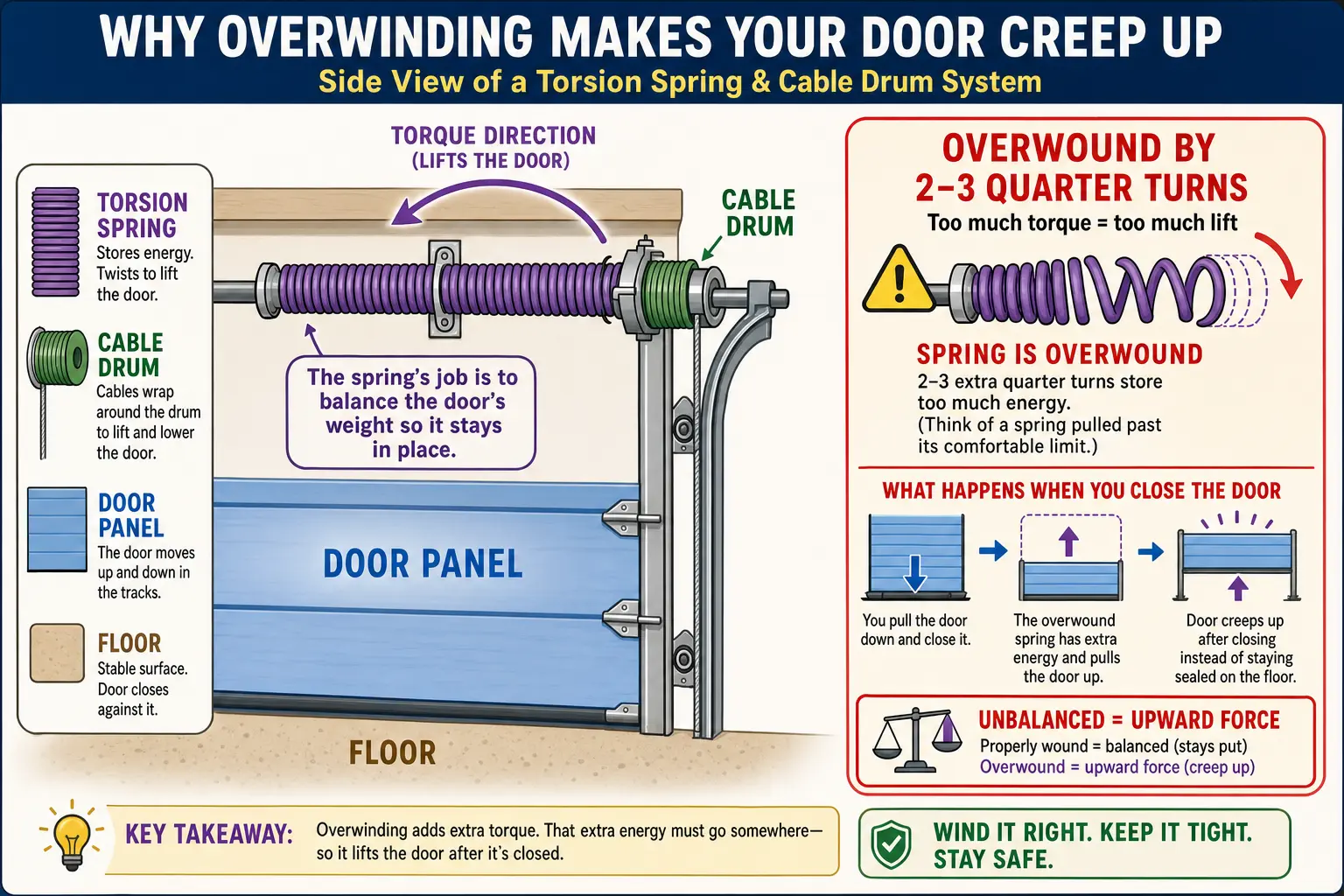
When a DIYer or inexperienced installer overwinds a spring by even 2 to 3 quarter-turns, or installs an incorrect wire gauge, the rotational torque balance is destroyed. At floor level, where the spring should hold neutral equilibrium, the excessive tension exceeds gravitational force. The physical spring effectively “pulls” the door upward under static pressure once the motor release brake disengages.

Visualizing why an overwound torsion spring creates excess lifting force that causes a garage door to creep open slightly after closing. Shows torque imbalance and spring tension effects in simple terms.

Beyond leaving your home vulnerable, an overwound spring places severe strain on your opener motor. During downward travel, the motor forced to push against excess spring torque can strip internal nylon drive gears, leaving you with a garage door motor clicking but not opening when you press the wall button.

Still stuck? Get it fixed today.
24/7 emergency service from licensed local technicians.
Call (860) 362-3018

5 Unmistakable Signs Your Garage Door Spring is Overwound


If you suspect mechanical tension imbalance, look for these five key indicators:

  1. Static 1-to-6 Inch Floor Creep: The door touches the ground, the motor shuts off with a single click, and within 2 to 30 seconds, the bottom seal drifts off the concrete floor.
  2. The Manual Floor Float: When disconnected from the automatic opener, the door refuses to stay fully closed on the ground and floats up several inches on its own.
  3. Severe Opener Strain During Downward Travel: The motor hums deeper, vibrates excessively, or moves noticeably slower when closing than when opening.
  4. Coil binding and Loud Squeaking: Under excessive compression turns, torsion spring coils press against each other tightly, creating loud grinding or chatter during rotation.
  5. Hyper-Tension at the Bottom / Cable Slack at the Top: Cables remain dangerously taut when the door is down, but show excessive slack near the top of the travel track.

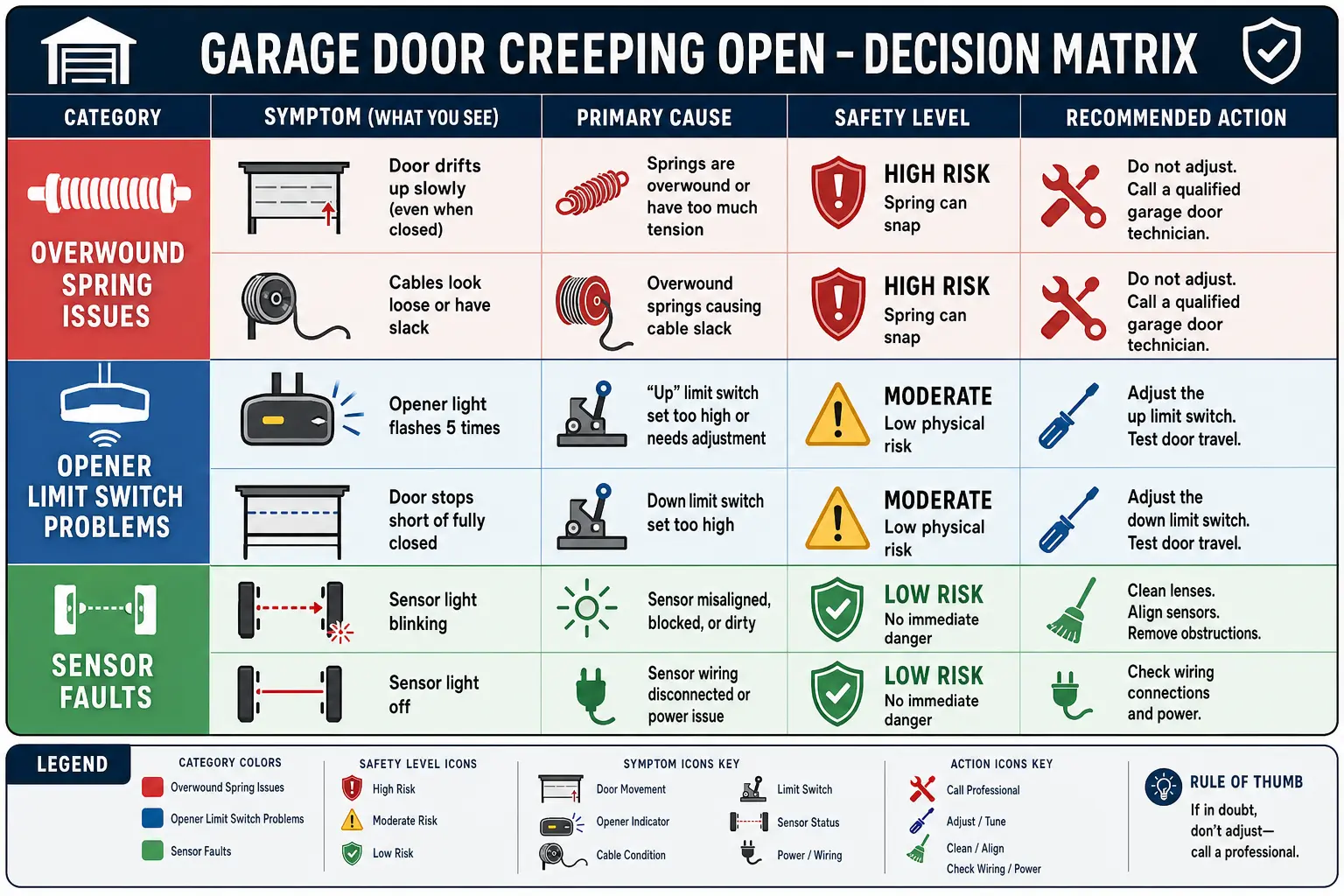
Diagnostic Decision Matrix


Use this breakdown to determine whether your issue stems from spring physics, opener travel limits, or safety sensors:

Symptom Pattern Primary Cause Safety & Motor Risk Action Required
Door shuts, motor turns off, then door slowly drifts up 1–6 inches Overwound Spring Tension High (Stripped Opener Gears) Professional Spring Rebalancing
Door hits floor and immediately reverses 6+ inches with flashing lights Travel Limit / Force Setting Low (Electronic Setting) Adjust Downward Force/Limit Screws
Door stops midway down and reverses immediately Photo-Eye Sensor Obstruction Low (Safety Feature) Align/Clean Optical Sensors
Door slams hard onto concrete and bounces Down Limit set too far Medium (Panel Damage) Reduce Downward Travel Screw

A quick-reference diagnostic chart helping homeowners distinguish whether their garage door creep is caused by an overwound spring, a limit switch setting, or sensor malfunction, aiding faster, accurate troubleshooting.

Safe DIY Diagnostics vs. Professional Adjustment Protocols


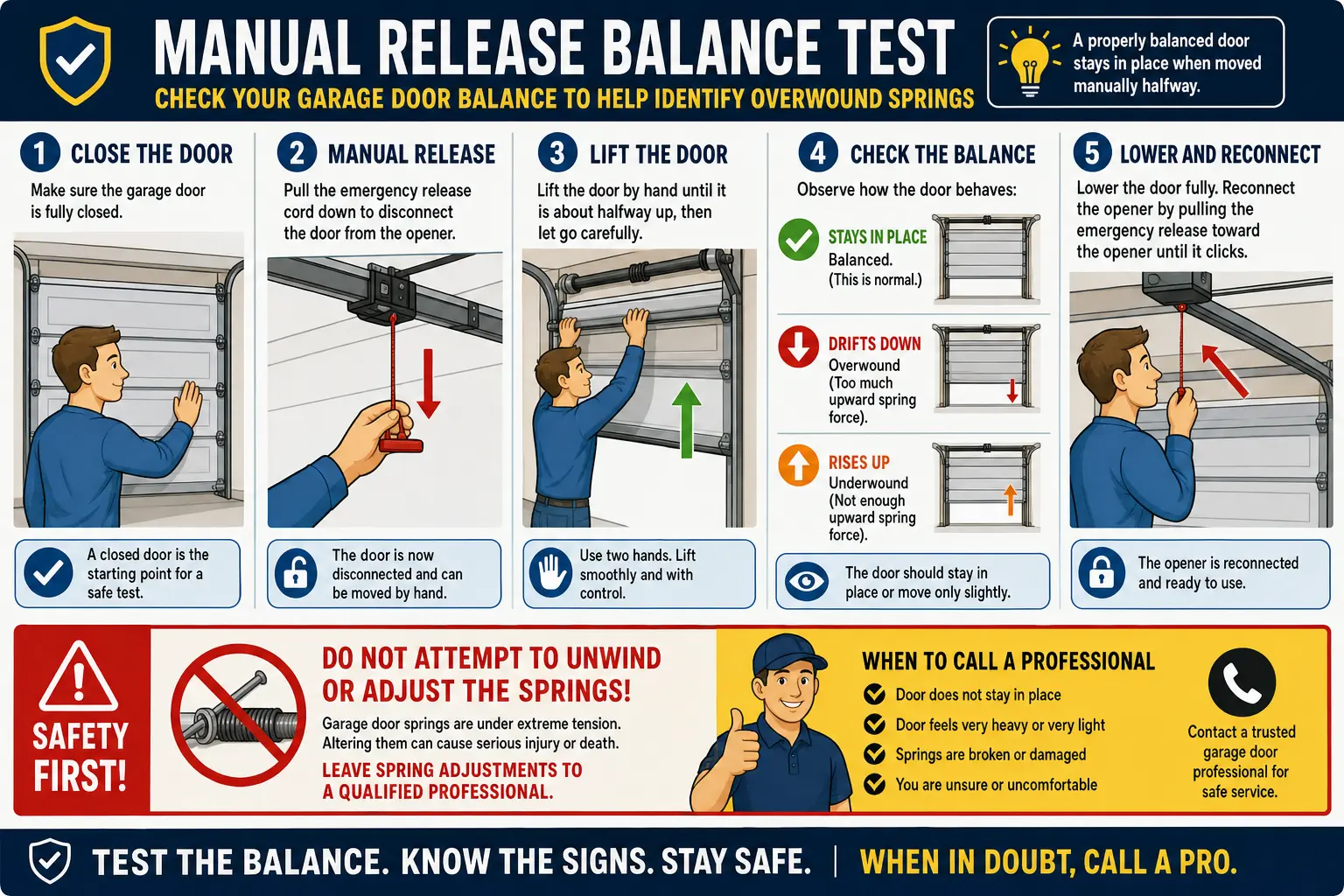
You can safely confirm an overwound spring without exposing yourself to dangerous spring tension by using the manual release disconnect test.

Performing the Safe Manual Release Test:

  1. Close the garage door completely using the opener.
  2. Pull the red emergency release cord to disengage the trolley from the carriage rail.
  3. Manually push the door down so the bottom seal contacts the floor.
  4. Release your hands completely.

If the door stays resting flat on the floor, your springs are balanced, and the issue lies in your opener’s down-travel setting. If the door immediately lifts off the ground by 2 to 6 inches on its own, your springs are overwound.

A clear, beginner-friendly guide to safely testing garage door balance through the manual release method, helping users identify if their springs are overwound without risking injury.

Why DIY Spring Unwinding is Dangerous

Torsion springs hold up to 300+ pounds of system torque. Releasing tension requires specialized steel winding bars and a precise understanding of quarter-turn counts. Attempting to unwind winding cones using screwdrivers or vise-grips causes thousands of severe emergency room injuries every year according to DASMA safety bulletins.

When spring adjustments are needed, contacting a licensed technician for 24 hour garage door repair ensures correct quarter-turn recalibration, protects your opener’s drive motor, and restores full security to your garage.

Frequently Asked Questions


Can an overwound spring burn out my garage door opener motor?

Yes. When a spring is overwound, the motor must exert continuous downward force to overcome the extra spring lift during the closing cycle. Over time, this extra stress strips internal nylon drive gears, overheats the motor logic board, and leads to premature mechanical failure.

How many turns should be on a residential garage door spring?

For a standard 7-foot tall garage door using a 4-inch drum, a spring typically requires 7.5 to 8 full turns (30 to 32 quarter-turns). A 8-foot tall door typically requires 8.5 to 9 full turns (34 to 36 quarter-turns). However, exact turns depend on wire diameter, inner diameter, and door weight.

Why does my garage door creep open only during cold weather?

Cold weather causes metal spring coils to contract and increases grease viscosity inside the tracks. If your spring balance was already borderline overwound, cold temperatures alter track resistance and metal elasticity, making static spring creep more noticeable during winter months.

Contact / Request a Call