Replacing Your Garage Door While Keeping Your Existing Opener: The Evaluation Framework


Published: Oct 15, 2026

When upgrading your home’s curb appeal or structural insulation, retaining your current automatic garage door opener seems like a logical cost-saving move. In over 80% of residential retrofits, keeping your existing motor is technically feasible. However, technical feasibility does not always equal long-term financial wisdom.

Evaluating this decision requires looking past upfront hardware costs to examine mechanical balance, labor bundling, safety regulations, and component lifespans.

The Mechanics Myth: How Garage Doors and Openers Work Together


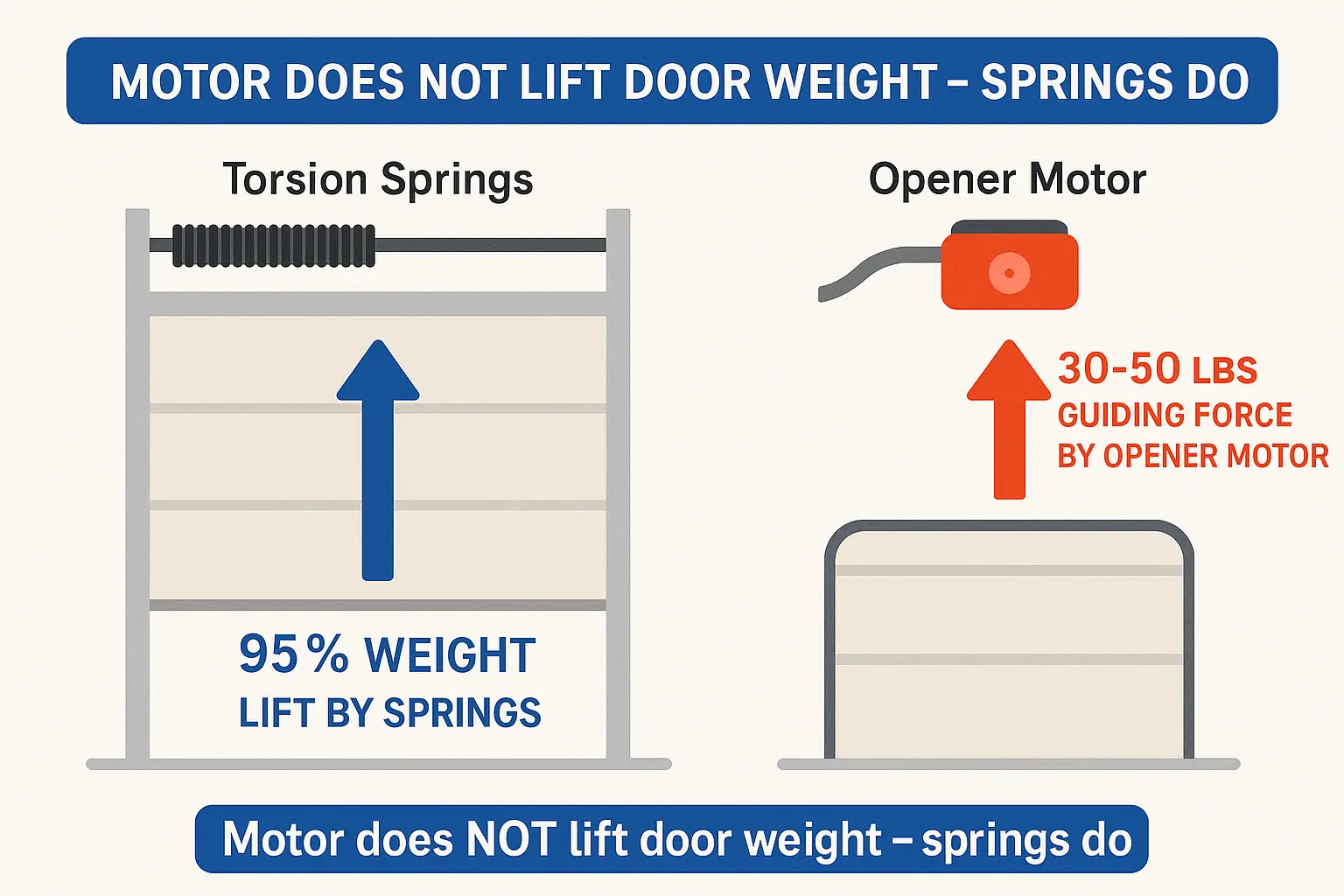
A common misconception among homeowners is that a larger or heavier door requires a motor upgrade to pull the extra weight. In reality, your motor does not lift the door—the counterweight springs do. According to the Door & Access Systems Manufacturers Association (DASMA), properly calibrated torsion or extension springs lift over 95% of the door’s total weight. The motorized opener simply provides a guiding force of 30 to 50 pounds to initiate and regulate travel.

This visual clarifies that the garage door opener motor provides only guidance force, while torsion springs do the heavy lifting, correcting a widespread misconception.

Whether you transition from an non-insulated aluminum door to a heavy insulated steel model, your existing 1/2 HP motor can move the new door effortlessly—provided you invest in new, properly rated springs. Attempting to reuse old springs with a new door ruins operational balance, leading to premature motor burnout. Professional garage door spring installation ensures your motor encounters less than 20 pounds of resistance, protecting its internal gears.


The "Keep vs. Replace" Diagnostic Scorecard


Before deciding to keep your existing motor, score your equipment against these critical technical and safety benchmarks:

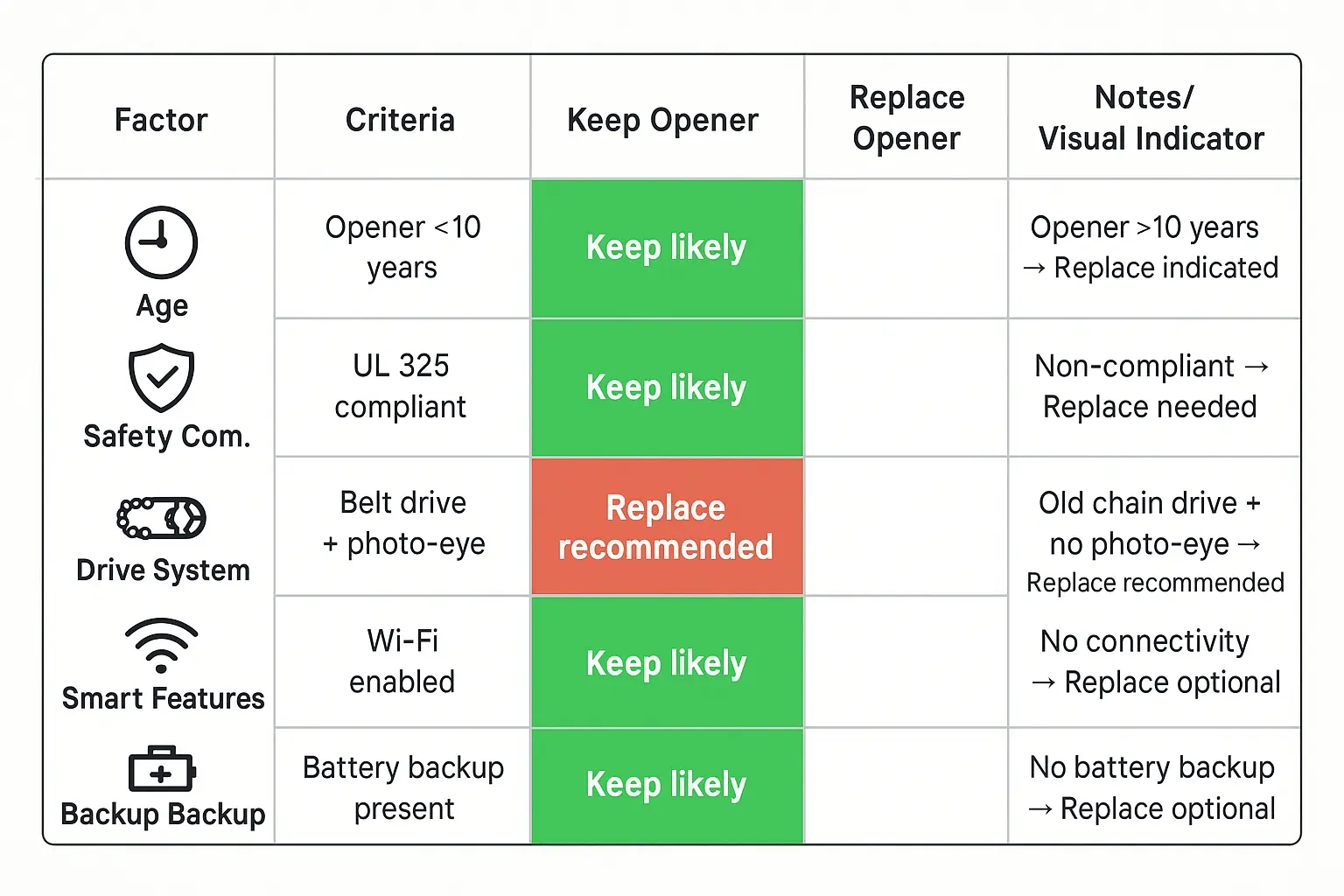
An easy-to-follow decision scorecard empowering homeowners to evaluate their current garage door opener’s compatibility and safety for reuse with a new door.

  • System Age: Residential doors last 15 to 30 years, while opener motors average a 10 to 15-year lifespan. Reattaching a 12-year-old motor to a brand-new door means you will likely pay separate repair fees when the motor fails shortly down the road.
  • Safety Compliance (UL 325): The U.S. Consumer Product Safety Commission mandates auto-reversing photo-eye sensors for all openers produced after 1993. Pre-1993 units lack non-contact safety sensors and present significant safety risks and property liability.
  • Emergency Regulations: Legislation like California’s SB 969 mandates battery backup systems on all residential openers to ensure egress during power outages—a feature older units lack.
  • Noise & Modern Tech: If your existing drive uses a loud chain, upgrading to a modern DC-powered belt unit gives you a far more quiet garage door opener with smart connectivity built in.

Master Component Reuse Matrix


When installing a new door, components should be evaluated individually rather than assuming the whole system stays or goes:

Component Recommendation Technical Rationale
Door Panels Replace New primary assembly.
Torsion / Extension Springs Replace (Mandatory) Calibrated specifically to the exact weight and height of the new door.
Vertical & Horizontal Tracks Replace (Recommended) New doors require matched track thickness, radius curves, and alignment tolerances.
Opener Motor Head Keep (If < 10 yrs old) Mechanically sound if force margins and safety features meet modern standards.
Trolley Rail & J-Arm Replace or Reinforce Requires correct top-section garage door strut placement to prevent panel buckling under motor torque.

Technical Considerations for Re-Attaching Existing Motors


If your opener is under 8 years old and fully compliant, follow these crucial technical steps during installation:

  1. Reinforce the Top Section: Always attach a horizontal strut or heavy-duty operator bracket to the top door panel. Direct J-arm attachment without reinforcement can tear steel skins or crack composite panels, voiding your manufacturer warranty.
  2. Recalibrate Travel & Force Limits: New door thicknesses change physical stop points. Technicians must fix garage door opener limit switches and reset force profiles to prevent the motor from smashing the door into the header or floor.
  3. Perform Safety Reverse Testing: Once you reconnect garage door opener hardware, place a 2×4 board flat under the door center. The door must reverse immediately upon contact.

Completing a professional garage door opener installation alignment ensures smooth operational cycles without risking damage to your new investment.


Final Recommendation & Next Steps


If your current opener is less than eight years old, features infrared safety eyes, and operates quietly, keeping it during a door replacement makes financial sense. However, if your opener approaches the decade mark, bundling a modern unit with your new door eliminates duplicate labor costs and protects your investment for years to come.

Frequently Asked Questions


Will using an old opener void my new garage door warranty?

Using an existing motor will not void your door warranty on its own. However, failing to install a top-section reinforcement bracket or operating the door with improperly balanced springs can cause structural panel damage that manufacturers like Clopay and Amarr will not cover.

Can I use my old tracks with a brand-new garage door?

It is strongly discouraged. Track gauge thickness, lip profiles, and curve radii vary by manufacturer and panel weight. Using old tracks with new doors often causes binding, excessive roller wear, and noise issues.

How do I know if my new door is too heavy for my old motor?

If your new door is equipped with correctly weighted torsion springs, even a standard 1/2 HP motor can operate it effortlessly. If the motor struggles, the issue is almost always spring miscalculation rather than insufficient motor horsepower.


Contact / Request a Call