Optimal Garage Environments for Lithium Battery Storage: The Ultimate Safety & Performance Blueprint


Published: Sep 18, 2026

Homeowners investing in electric vehicles (EVs), home solar arrays, or premium cordless power tools face a modern dilemma: where do you store these expensive lithium batteries? Keeping them inside your living space presents safety concerns in the rare event of a fire, yet storing them in an unconditioned garage can rapidly degrade their capacity and compromise their lifespan.

To resolve this risk-versus-convenience tradeoff, you must establish a structurally verified, climate-stable garage environment. Below is the scientific and spatial blueprint to turn your garage into a high-performance battery sanctuary.
The Physics of Thermal Degradation


Storing batteries in seasonal extremes permanently damages their chemistry. The absolute thermodynamic sweet spot for long-term lithium storage is 59°F (15°C) to 77°F (25°C). Deviating from this range triggers two distinct electrochemical failure modes.

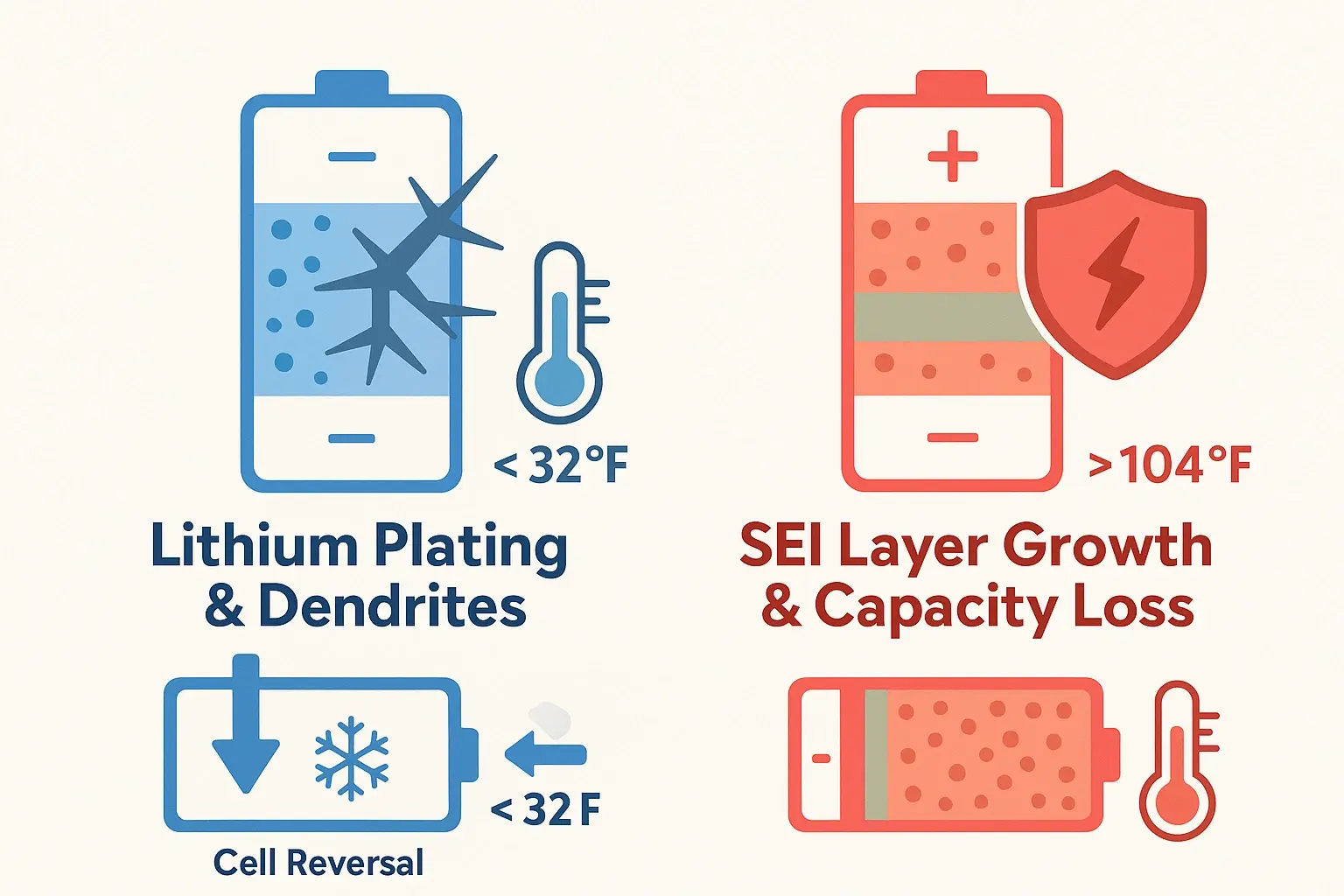
  • The Freezing Danger (Lithium Plating): Charging a lithium battery below 32°F (0°C) prevents ions from smoothly intercalating into the graphite anode. Instead, they accumulate on the anode surface as metallic lithium plating. Over time, these form microscopic needles (dendrites) that can pierce the internal separator, causing catastrophic short circuits. Furthermore, drawing high currents from frozen power tool batteries can trigger cell reversal, permanently destroying the pack.
  • The Heat Danger (SEI Growth): Sustained ambient temperatures above 104°F (40°C) accelerate the growth of the Solid Electrolyte Interphase (SEI) layer on the electrodes. This process permanently locks away active lithium, degrading capacity. Storing a battery at 104°F at a normal charge level reduces its capacity to 85% in a year. If stored at 100% State of Charge (SOC) at 104°F, it can lose 35% of its total capacity in just three months.

This infographic clarifies how extreme cold below freezing causes lithium plating that can short circuits, while heat above 104°F accelerates SEI growth reducing capacity — key reasons garages must maintain stable moderate temperatures for battery health.


The Chemistry Matrix: NMC vs. LFP


Not all lithium batteries are engineered the same. Your garage setup must adapt to the specific chemistry you are storing:

  • NMC (Nickel Manganese Cobalt): Commonly found in EVs, e-bikes, and electronics. It offers high energy density but is highly sensitive to thermal runaway. Target storage: 50°F to 70°F.
  • LFP (Lithium Iron Phosphate): Standard for home solar wall batteries. LFP is incredibly stable and has a long lifecycle (3,000+ cycles), but exhibits high internal resistance in freezing temperatures. Target storage: 32°F to 80°F.

EV & Portable Battery Storage Protocols


Electric Vehicles (EVs)

Unconditioned winter storage can cause an average range loss of 20% due to self-heating demands. Always keep your EV plugged in during seasonal extremes; this allows the vehicle’s Battery Management System (BMS) to run active climate control using grid power rather than draining the battery. Always store your EV at a 50% to 70% State of Charge (SOC) if parking it long-term.

Tool & Micromobility Batteries

For e-bikes, RC packs, and cordless tools:

  1. Avoid unsupervised overnight charging to mitigate fire hazards.
  2. Elevate storage: Place batteries on non-conductive, dry wooden or plastic shelves away from metal clutter to prevent terminal shorting.
  3. The “Bring Them Inside” Rule: If your garage is uninsulated and drops below freezing or climbs above 90°F, bring power tool batteries into a climate-controlled basement.

Stationary Home Solar Batteries & Wall Storage (NFPA 855 Standards)


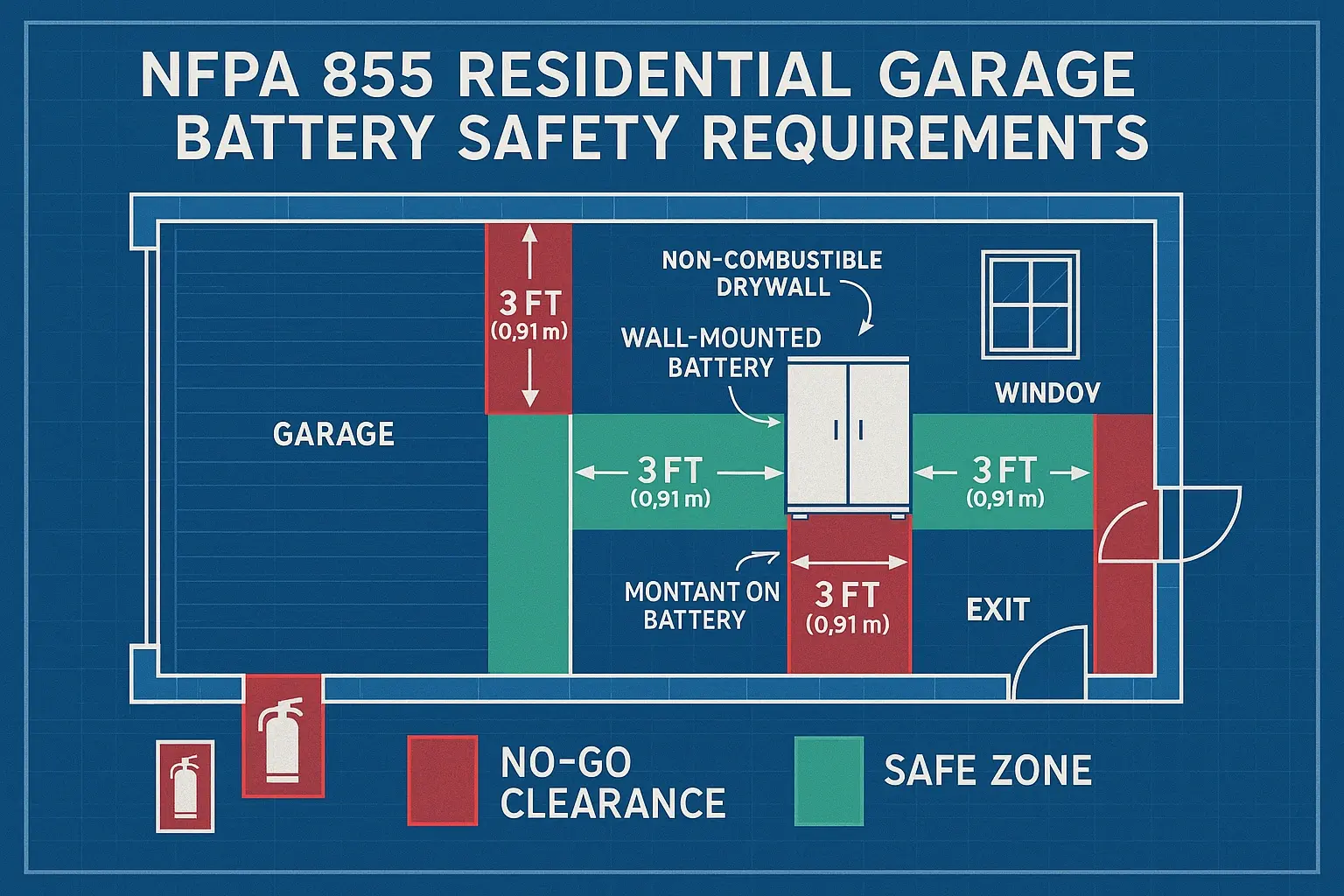
To satisfy municipal building codes and qualify for insurance coverage, wall-mounted solar batteries must adhere strictly to the National Fire Protection Association (NFPA) 855 standards:

  • Capacity Caps: NFPA 855 limits residential battery installations to a maximum of 80 kWh in garages, compared to a restrictive 40 kWh inside living spaces.
  • Setbacks & Clearances: You must maintain a minimum 3-foot (0.91 m) clearance between individual battery units, and from all garage doors, windows, or structural exits.
  • Fireproofing: Batteries must be mounted on non-combustible surfaces, such as concrete or 5/8-inch Type X drywall.

This visual blueprint anchors the crucial NFPA 855 residential guidelines: keep 3-foot clearances around your lithium battery units, limit capacity to 80 kWh in garages, and mount batteries on fire-resistant surfaces to ensure safety and code compliance.


Engineering the Optimal Garage - Environmental Upgrades


Transforming your garage into an ideal storage space requires upgrading both passive thermal envelopes and active safety systems.

1. Passive Climate Safeguards

Before installing active climate control, secure your garage’s thermal boundary:

2. Active Environmental & Safety Controls

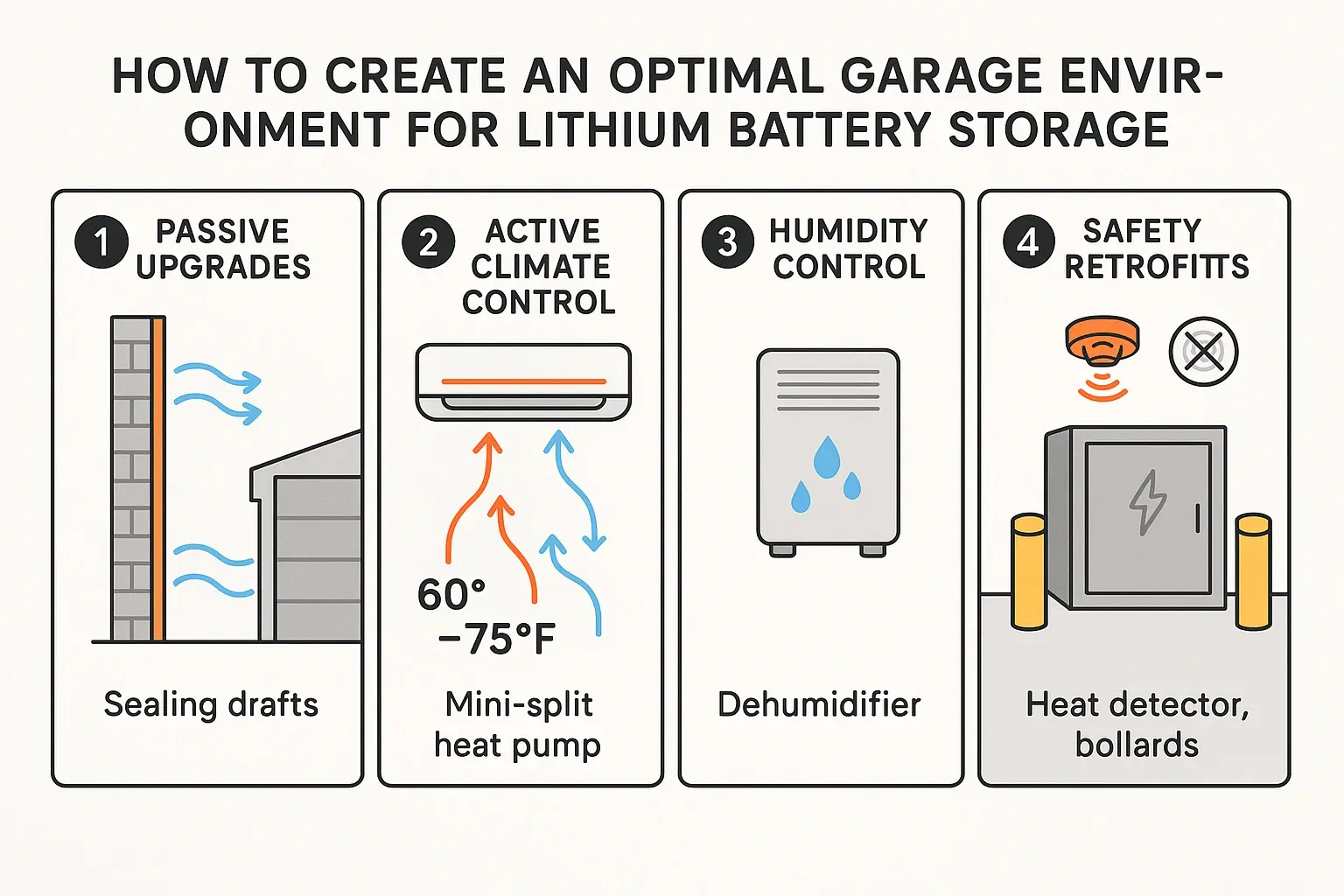
  • Climate Systems: Install a mini-split heat pump to maintain a stable year-round temperature between 60°F and 75°F. Keep relative humidity between 45% and 75% without condensation to protect sensitive electrical terminals from corrosion.
  • Smart Detection: Standard smoke detectors false-alarm due to dust and vehicle exhaust. Install specialized rate-of-rise heat detectors connected to your home’s main alarm system.
  • Impact Protection: Protect wall-mounted battery banks from parking mishaps by installing structural steel safety bollards.

Follow this clear sequence of environmental and safety improvements—from insulation to active HVAC and protective retrofits—that transform a typical garage into an ideal space for lithium battery storage.


Securing Your Tech Starts at the Entryway


Protecting your high-value battery investments begins with control over your garage’s environment. Schedule a seasonal garage door tune-up or consult with an expert to upgrade your insulation and weather-sealing today.

Lithium Storage FAQs


Can I store lithium batteries in an unheated garage during winter?

You can store them, but you should never charge them if temperatures drop below 32°F (0°C). Doing so causes permanent lithium plating and raises fire risks.

How do I safely extinguish a lithium-ion battery fire in a garage?

For small devices, use an ABC dry-chemical or CO2 extinguisher to suppress surrounding flames. For large-scale battery banks, call emergency services immediately; these fires require massive amounts of water to cool the cells and stop thermal runaway.

Why is relative humidity control important?

High humidity (above 75%) causes condensation on cool battery terminals, accelerating corrosion, degrading electrical connections, and increasing the risk of short-circuits.


Contact / Request a Call