main logo

The Ultimate Guide to Garage Door Bottom Seals: A Buyer’s First Step


Published: Jun 24, 2026

Ever walked into your garage on a chilly morning and felt a draft that had no business being there? Or maybe you’ve noticed a small puddle of water creeping in after a rainstorm, or worse, evidence of an unwelcome furry visitor. That thin strip of rubber or vinyl at the bottom of your garage door is the unsung hero responsible for keeping your space clean, dry, and energy-efficient.

But when it's time to replace it, you’re suddenly faced with a confusing world of T-styles, J-types, bulbs, beads, and different materials. It’s easy to get lost.

This guide is your friendly map. We'll walk you through everything, starting with the single most important secret to getting it right the first time.

Foundation Part 1: The #1 Mistake to Avoid - Match Your Seal to Your Retainer


Before you even think about the material or the width of the seal, stop. Look at the very bottom of your garage door. That metal track holding the old seal in place is called the retainer, and its shape dictates everything.

Buying a seal without knowing your retainer type is like buying a phone case without knowing your phone model—it simply won't fit. This is the most common and frustrating mistake people make. To avoid it, your first job is to play detective and identify your retainer.
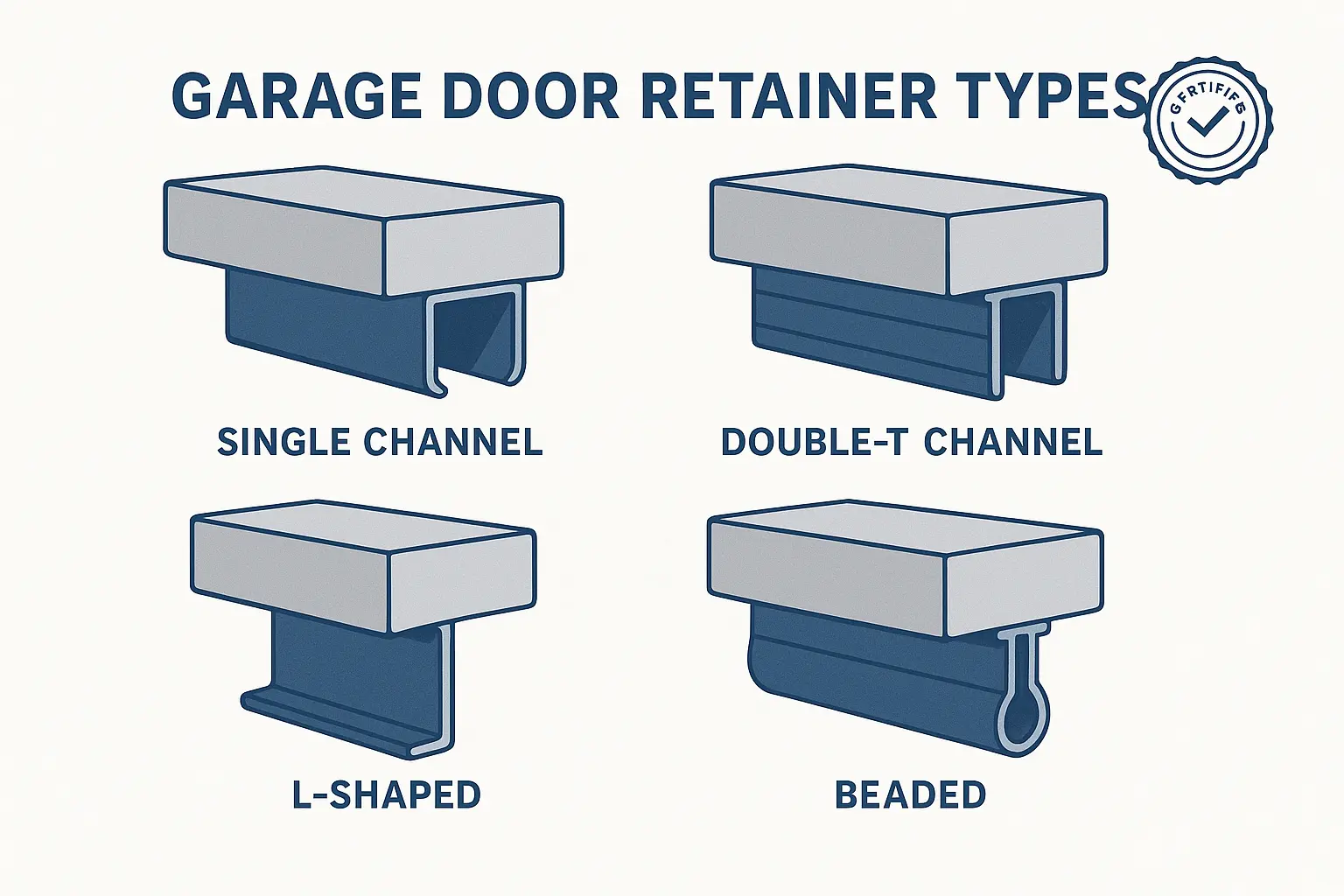
Visualizing the critical door retainer types to avoid costly mistakes — your bottom seal choice depends on this foundation.

Common Retainer Types:


  • Single-Channel (L-Shape or Flat): This common type has one channel. It typically accepts seals with a T-shape or a beaded edge.
  • Double-Channel (Tongue and Groove): This retainer looks like two "T" slots side-by-side and requires a T-shaped seal.
  • Slotted Retainers for P-Bulb Seals: Often found on older or commercial doors, these retainers have a wider opening designed for a P-bulb or "P-style" seal.
  • Direct-Mount (on Wooden Doors): Some older wooden doors don't have a metal retainer. The seal is nailed or screwed directly onto the door's bottom edge.
Action Step: Take a clear photo of the end of your current seal and the channel it slides into. This picture will be your most valuable tool when shopping.
Visualizing the critical door retainer types to avoid costly mistakes — your bottom seal choice depends on this foundation.

Foundation Part 2: The Vocabulary of Seals - A Visual Dictionary


Now that you've identified your retainer, you can confidently explore the different seal profiles that will actually fit. Think of these as the "keys" that fit the retainer "lock."
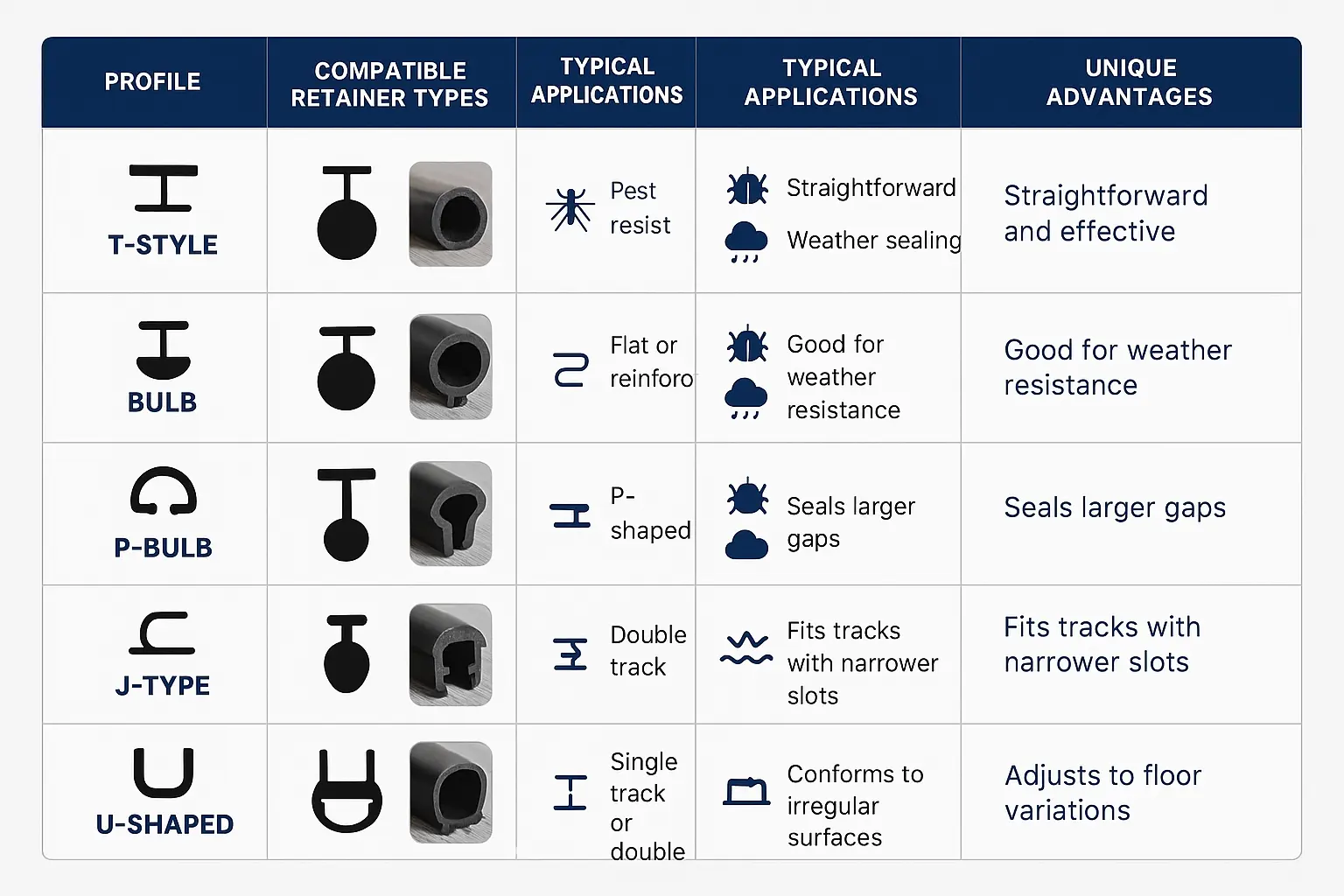
Comprehensive comparison of popular garage door bottom seal profiles to match your door’s retainer and environment needs with ease.

Common Seal Profiles:


  • T-Style: The most popular profile. The top of the seal forms a "T" shape that slides into single or double-channel retainers. They come in various widths (e.g., 1/4" T, 5/16" T), so measure the old one carefully!
  • J-Type: One side is longer than the other, creating a "J" shape that hooks over the inside of the door. This helps create a better seal against the back of the door.
  • Beaded: Instead of a "T," this seal has small, round beads on top that slide into a specific C-shaped channel retainer. It's less common but crucial to identify if you have it.
  • Bulb: This seal has a round, hollow "bulb" shape at the bottom. It’s an excellent choice for uneven or cracked garage floors because the bulb can compress to fill gaps up to an inch high.
  • P-Bulb: A combination profile with a "P" shape on top that slides into a slotted retainer and a bulb at the bottom for sealing gaps.
  • U-Shaped with Retainer: This is an all-in-one solution. The U-shaped seal wraps around the bottom of the door, and the included retainer is screwed into the door to hold it in place. It's perfect for replacing seals on doors that don't have a standard retainer.
Comprehensive comparison of popular garage door bottom seal profiles to match your door’s retainer and environment needs with ease.

Building: Choosing the Right Material for Your Climate


You've matched the profile to your retainer. The next step is choosing a material that can stand up to your local weather. The wrong material might crack in the cold or degrade under intense sun, forcing you to replace it much sooner.

Material Comparison:

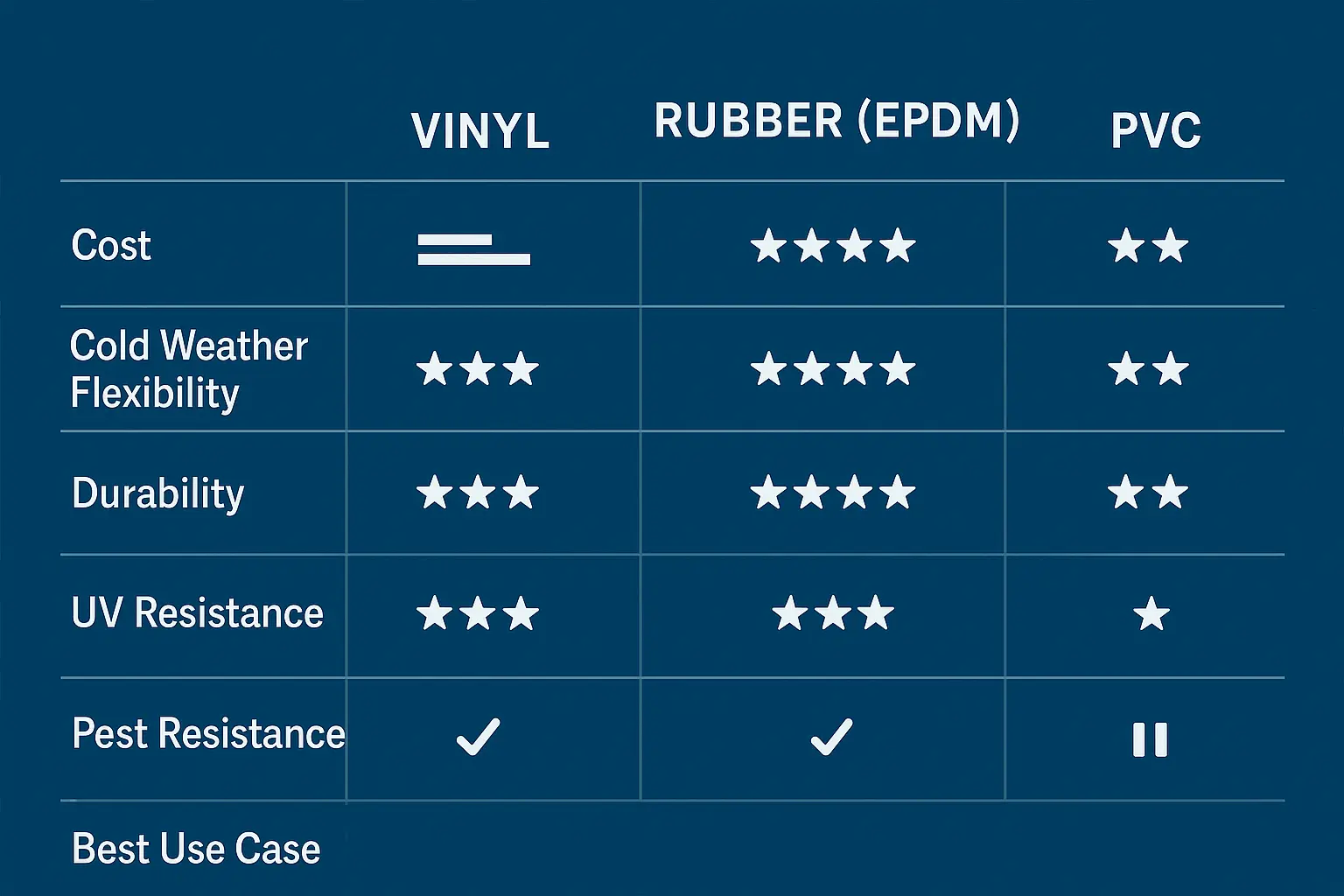
Material choices matter: Compare vinyl, rubber, and PVC seals to find the best fit for your climate and longevity needs.


MaterialCold Weather FlexibilityDurability & UV ResistanceBest Use Case
VinylGoodModerateA budget-friendly choice for moderate climates without extreme temperature swings. Can become stiff in freezing weather.
Rubber (EPDM)ExcellentExcellentThe superior choice for climates with freezing winters. EPDM rubber stays flexible and won't crack in the cold, ensuring a solid seal year-round.
PVCFairGoodA durable plastic polymer that holds its shape well but can be less flexible than rubber in extreme cold.


Material choices matter: Compare vinyl, rubber, and PVC seals to find the best fit for your climate and longevity needs.

Mastery: Solving Specific Problems


A new bottom seal can do more than just block drafts. By choosing the right combination of profile and material, you can solve some of the most common garage headaches. If you're struggling with high utility bills, understanding how can a garage door bottom seal help with energy efficiency? is the first step toward a more comfortable and cost-effective home.
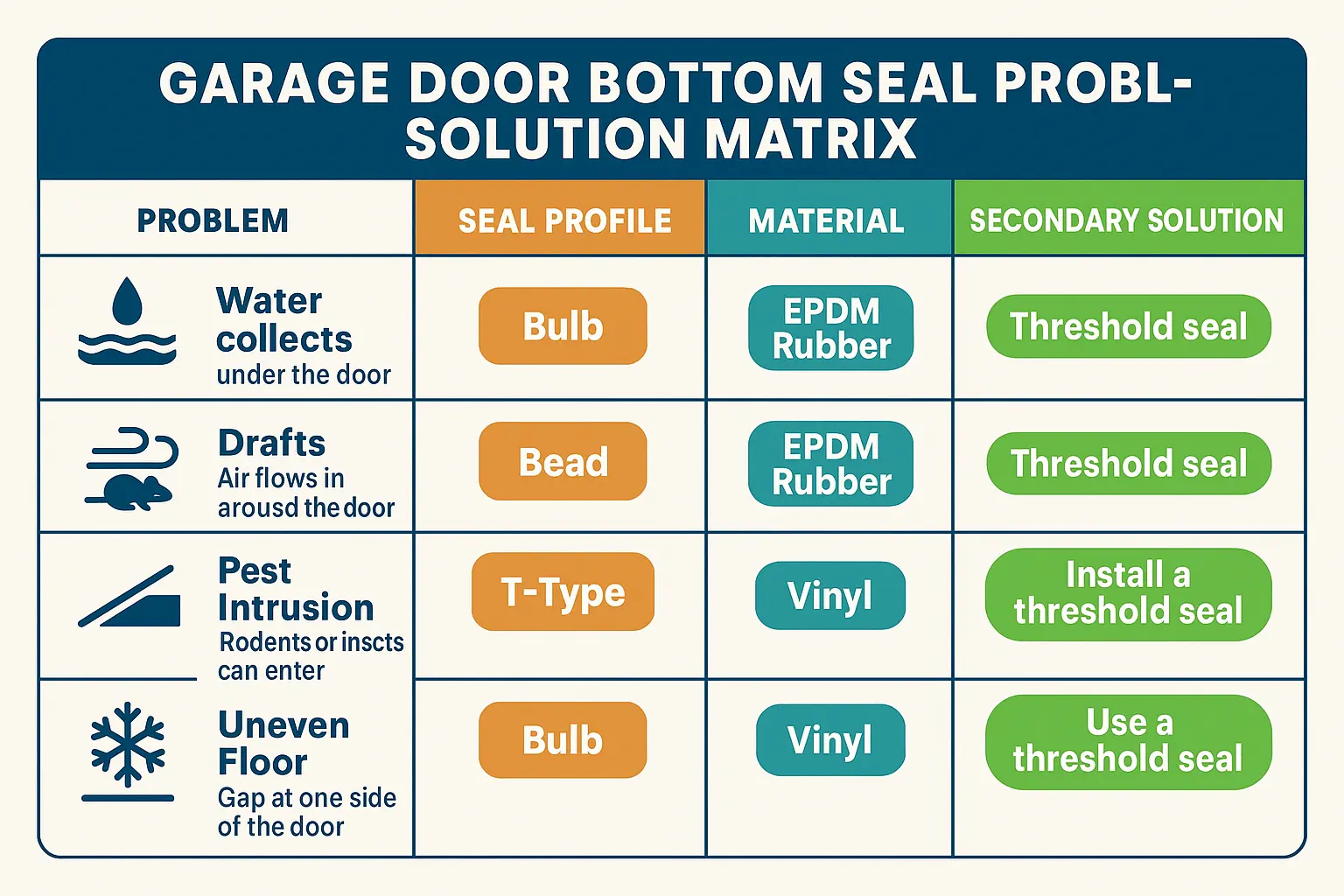
Match your garage door problems to the right bottom seal solutions — confident sealing starts here.
Problem: An Uneven or Cracked Floor
The Likely Cause: A standard flat seal can't conform to the floor's imperfections, leaving gaps.
Recommended Seal Solution: A Bulb-style seal is ideal. Its round shape compresses to fill gaps effectively. For severe slopes, consider adding a garage door threshold seal on the floor itself.
Problem: Water Seeping Under the Door
The Likely Cause: The seal is worn, cracked, or too small, allowing water to penetrate.
Recommended Seal Solution: A wider seal (e.g., 4" or 6") combined with a U-shaped profile can create a better barrier. EPDM rubber provides a more reliable, watertight seal.
Problem: Pests and Rodents Getting In
The Likely Cause: Small gaps created by a worn or ill-fitting seal provide an easy entry point.
Recommended Seal Solution: A thick rubber seal is harder for pests to chew through. Some brands offer rodent-proof seals infused with repellent materials. Ensure there are no gaps on the sides.
Problem: Daylight Visible on the Sides
The Likely Cause:The seal is not wide enough for the door, or the door isn't closing completely.
Recommended Seal Solution: Measure your door's thickness and choose a seal that's at least an inch wider on both sides. If the door isn't closing right, you may have garage door limit switch problems.

Match your garage door problems to the right bottom seal solutions — confident sealing starts here.

Your Pre-Purchase Checklist


Feeling more confident? Before you click "buy," run through this final checklist to ensure you get the perfect seal.

  • Identify Your Retainer: Take a picture of the channel (single, double, P-style, etc.).
  • Measure Your Old Seal's Profile: If it’s a T-style, measure the width of the "T" (e.g., 1/4" or 5/16").
  • Measure Your Door's Width: Order a seal that's a foot longer than you need. You'll trim it to the perfect length during installation.
  • Measure Your Door's Thickness: This helps ensure the seal is wide enough to create a good barrier.
  • Choose Your Material: Select vinyl for moderate climates or EPDM rubber for areas with freezing temperatures.
  • Assess Your Floor: If it's uneven, prioritize a bulb-style seal.

Frequently Asked Questions


How do I know if I need a new garage door seal?

The signs are usually clear: you can see daylight under the door, feel a draft, or notice water, leaves, or pests getting inside. Visually inspect the seal for cracks, brittleness, or flat, compressed sections.

How often should a garage door bottom seal be replaced?

This depends on your climate and the material. A high-quality EPDM rubber seal in a harsh climate might last 5-10 years, while a basic vinyl seal in a mild climate could last just as long or degrade faster under intense sun. The significant energy loss due to poor door seals makes proactive replacement a smart investment.

Can I replace just the seal, or do I need a new retainer too?

In most cases, you only need to replace the seal insert. However, if your aluminum retainer is bent, cracked, or severely corroded, it won't hold the new seal properly and should be replaced as well.

Is installing a new bottom seal a DIY job?

For most homeowners, yes. It typically involves removing the old seal and sliding the new one into the retainer. It's helpful to have a second person to help feed the seal through the channel. Lubricating the channel with silicone spray or soapy water can make the process much easier. A complete garage door safety checklist is always a good idea before starting any DIY garage door project.

Your First Step to a Better Garage


Choosing the right garage door bottom seal doesn't have to be complicated. By focusing on your retainer first, you can cut through the confusion and find the perfect fit. A well-sealed garage is more than just a convenience—it protects your home, saves you money on energy bills, and gives you peace of mind.

Now that you understand the what and why, you're equipped to make a smart, confident decision that will keep your garage secure and comfortable for years to come.

You may also like


blog photo

Why Weather Stripping Makes Your Garage Door Reverse

It’s one of the most baffling home repair moments. You press the button, your garage door dutifully lowers, makes contact with the floor, and then—for no apparent reason—it immediately reverses and goes all the way back up. You check for a stray recycling bin, a forgotten bicycle, anything in its path. Nothing.If this scenario sounds frustratingly familiar, you’re not alone. You’ve likely stumbled upon a classic garage door mystery. While most homeowners immediately suspect the safety sensors, the true culprit is often sneakier and hiding in plain sight: the rubber weather stripping at the bottom of your door.Let's walk through this problem like a seasoned detective, starting with the usual suspects and then zeroing in on how a simple piece of rubber can outsmart your entire garage door system.

blog photo

How to Choose a Garage Door Color That Matches Your Exterior

Choosing a garage door color can feel surprisingly high-stakes. It covers a huge portion of your home’s exterior and has the power to either create a polished, harmonious look or an accidental eyesore. If you’re staring at a wall of paint swatches feeling lost, you’re not alone. Many homeowners focus on finding a “popular” color, but the secret to curb appeal isn’t about trends—it’s about harmony.Think of your garage door as your home's second front door. It’s a major architectural feature that can dramatically boost your home's character when chosen thoughtfully. This guide will walk you through the same principles designers use, transforming that overwhelming decision into a simple, confident choice. We'll move beyond just looking at colors and teach you how to see them, ensuring your new garage door perfectly complements your home's beautiful brick, stone, or stucco.

blog photo

Best Garage Door Materials for Coastal & High-Wind Regions

If you live in a coastal or high-wind region, you’ve probably got a storm-prep checklist: board up the windows, secure outdoor furniture, and stock up on supplies. But have you ever stopped to think about the largest, most vulnerable opening in your home? Your garage door. During a hurricane, intense wind pressure can cause a standard garage door to buckle and fail. Once the wind gets inside, the pressure can build up and blow your roof off from within, leading to catastrophic structural failure. It’s a terrifying domino effect, and it all starts with the garage door. This isn't just about protecting your car; it's about safeguarding your entire home. Understanding how to choose a storm-ready door is one of the most critical steps you can take to fortify your home against the elements.