Master Guide to Garage Door Mechanical Assembly and Component Selection


Published: Sep 15, 2026

Every time a garage door cycles, a complex mechanical system balances hundreds of pounds of physical tension to deliver smooth, quiet movement. When components wear out, homeowners face a critical trade-off: the cost-savings of DIY maintenance versus the real physical risks of high-tension hardware.

According to data from the Consumer Product Safety Commission (CPSC) and the National Electronic Injury Surveillance System (NEISS), there are between 20,000 and 30,000 garage door-related injuries in the United States every year. Over 2,200 individuals are crushed annually by falling doors, and more than 7,500 sustain painful finger and hand pinches near tracks or hinges. When evaluating a diy vs professional garage door repair: which is better path, identifying which components you can safely service yourself is the first step toward securing your home safely.
The Safety-First DIY Risk Assessment


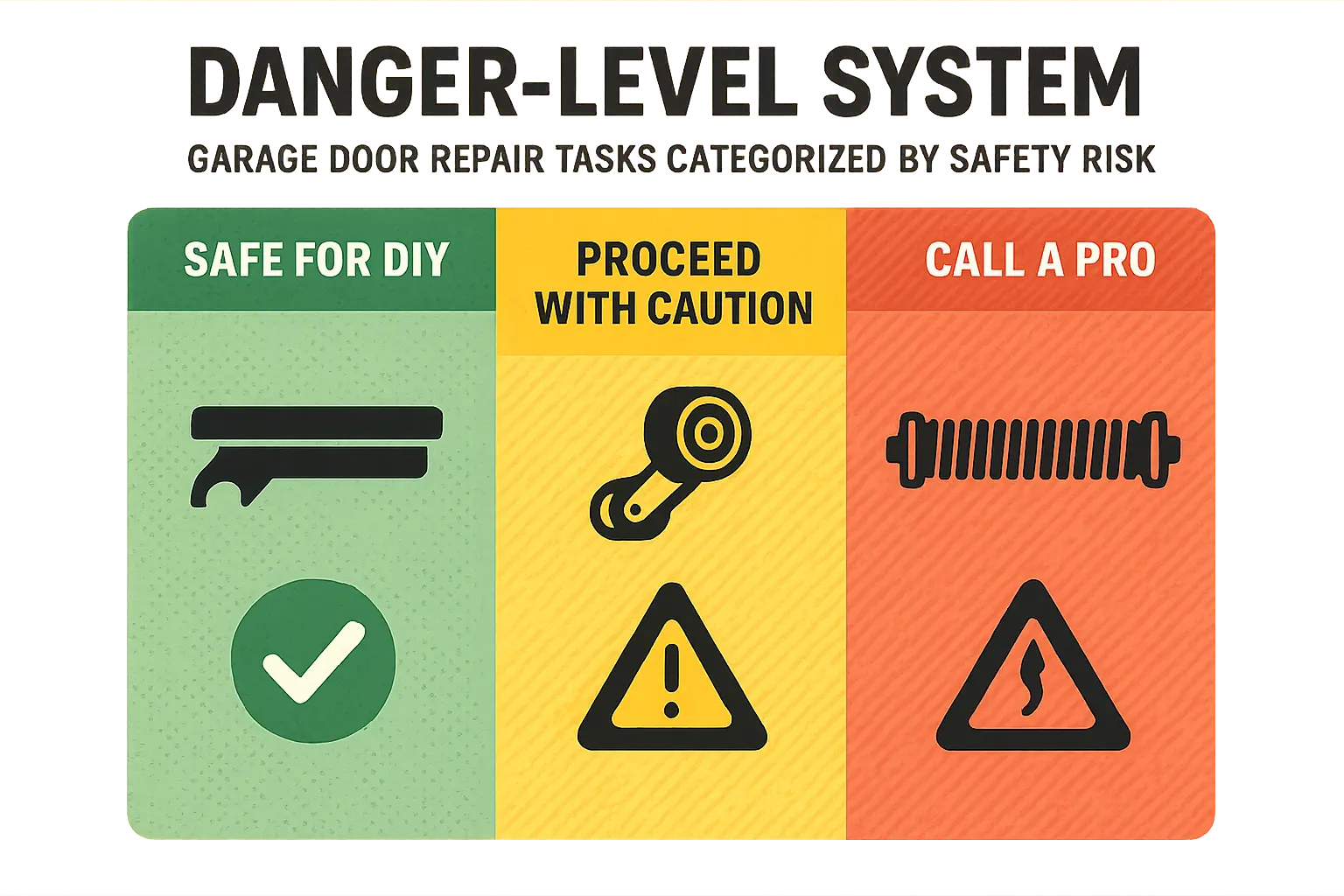
To protect your safety and avoid costly system damage, we categorize all mechanical assemblies into a color-coded danger rating system. Green-tier tasks are straightforward and safe for DIYers. Yellow-tier tasks require mechanical aptitude and strict alignment rules. Red-tier tasks involve high-tension mechanical forces that should only be handled by trained, licensed professionals.

A visual safety decision matrix categorizing garage door repairs by risk level, helping DIYers quickly identify which tasks they can safely perform and when to call a professional.

Bottom Weather Seal and Track Selection Engine


Replacing a worn-out bottom seal is a safe, high-impact project that stops drafts, keeps out water, and improves home energy efficiency. However, choosing the wrong replacement compound or profile will leave gaps.

  • EPDM Rubber: This is the industry standard material. It remains flexible and resists cracking down to -40°F, making it ideal for freezing northern climates.
  • Vinyl (PVC): A cost-effective material best suited for mild climates. It stiffens, curls, and cracks when exposed to extreme cold.
  • Silicone: The premium, high-durability option. It offers exceptional lifetime flexibility across all extreme temperatures.

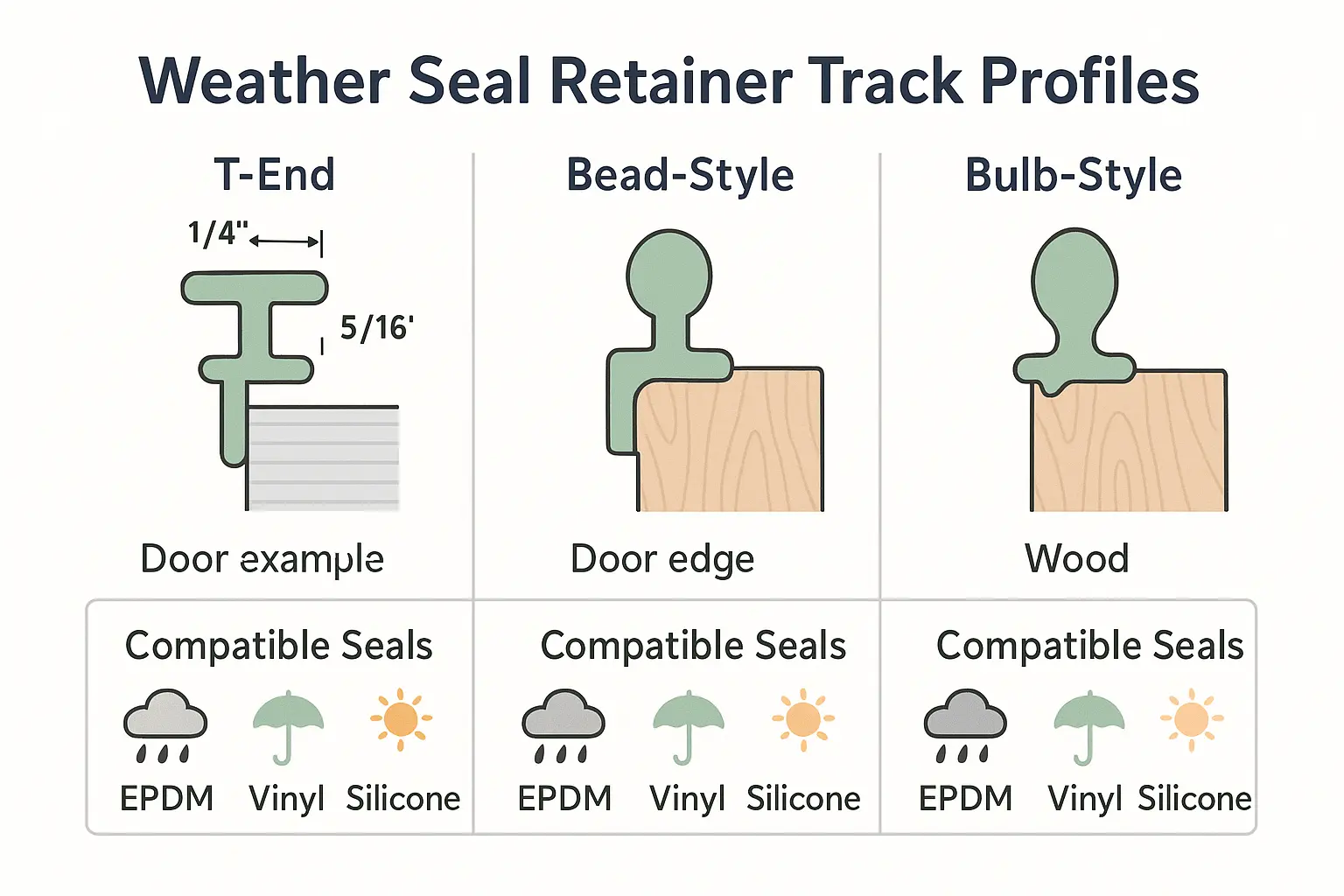
To ensure a perfect fit, match your existing aluminum retainer profile (T-End, Bead-Style, or Bulb-Style) precisely.

A side-by-side visual comparison of common garage door bottom seal retainer profiles and compatible weatherseal materials, enabling precise part selection based on door type and climate.

When installing your seal, apply a silicone-based spray or soapy water to help the rubber slide easily into the aluminum channels. Never use petroleum-based lubricants (like WD-40), which corrode rubber and vinyl over time. Always leave a 1-inch overhang on both sides of the door. This allowance gives the weatherstripping room to shrink naturally in winter without pulling away from the corners.

Nylon vs. Steel Roller Upgrades


Worn-out rollers make a door run loudly and place extra strain on your automatic opener. When choosing a new garage doors roller type, upgrading from basic steel to high-performance nylon makes a dramatic difference.

Steel rollers are durable but noisy, requiring constant oiling and rusting quickly in damp environments. On the other hand, sealed precision nylon rollers (such as 6200-2RS bearings) reduce operational noise by up to 75% and are rated for 100,000 cycles under UL 325 guidelines.

If you want to silence your door without tackling dangerous tension-held brackets, use the Hinge-First Silence Strategy. You can resolve 90% of track noise by performing a garage door hinge repair and swapping only the top and middle rollers. This allows you to skip replacing the bottom rollers entirely, avoiding the high-tension bottom fixtures.

Bottom Roller Replacement via the Track-Bend Method


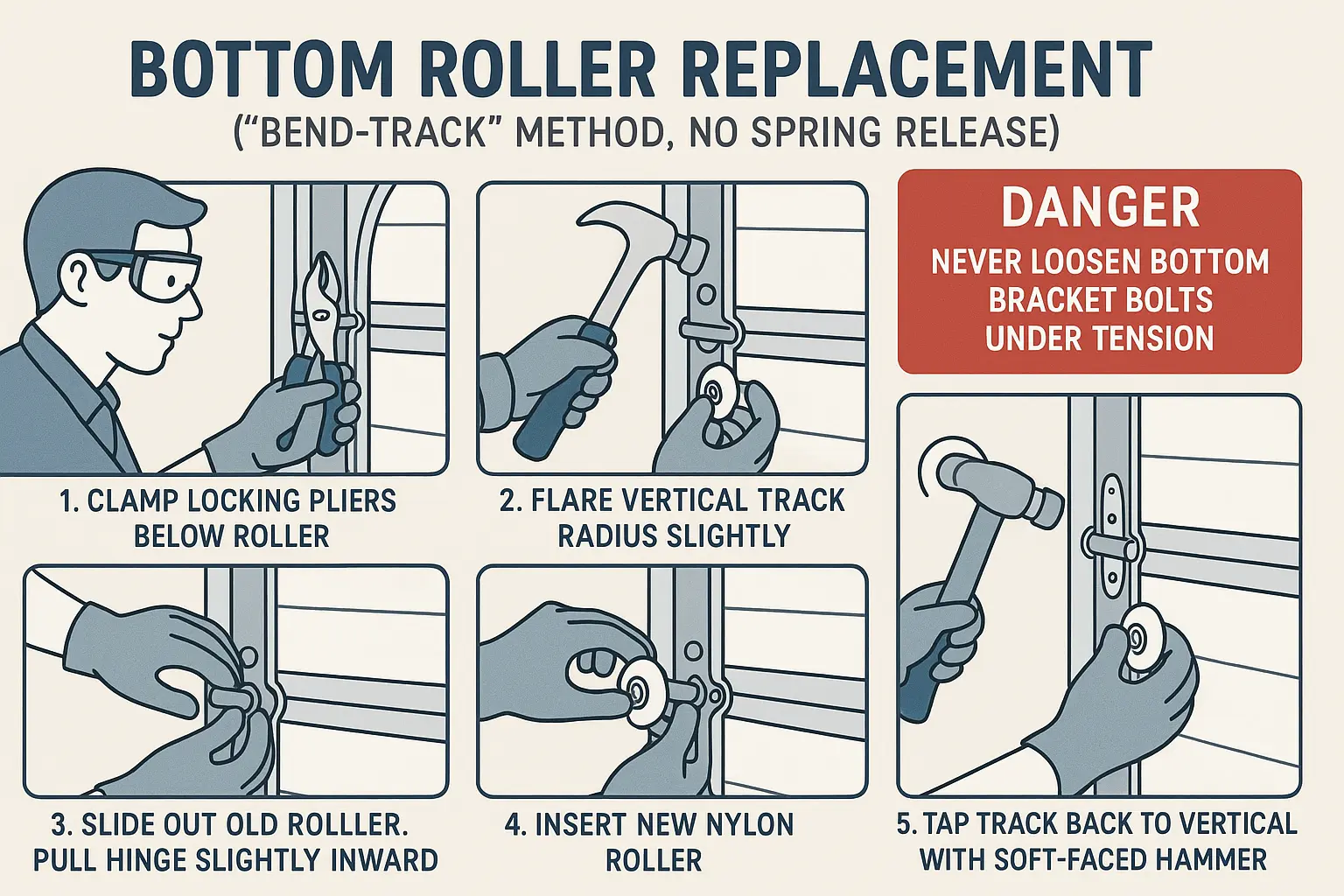
If you must replace a damaged bottom roller, never unscrew the bottom corner bracket while the lift cables are under tension. Doing so can release the spring’s stored energy instantly, causing serious injury. Instead, use this safe track-bending technique:

  1. Lock Out the Door: Clamp two locking vise-grip pliers directly onto the vertical track beneath the door to keep it firmly in place.
  2. Flare the Track: Use an adjustable wrench to gently flare open a small section of the vertical track’s curved lip.
  3. Swap the Roller: Align the bottom roller with this opening, pivot the roller stem out to swap it, and insert your new nylon roller.
  4. Restore the Alignment: Guide the roller back into the track and use a soft rubber mallet to tap the track lip back into its original vertical shape.

An illustrated safety-first process to replace a garage door’s bottom roller without releasing spring tension by carefully flaring and re-aligning the track.

If your rollers are worn or binding, scheduling a professional broken rollers repair ensures that your door retains proper garage door alignment without risking structural track damage.

Managing High-Tension Springs and Lift Cables


The springs and lift cables do the heavy lifting in your garage door system. Understanding the difference between a torsion spring vs extension spring setup is vital for understanding mechanical safety.

Extension springs run parallel to the horizontal tracks and store energy by stretching. If an extension spring snaps without a 3/32″ or 1/8″ galvanized steel safety cable threaded through its center, it can recoil violently. Clinical studies from the National Institutes of Health (NIH) show that unsafeguarded spring failures are a leading cause of severe ocular trauma and facial fractures.

Torsion springs, mounted on a bar above the header, handle significantly higher torque. Performing a garage door torsion spring winding adjustment requires specialized winding bars and professional training. If a lift cable snaps or your garage door cable has too much slack, the entire system can become unbalanced and fall. Keeping your tracks aligned under proper garage door track alignment standards prevents uneven cable wear and keeps the system running safely.

Frequently Asked Questions


Can I replace my lift cables without releasing spring tension?

No. Lift cables are under intense tension from either the torsion shaft or extension springs. Attempting to detach the cables or bottom brackets without winding down the springs can cause the cables to whip violently, leading to severe injuries and structural damage. If your cables are frayed, you should always book a professional garage door cable replacement near me service.

Why are sealed nylon rollers preferred over steel rollers?

Sealed nylon rollers feature a protective casing (like 6200-2RS ball bearings) that prevents dust, grit, and moisture from getting inside the bearings. This design eliminates the need for regular oiling, runs up to 75% quieter than steel, and lasts for up to 100,000 cycles, providing a much longer lifespan than unsealed steel options.

What should I do if my garage door cables are slipping off the drum?

Slipped cables are usually caused by uneven spring tension, worn-out cable drums, or a sudden obstruction that made the door close unevenly. If a cable slips, stop using your automatic opener immediately to prevent the door from falling or jamming. You will need a professional garage door drum replacement near me to rebalance the spring system and wind the cables safely back onto their drums.

Contact / Request a Call