Overhead Door Windlocks for Coastal Commercial Buildings: Engineering Guide


Published: Nov 5, 2026

During extreme coastal storm events, a commercial facility’s largest structural vulnerability is rarely its roof decking or exterior masonry—it is the overhead door opening. According to FEMA storm mitigation studies, overhead garage doors account for over 80% of major residential and commercial structural wind damage during severe hurricanes. When high-velocity coastal winds dislodge a door curtain, the resulting sudden internal pressurization combines with external negative wind suction, frequently leading to roof uplift and total building envelope failure.

Specifying high-performance windlock hardware is the primary mechanical defense against curtain dislodgement, transferring multi-ton lateral shear forces directly into building jambs. When configuring a heavy-duty commercial garage door for coastal environments, understanding the structural mechanics of windlocks is critical for protecting physical assets and ensuring regulatory compliance.
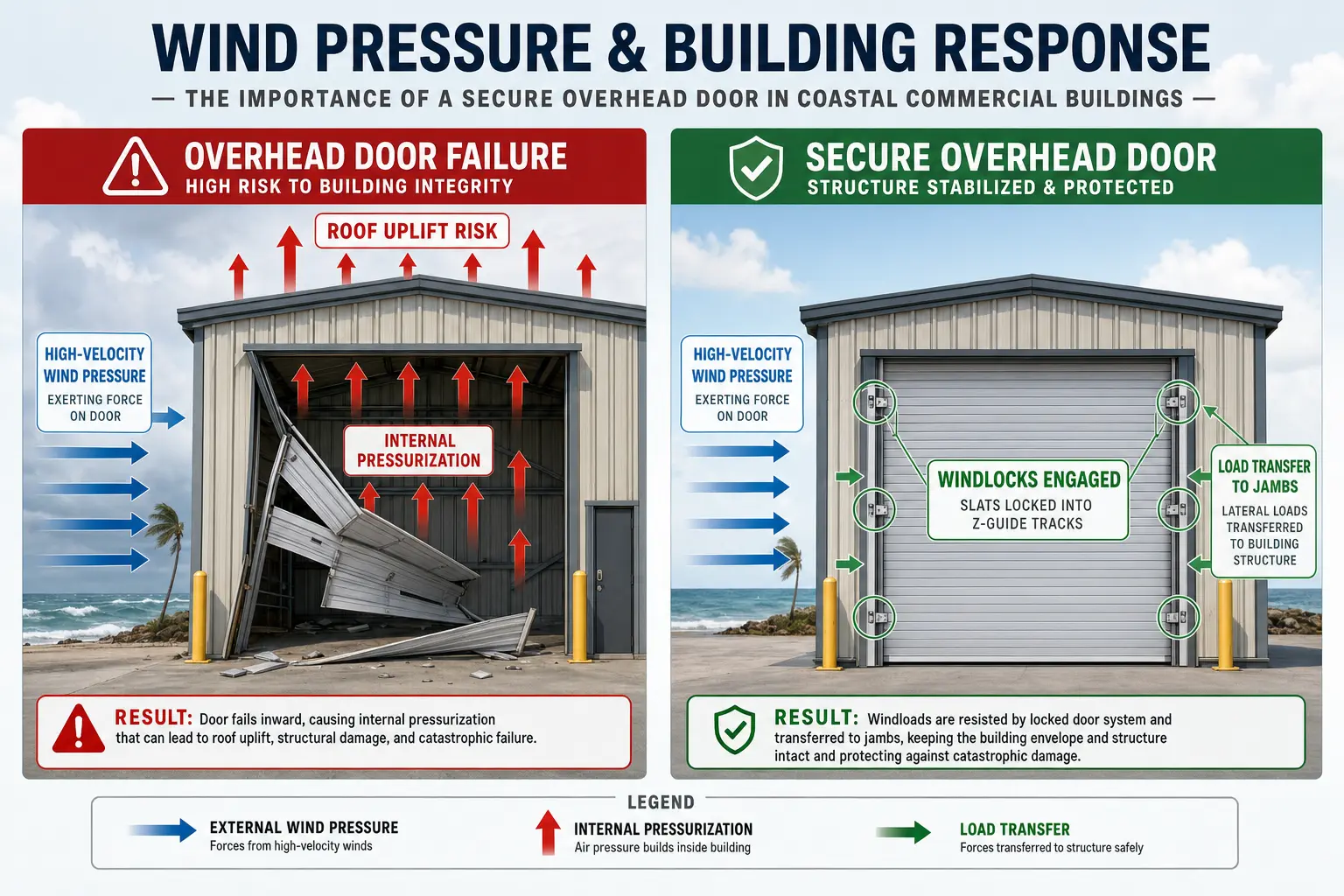
This diagram clarifies how failure of overhead doors during high coastal winds causes dangerous internal pressure leading to roof uplift, and how windlocks act as secure mechanical anchors transferring wind loads to the building structure.

Windlock Types & Mechanical Mechanics


Windlocks are heavy-gauge steel lugs, endlocks, or continuous retention assemblies riveted to curtain slats that slide inside deep-pocket structural guide tracks. Under normal operation, they move freely within the guide channel. Under wind load, the locks engage the track inner flange, flex-locking the curtain to withstand massive push and pull pressure.

Selecting the right hardware configuration depends on opening dimensions and design pressure (PSF) demands:

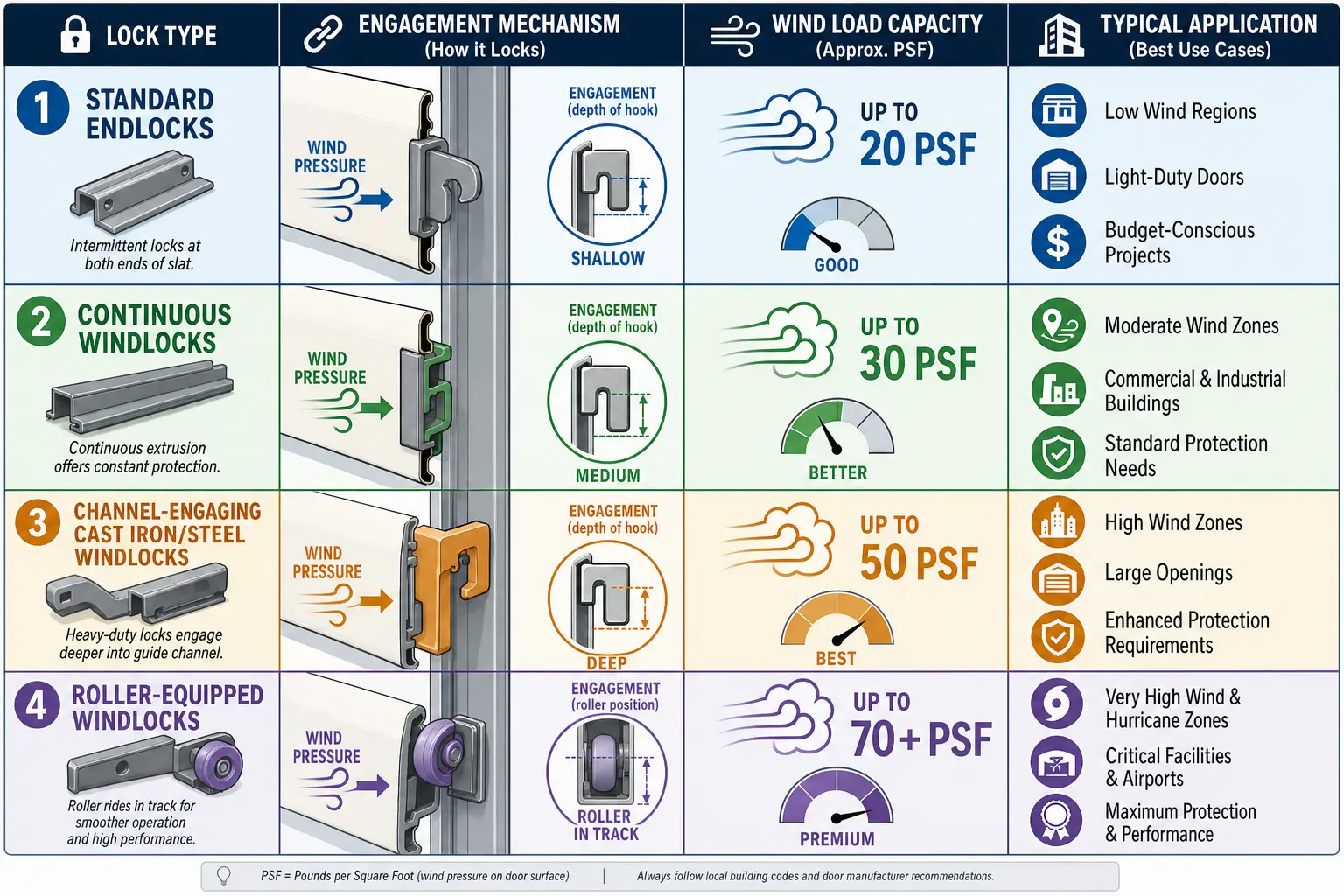
  • Alternating Standard Endlocks: Installed on every other slat, providing baseline alignment and light wind load retention (< 20 PSF) suitable for sheltered interior openings or low-wind inland zones.
  • Continuous Windlocks: Fixed to every single curtain slat. Continuous systems distribute lateral forces evenly along the vertical tracks, making them necessary for high-wind coastal environments.
  • Cast Iron / Ductile Steel Lug Windlocks: Heavy-duty hooked lugs engineered to lock into structural Z- or E-guide channels. Designed for extreme positive and negative design pressures (+80 to +120 PSF).
  • Roller-Equipped Windlocks: Incorporate smooth-rolling ball bearings into the lock mechanism. Ideal for high-cycle coastal logistics centers subject to persistent wind pressure, preventing track binding during motorized operation.

Ensuring proper garage door track alignment is vital; even minor misalignment under wind load can cause hardware binding or structural detachment. When selecting a heavy-duty roll up garage door, track depth and lock engagement geometry must match site-specific engineering requirements.

This comparison matrix breaks down the mechanical features and appropriate wind load capabilities of different overhead door windlocks, empowering facility managers and engineers to select the hardware best suited for coastal commercial buildings.

Still stuck? Get it fixed today.
24/7 emergency service from licensed local technicians.
Call (860) 362-3018

Building Codes, Testing Standards & Regulatory Compliance


Under ASCE 7-22 specifications for coastal Exposure Categories C and D, Components and Cladding (C&C) design pressure calculations routinely demand performance ratings from +50 to +120 PSF (Positive) and -60 to -140 PSF (Negative Suction), accommodating design wind speeds reaching up to 180+ MPH.

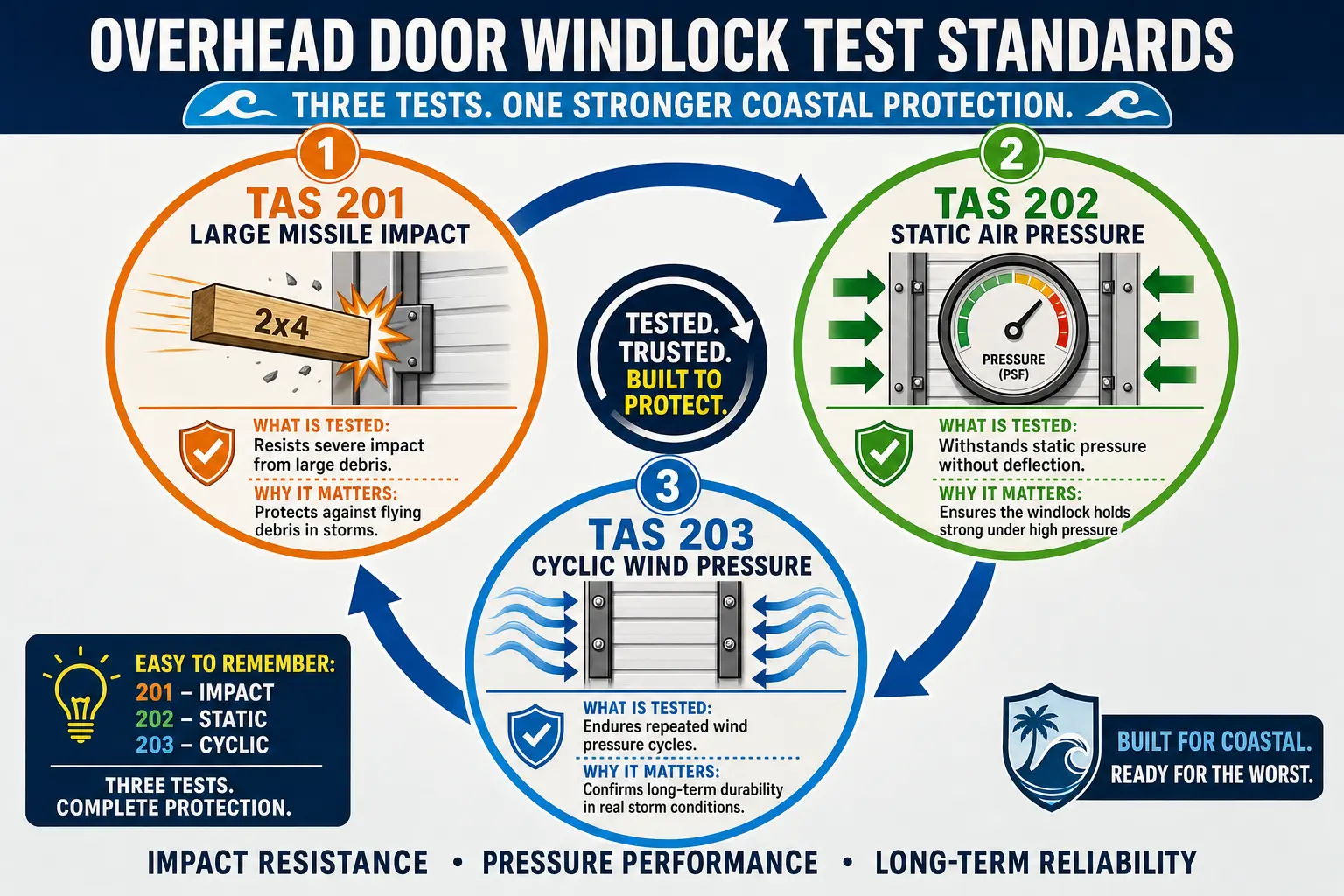
To meet High Velocity Hurricane Zone (HVHZ) requirements, such as Florida Building Code and Miami-Dade Notice of Acceptance (NOA) standards, door assemblies undergo three rigorous testing protocols:

  1. TAS 201 (Large Missile Impact Test): The assembly must withstand impacts from a 9-pound 2×4 wooden plank fired at 50 feet per second (34 mph) without curtain penetration.
  2. TAS 202 (Static Air Pressure Test): Evaluates structural load performance under uniform static pressure (per ASTM E330), requiring curtain deflection limits to remain under L/180 with a 1.5× structural safety factor.
  3. TAS 203 (Cyclic Pressure Loading Test): Subjecting the door to 9,000 cycles of alternating positive and negative pressure to ensure windlocks remain securely retained in guide tracks without material fatigue or fastener shear.

While horizontal reinforcements like garage door strut placement provide flexural stiffness for sectional doors, rolling steel curtains rely almost entirely on track-engaged windlocks to pass TAS 203 cyclic retention tests.

This infographic serves as a memory anchor by visually summarizing the key Miami-Dade HVHZ testing standards that overhead door windlock systems must pass to ensure wind protection and regulatory compliance.

Coastal Metallurgy: Combating Salt Air Corrosion


Coastal atmospheric environments contain high concentration levels of airborne sodium chloride that accelerate metal degradation. Standard G90 hot-dipped galvanized steel components often show red rust degradation after less than 250 to 500 hours of ASTM B117 salt fog exposure. Corroded windlocks freeze within tracks or fail at fastener points under load.

For long-term durability within 3,000 feet of saltwater:

  • 304 Stainless Steel: Suitable for moderate salt exposure, enduring 500 to 1,000 hours in ASTM B117 salt fog testing.
  • 316 Marine-Grade Stainless Steel: The gold standard for direct marine exposure, offering 1,000+ hours of salt fog resistance by incorporating molybdenum to resist pitting corrosion.
  • Zinc-Nickel Plated Rivets: Essential for fastening windlocks to slats, eliminating galvanic action between dissimilar metals.

Retrofit vs. Replacement ROI Analysis


Facility managers frequently evaluate whether retrofitting existing doors with windlocks is viable compared to complete door replacement.

Retrofitting is feasible only if existing structural jambs can accommodate deeper structural Z-guides, opening frames possess verified anchorage, and motor operators have sufficient horsepower to lift the added hardware mass. However, retrofitting standard doors rarely achieves certified NOA or FBC code compliance because the entire curtain-to-track assembly must be tested as a unit.

Investing in a factory-engineered, certified wind-load door system ensures code compliance while providing substantial commercial property hazard insurance premium reductions. Establishing routine commercial garage door repair schedules ensures windlock hardware and track clearances maintain their certified performance metrics year-round.

Frequently Asked Questions


Can you add windlocks to an existing non-wind-rated commercial rolling door?

While hardware can physically be riveted to existing slats, doing so does not yield a certified wind-rated door assembly. Certified wind ratings require tested combinations of specific slat profiles, track depths, windlocks, and structural jamb anchorages validated through laboratory pressure testing.

What is the structural difference between wind bars and windlocks?

Wind bars are rigid horizontal trusses or heavy steel angles mounted across sectional door panels to increase bending resistance. Windlocks are point-retention hardware attached to rolling steel slat ends that mechanically lock into guide tracks under wind load to prevent curtain pull-out.

How often should coastal commercial windlocks undergo physical inspection?

Coastal door systems require semi-annual inspections. Technicians inspect windlocks for salt-crust buildup, corrosion, cracked rivet heads, side-clearance tolerances, and track engagement depth to verify operational readiness before hurricane season.

Contact / Request a Call