Your Garage is Tougher on Lights Than You Think. Here’s How to Choose LEDs That Last.
Published: Jun 19, 2026
You flick the switch, and the familiar hum of your garage light is replaced by a sad, weak flicker. Or worse, nothing at all. If you’ve ever replaced a garage light bulb only to have it fail a year later, you’re not alone. It’s a common frustration, but the bulb might not be the real problem.
The real culprit? Your garage itself.
Uninsulated garages face a daily battle with fluctuating temperatures, condensation, and a constant barrage of dust. These aren't just minor inconveniences; they're silent killers for standard light fixtures. Before you buy another "super bright" LED that promises the world, it's time to understand the one feature that matters most for durability: its IP rating.
Think of it as a resilience score. Getting this right means you stop replacing lights and start enjoying a bright, reliable garage for years to come.
Foundation: IP Ratings Made Simple
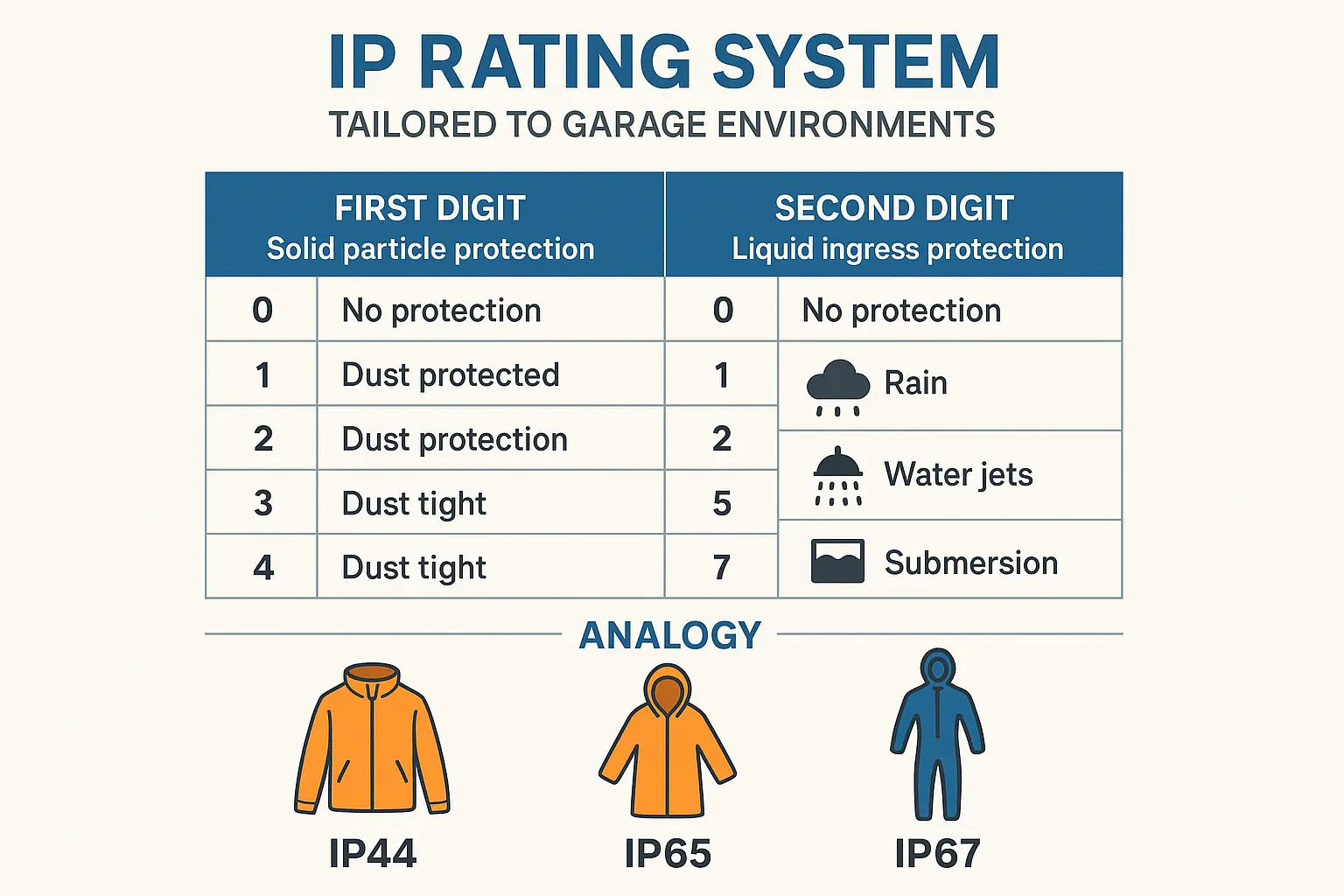
The two numbers after "IP" tell the whole story:
• First Digit (Solids): Rates protection against solid objects, from a finger (low rating) to fine dust particles (high rating). It ranges from 0 (no protection) to 6 (completely dust-tight).
• Second Digit (Liquids): Rates protection against moisture, from dripping water (low rating) to high-pressure jets or even full submersion (high rating). It ranges from 0 (no protection) to 8 (suitable for continuous submersion).
The easiest way to think about it is with an analogy:
• IP44 is like a windbreaker: It can handle a light splash or mist but won't hold up in a real downpour.
• IP65 is like a quality raincoat: It’s built to withstand being sprayed with a hose from any direction.
• IP67 is like a diving suit: It can be dropped in a puddle or temporarily submerged without any issue.
For a garage, a rating of "IP20" (common for indoor household lights) is an invitation for dust and moisture to get inside and destroy the sensitive electronics.
Building: The 3 Garage Killers (And How to Spot Them)
1. Moisture: The Difference Between Damp and Wet
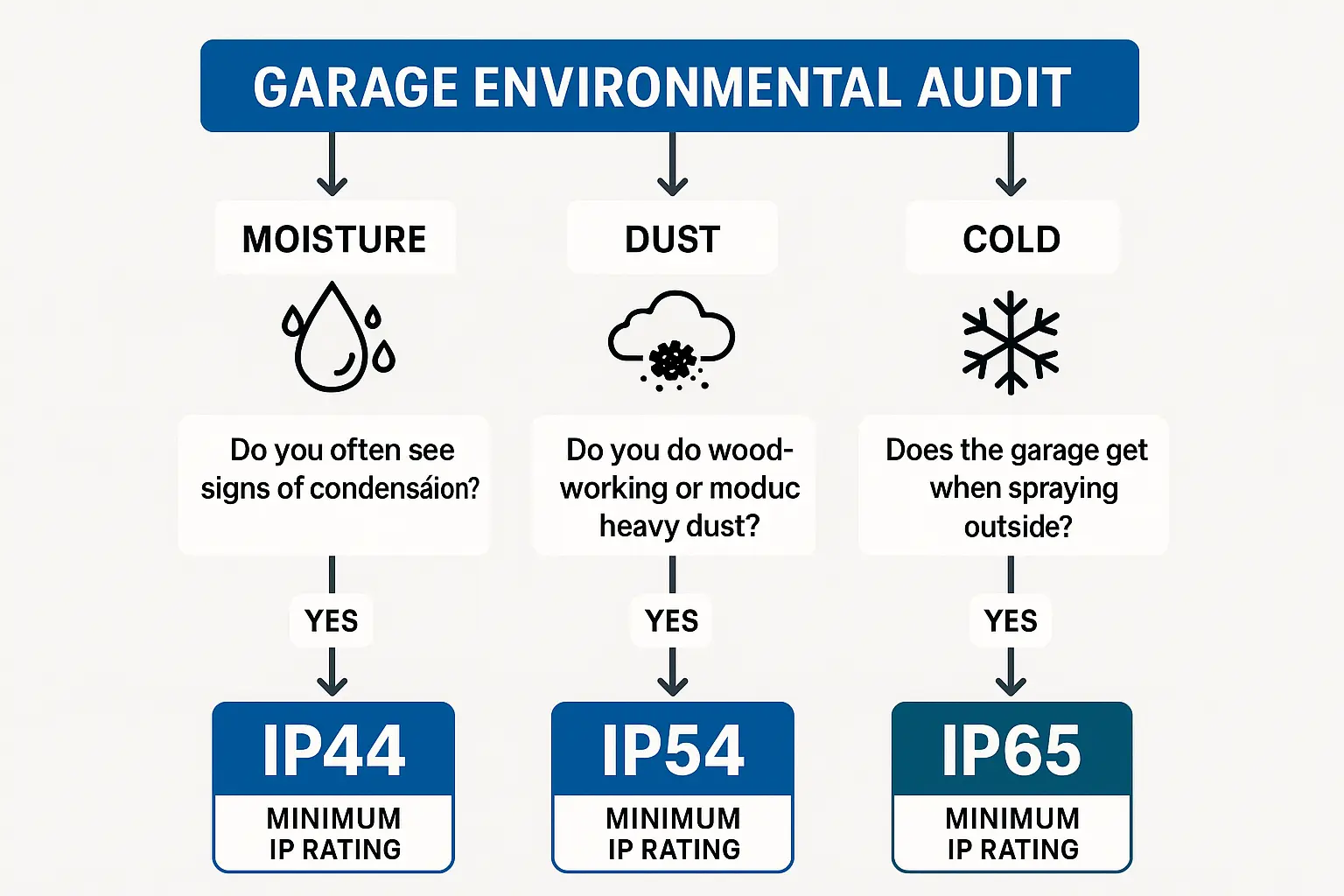
• Damp Conditions: Does your uninsulated garage get chilly in the winter? Do you see condensation forming on windows, tools, or the car? That's a damp environment. The air itself is heavy with moisture that can seep into unsealed electronics over time. For this, you need a light that is, at a minimum, damp-rated.
• Wet Conditions: This involves direct water contact. Do you wash your car inside the garage? Do you spray down the floors with a hose to clean them? This is a wet environment. A damp-rated light won't survive. You need a light with a high liquid IP rating (IPX5 or greater) that can handle direct water jets.
2. Dust: More Than Just a Nuisance
• Ambient Dust: Every garage has some level of dust from cars, storage, and the outdoors.
• Hobby Dust: If your garage is also your workshop for woodworking, sanding, or cutting drywall, you're dealing with a much bigger threat. Fine particulates can work their way into the tiniest crevices of an unsealed light, causing it to overheat and fail prematurely. For this, you need a light that is fully "dust-tight" (IP6X).
3. Cold: The LED's Surprising Advantage
Mastery: The Garage Audit & Recommendation Engine
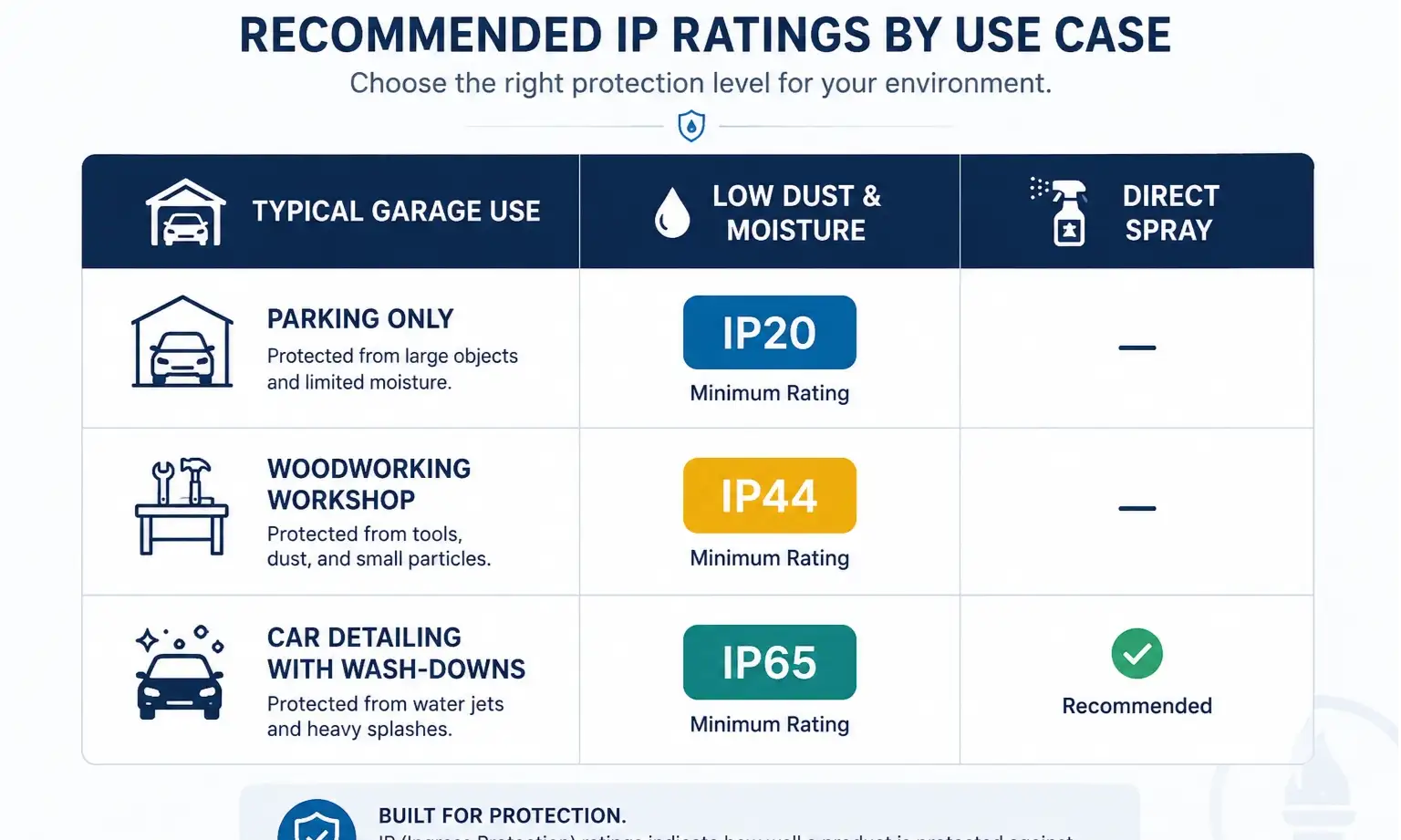
| Garage Use Case | Primary Hazards | Minimum IP Rating | Why It's the Right Choice |
|---|---|---|---|
| Simple Parking & Storage | Ambient Dust, Winter Condensation | IP44 | Protects against solid objects larger than 1mm and water splashes from any direction. Perfect for basic damp conditions. |
| DIY & Home Projects | Moderate Dust, Occasional Spills | IP54 | Offers enhanced dust protection while still handling water splashes. Good for a multi-purpose space. |
| Dedicated Woodworking/Metalworking | Heavy, Fine Dust, Condensation | IP64 / IP65 | IP6X is critical here. It's completely dust-tight, preventing overheating. The '5' for liquids handles moisture and cleanup. |
| Car Detailing & Wash Bay | High-Pressure Water Jets, Dust | IP65 | The '5' rating for liquids is non-negotiable. It ensures the fixture can withstand direct spray from a hose. |
| Ultimate Durability | All of the above, including floor washing | IP66 / IP67 | Built for powerful water jets (IP66) or temporary submersion (IP67). This is overkill for most but ideal for intense use. |
Action: Completing Your Lighting Plan
4. Select Fixture and Layout: Consider strip lights for even, whole-room coverage, or adjustable spotlights to focus on specific workbenches. A good plan often uses both. A well-thought-out layout can be enhanced with smart lighting solutions for your overhead garage door, adding convenience and security.
Frequently Asked Questions
What's the minimum IP rating I need for a garage?
Are all LED lights good for cold weather?
Do I really need a special light for my dusty workshop?
Can I connect my new lights to my garage door opener?
Your Path to a Brighter Garage
Upgrading your lighting is one of the most impactful improvements you can make. By putting durability first, you ensure your investment pays off for years to come. For more ideas on modernizing your space, learn how smart lighting for overhead garage doors can transform your daily routine.
You may also like