Forklift Struck Your Commercial Overhead Door: Section, Track, or Both?


Published: Nov 12, 2026

When a forklift mast or fork-blade collides with an overhead door, loading dock operations grind to a halt. In industrial logistics, loading dock doors account for 18% to 22% of all physical warehouse damage, making vehicle strikes a frequent operational crisis. Facility managers face an urgent technical and financial evaluation: replace the damaged door section, repair or realign the track assembly, replace both components, or invest in a full door replacement.

Making the right determination requires balancing mechanical integrity, safety compliance, and financial trade-offs—especially when dock downtime costs between $500 and $1,500 per hour per bay in delayed cross-docking and truck staging penalties.
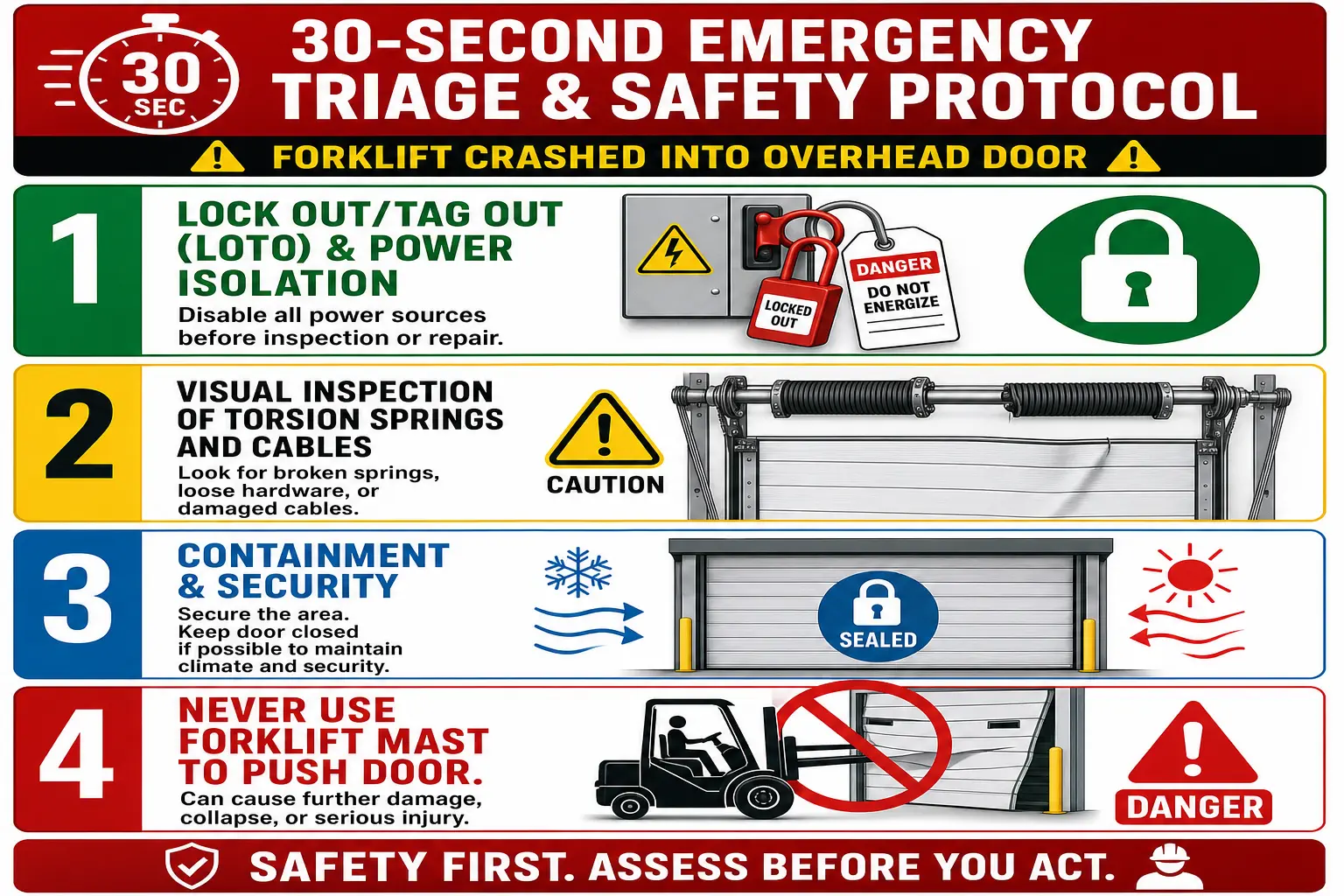
Immediate Action Protocol: 30-Second Safety & Triage Checklist


A concise safety checklist infographic guiding facility personnel through critical immediate actions to safely assess overhead door damage after a forklift impact. Prioritizing lockout and spring hazard identification reduces injury risks.

Before conducting a physical mechanical assessment, clear the area around the impacted bay and execute these triage steps to protect personnel:

  • Isolate Power (LOTO): Immediately apply Lockout/Tagout procedures to the electric operator to prevent automated cycling while components are dislodged.
  • Inspect High-Energy Hazards: Examine the counterbalance system. If torsion springs show gap displacement or lifting cables lose tension, structural equilibrium is compromised. Never handle components under high tension; schedule an immediate inspection for broken garage door springs before proceeding.
  • Prohibit Mechanical Force: Never attempt to force a jammed door open or closed using a forklift mast. Pushing buckled sections into bent tracks causes roller shearing and catastrophic cable snapping.
  • Contain the Environment: In food processing or cold-storage environments, apply temporary thermal curtains to protect interior climate zones while evaluating repairs.
Still stuck? Get it fixed today.
24/7 emergency service from licensed local technicians.
Call (860) 362-3018

Structural Damage Archaeology: Assessing Core Components


Identifying the full scope of structural damage requires evaluating three distinct hardware assemblies:

  1. Door Sections (Panels): Inspect internal reinforcing ribs, steel skins, and hinge mounting lines. Lower sections typically absorb direct impacts, which can crack insulation cores and dislodge roller brackets.
  2. Track Assembly: Check vertical track channels, wall mounting angles, and high-lift curve transitions. Even minor track crimping forces rollers out of alignment during operation.
  3. Hardware and Cable Balance: Check whether roller stems are binding within the track profile or if lifting cables have frayed. Damaged cables require prompt garage door cable replacement to prevent unbalancing the counterweight system.

The Decision Matrix: Replace Section, Track, Both, or Whole Door


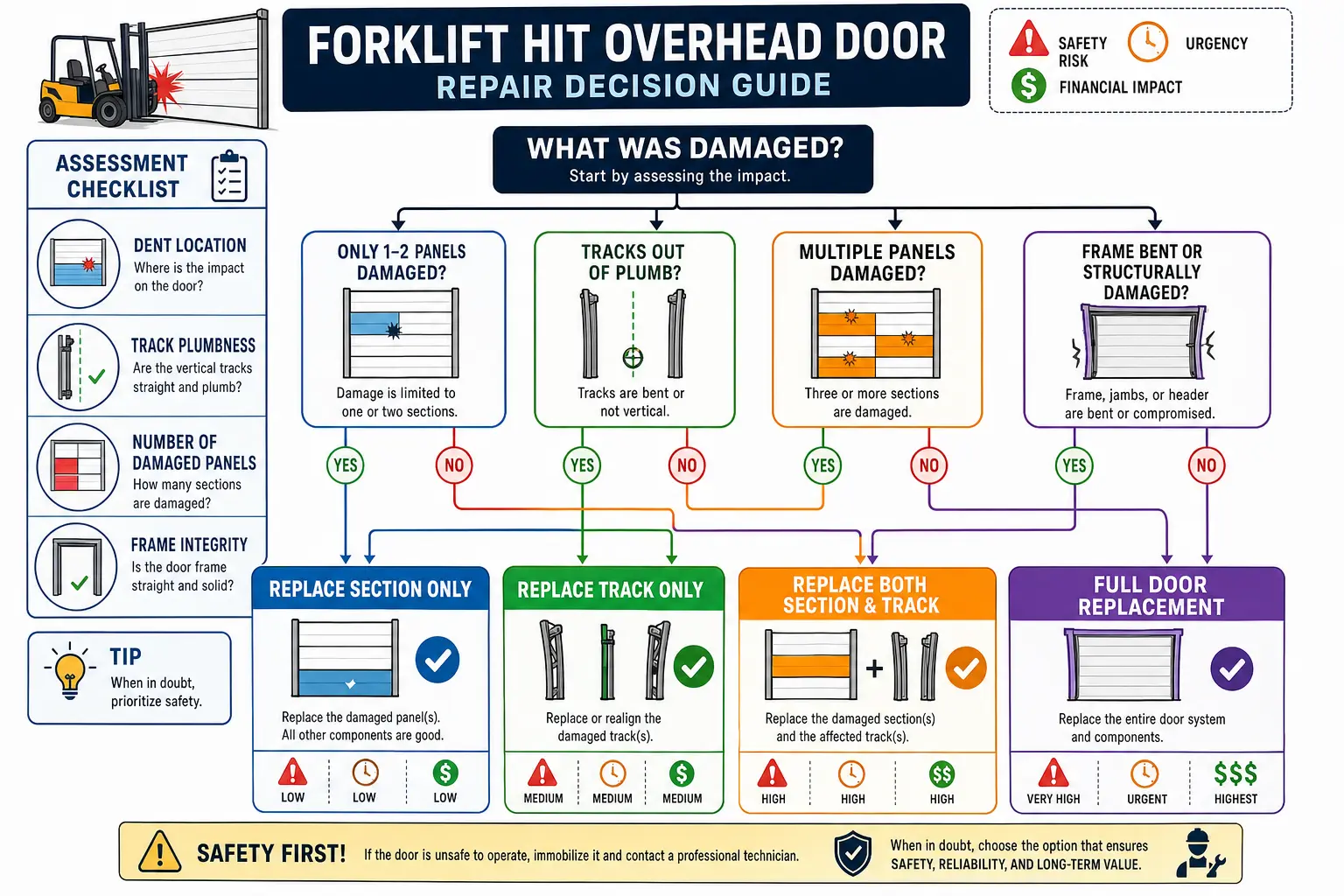
A step-by-step decision matrix flowchart helping facility managers quickly determine whether to replace door sections, tracks, both, or the entire overhead door after forklift impact. This visual simplifies complex evaluations for operational urgency.

Selecting the appropriate scope of work depends on hardware alignment tolerances and economic evaluation metrics:

  • Replace Section Only: Suitable when damage is confined to 1 or 2 panels, track plumbness is intact, and roller engagement remains stable. A targeted broken garage door panel replacement restores thermal seals and structural rigidity without disturbing functioning track infrastructure.
  • Replace Track Only: Applicable when fork blades crush a vertical track channel while door panels remain structurally sound. Performing targeted bent garage door track realignment or track segment replacement restores smooth roller travel.
  • Replace Both Section and Track: Necessary when direct mast collisions crush bottom panels and twist vertical tracks simultaneously. Forcing warped panels through misaligned tracks increases hardware friction, escalating total garage door off track repair cost.
  • Full Door Replacement (“The Two-Section Rule”): When 3 or more door sections suffer structural damage, replacement parts, freight costs, and field labor typically exceed 75% to 80% of a brand-new system. In these scenarios, a full garage door installation provides better long-term reliability and warranty coverage.

Mechanical Assessment and Safety Tolerances


According to DASMA Technical Data Sheet #154, track channel tolerances must be strictly maintained. If track channel constriction or web distortion exceeds 1/8 inch (3.17mm), roller binding probability increases by 85%. Operating damaged doors beyond this threshold risks sudden cable derailment and violates workplace safety compliance.

Hinge pin play and panel skin delamination also reduce horizontal structural load performance. Integrating routine garage door tune up inspections into maintenance schedules helps detect subtle alignment shifts before operational breakdowns occur.

Cost, Labor, and Operational Downtime Comparison


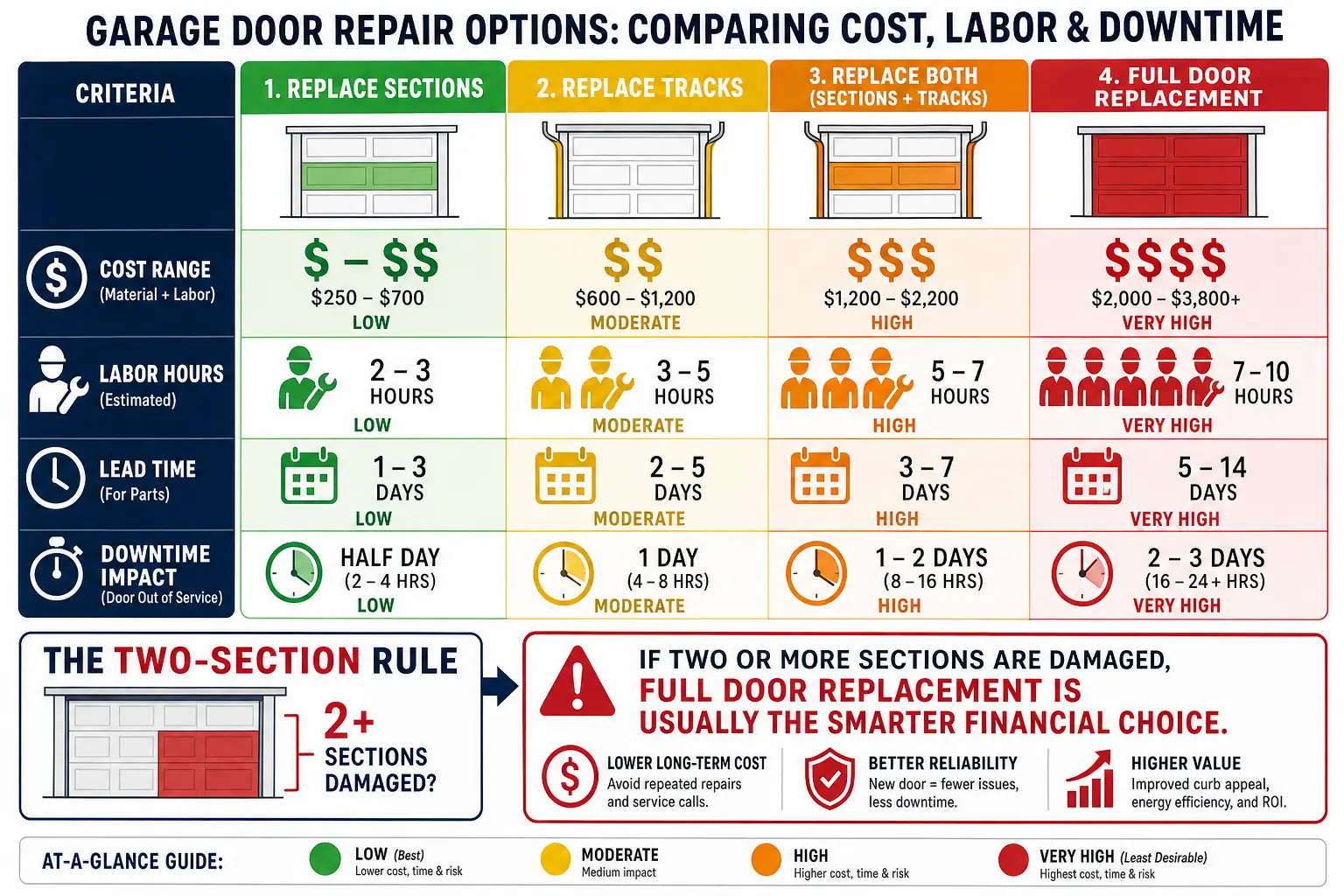
A visual cost and downtime matrix providing facility managers a quick reference to evaluate financial and operational impacts of different repair options after forklift damage, emphasizing the critical 'Two-Section Rule'.

Understanding financial trade-offs helps facility directors select repair strategies that balance budget constraints with operational timelines:

  • Track Replacement ($350–$900): Low material expenditure, 2–4 labor hours, minimal dock interruption.
  • Single/Double Panel Replacement ($600–$1,800): Moderate cost, short component lead time, restores environmental seals.
  • Section & Track Combined Repair ($1,200–$2,800): Comprehensive resolution for moderate impacts, completed within a single work shift.
  • Full Door Assembly Replacement ($3,500–$12,000+): Recommended when multiple sections fail, structural frame racking occurs, or OEM panels are discontinued.

For complex facility challenges, reviewing our resource on commercial garage door repair delivers deeper operational guidance.

Preventative Engineering: Stopping Repeat Impacts


Eliminate recurring loading dock collisions by adopting targeted protection systems:

  • Heavy-Duty Track Guards: Floor-anchored steel column protectors absorb low-level impacts, shielding vulnerable vertical tracks.
  • Full-Height Continuous Angle Mounts: Replace standard bracket-mounted tracks with heavy-gauge continuous steel angles for superior impact resistance.
  • Impactable Knockout Doors: Breakaway panel designs release from tracks upon direct collision and snap back into place within minutes, avoiding structural damage and section replacement costs.

Restoring Dock Operations Safely


Forklift collisions require clear mechanical diagnostics to protect facility personnel, minimize bay downtime, and control repair expenditures. Applying structured triage protocols, checking engineering tolerances, and leveraging the Two-Section Rule enables operations leaders to make sound repair decisions. Partnering with experienced commercial door specialists ensures loading bays remain efficient, safe, and fully operational.

Frequently Asked Questions


Can we temporarily run the door on a manually straightened track?

No. Hammering or bending track channels leaves internal micro-imperfections. Deflections greater than 1/8 inch bind rollers, stress cables, and create operational safety hazards under heavy daily use.

How do I find the manufacturer model number on a commercial overhead door?

Locate the metal data tag riveted to the interior face of the bottom section or end stiles. This plate lists the manufacturer name, model series, and serial number required to source matching replacement sections.

Does property insurance cover commercial door forklift strikes?

Most commercial property and general liability policies cover building equipment damage caused by internal vehicle strikes. Document structural damage immediately with photographs and detailed repair estimates prior to starting service work.

Contact / Request a Call