How to Describe Your Garage Door Problem on the Phone for a Faster Fix


Published: Oct 16, 2026

When your garage door fails, picking up the phone is usually the fastest path to a solution. However, the five minutes before you dial determine whether a technician resolves your problem on trip number one or leaves you waiting for a backordered part. Industry dispatch data reveals that accurate phone triage reduces repeat service visits by up to 34%, saving homeowners an average of $85 to $150 in secondary labor fees.

Because nationwide garage door repair costs typically range from $150 to $350, vague symptom descriptions often cause phone quotes to vary by up to 200% upon technician inspection. By mastering a few key technical terms and observing basic visual cues, you can guarantee the dispatcher sends the right specialist equipped with the exact inventory needed.
The 60-Second Pre-Call Diagnostic Checklist


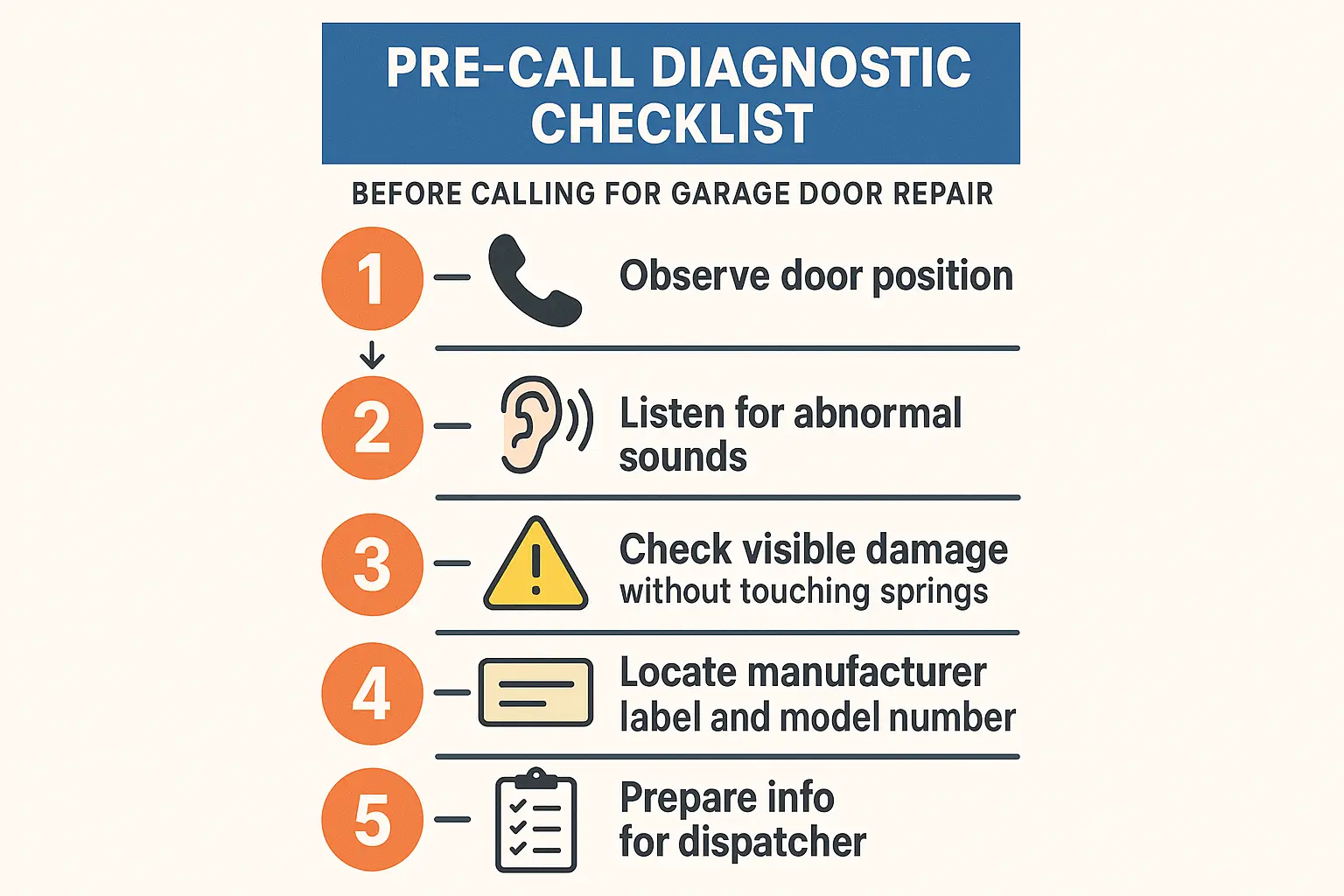
This 5-step pre-call checklist empowers homeowners to gather essential details safely and effectively before calling garage door repair, enabling faster and more accurate service dispatch.

Before placing your call, conduct a quick safety-first inspection from inside the garage. Never attempt to adjust mechanical components yourself; high-tension springs exert between 200 and 500 pounds of torque and pose severe injury risks. Instead, take 60 seconds to gather these details:

  1. Identify the Motor Unit: Look at the motor housing mounted to your ceiling to note the manufacturer brand (LiftMaster, Chamberlain, Genie) and drive system (belt, chain, or screw). If the label is faded or painted over, learn how to identify unknown garage door opener models visually.
  2. Check Door Dimensions & Material: Is it a single-car (8-9 ft) or double-car (16 ft) door? Is it steel, wood, or insulated composite?
  3. Observe Physical Position: Is the door stuck fully open, closed, or crooked halfway along the track?
  4. Listen for Motor Activity: Does the opener motor hum, click rapidly, or remain completely silent when triggered?

The 'Symptom-to-Technician' Translation Table


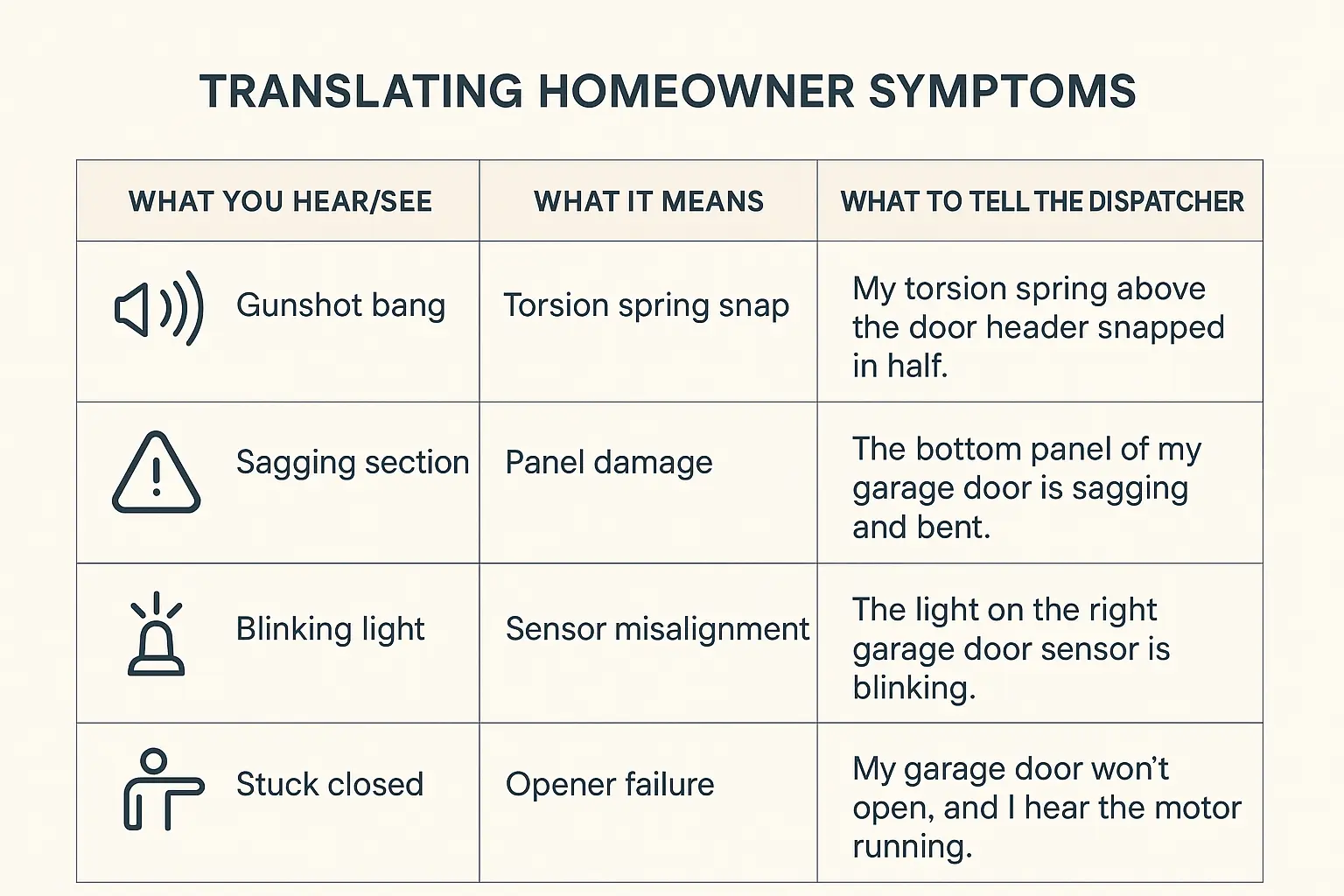
This translation table demystifies garage door symptoms, empowering homeowners to use accurate terminology and clear descriptions, resulting in faster, precise technician dispatch and repair estimates.

Translating layperson observations into technical dispatch vocabulary ensures the service vehicle carries matching replacement hardware. High-tension spring failures represent roughly 45% of all residential calls, while safety sensor issues account for 22% and broken lift cables comprise 15%.

  • Symptom: A loud “gunshot” sound from inside the garage; the door refuses to open.
  • Technical Term: Broken Torsion Spring.
  • What to Tell Dispatcher: “My torsion spring mounted on the bar above the door frame snapped in half.” Understanding proper garage door torsion spring winding explains why professional installation is critical.
  • Symptom: Door reverses immediately upon touching the floor, and the opener light flashes 10 times.
  • Technical Term: Safety Sensor Misalignment or Obstruction.
  • What to Tell Dispatcher: “The photo-eye safety sensors at the base of the track are out of alignment or flashing an error code.” Verify if your garage door safety sensor not working issue requires cleaning or rewiring.
  • Symptom: Motor housing hums or clicks, but the door panels do not move.
  • Technical Term: Stripped Drive Gear or Disengaged Trolley.
  • What to Tell Dispatcher: “The motor runs, but the drive gear isn’t engaging the chain.” Review why a garage door clicks but won’t open to describe the sound accurately.
  • Symptom: Door hangs crookedly, and steel rollers popped out of the side rails.
  • Technical Term: Off-Track Door / Cable Derailment.
  • What to Tell Dispatcher: “The cable came off the drum, causing an off-track door.” Inquire about realistic garage door off track repair cost factors and how professionals safely fix garage door off track conditions on the first visit.
  • Symptom: Frayed or snapped steel wire hanging near vertical tracks.
  • Technical Term: Snapped Lift Cable.
  • What to Tell Dispatcher: “I have a broken lift cable on the left/right side.” Spotting early garage door cable problems prevents secondary track distortion.

Emergency Triage vs. Standard Scheduling


Not every mechanical fault requires an immediate after-hours dispatch fee. If your vehicle is trapped inside or your home is unsecure with a door stuck wide open, requesting an immediate emergency garage door repair dispatch is necessary. However, if the door is resting securely in the down position and you can park outside, scheduling a standard weekday appointment avoids emergency call-out surcharges.

5 Questions to Ask the Dispatcher Before Booking


Protect your property from call centers that outsource to untrained subcontractors by asking these five screening questions:

  1. Is your service diagnostic call fee credited toward total repair labor costs?
  2. Are your technicians direct, background-checked employees, fully licensed and insured?
  3. Does the service vehicle carry standard OEM torsion springs and drive belts on board?
  4. What written parts and labor warranty accompanies this repair?
  5. Will the technician provide a firm written estimate before starting any work?

Frequently Asked Questions


Why do phone quotes vary so much from final on-site costs?

Initial phone estimates reflect baseline labor fees. If crucial details—such as door weight, wire size, or opener drive type—are missing during the call, the technician must adjust part costs upon physical inspection to match your specific door specs.

Can I operate my garage door manually if the spring breaks?

No. High-tension springs balance the door’s heavy weight. Attempting to lift a 150-300 lb door manually without functional springs risks personal injury and will damage your opener’s internal gear system.

What information does a dispatcher need to send the right replacement parts?

Dispatchers require your opener brand, door dimensions (height and width), door construction material, and whether your system uses top-mounted torsion springs or side-mounted extension springs.

Contact / Request a Call