When choosing replacement rollers, material quality determines how quiet your door will run and how many years the system will last.
- Plastic (No Bearings): Rated for 1,000–3,000 cycles (~2-3 years). These budget rollers quickly develop flat spots under summer heat, causing them to slide rather than roll.
- Steel (Exposed 10-Ball Bearings): Rated for 5,000–7,000 cycles (~5-7 years). They are highly durable but prone to rust and require frequent oiling.
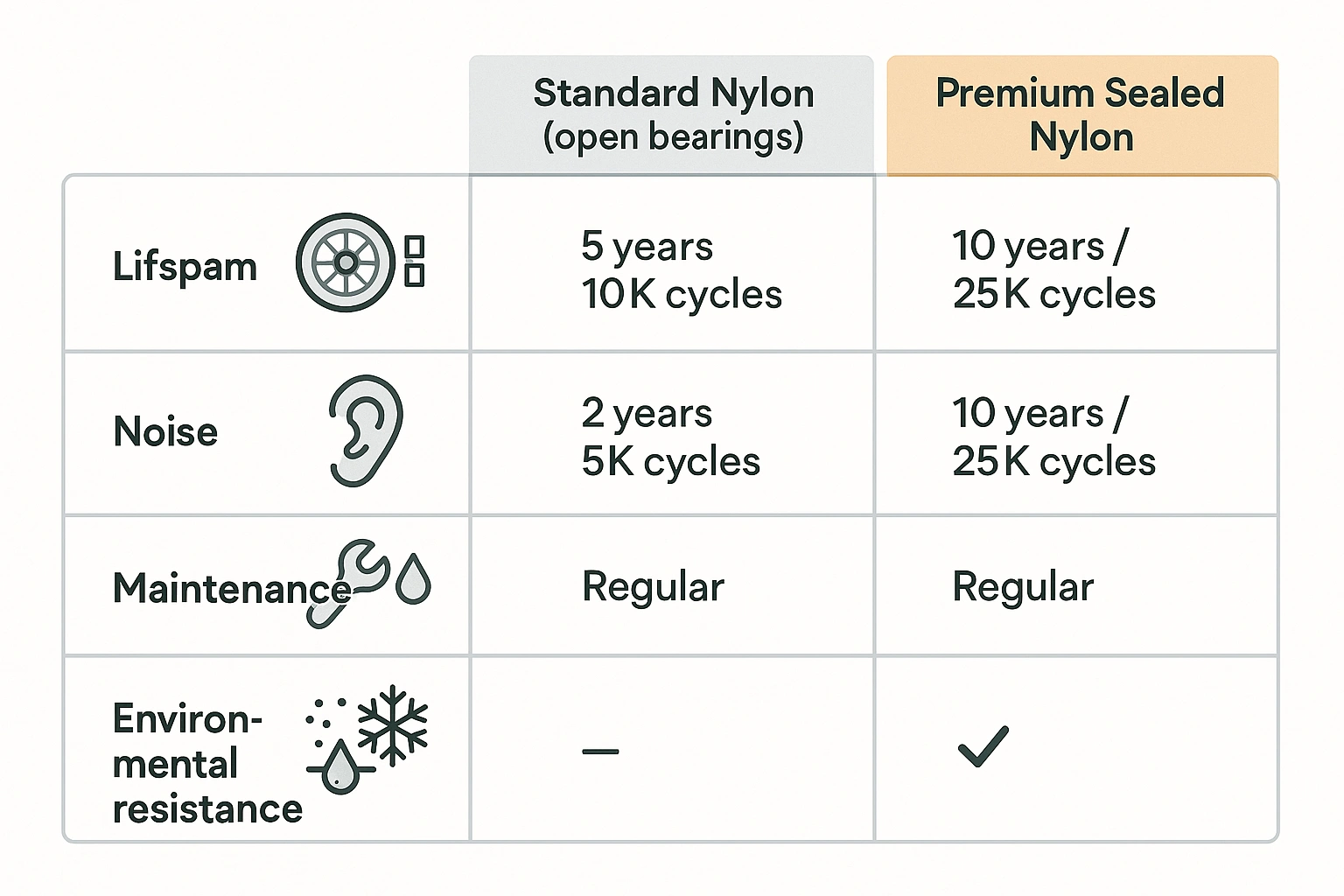
- Nylon (Exposed 10-Ball Bearings): Rated for 10,000–15,000 cycles (~10-15 years). These offer a quieter operation but leave the bearings vulnerable to dust and grit.
- Nylon (Premium 13-Ball Dual-Sealed Bearings – 6200ZZ or 6200-2RS): Rated for 20,000–100,000 cycles (~20-50 years). These are maintenance-free, waterproof, and run whisper-quiet.
The true secret to longevity lies in the bearing design. Open bearings allow dust and moisture to grind down the internal steel spheres. In contrast, dual-sealed rubber bearings (2RS) protect the lubricating grease from the elements, increasing roller lifespan by up to 600% in humid or coastal climates. Furthermore, in sub-zero winter temperatures, exposed-bearing steel rollers can freeze up, whereas sealed nylon rollers continue to spin smoothly.
Reviewing these material differences helps you identify when to replace garage door rollers before they lock up entirely and damage your tracks.