Commercial Door Operator Duty Cycle: Continuous vs. Intermittent Ratings & Sizing Guide


Published: Nov 10, 2026

Selecting a commercial door operator based solely on motor horsepower frequently leads to unexpected downtime and premature equipment failure. Industry data reveals that over 65% of commercial operator thermal shutdowns occur because facility specifiers size equipment based on average daily cycles rather than peak hourly throughput (DASMA 102). When loading dock or parking structure traffic surges, an improperly matched operator accumulates heat faster than it can dissipate, triggering safety lockouts that halt operations.

Evaluating continuous versus intermittent duty ratings requires looking beyond surface-level specifications. Understanding the underlying thermal mechanics, motor architectures, and duty cycle dynamics ensures your facility maintains uninterrupted workflow while optimizing capital investment.
Thermal Physics: Intermittent vs. Continuous Motor Architecture


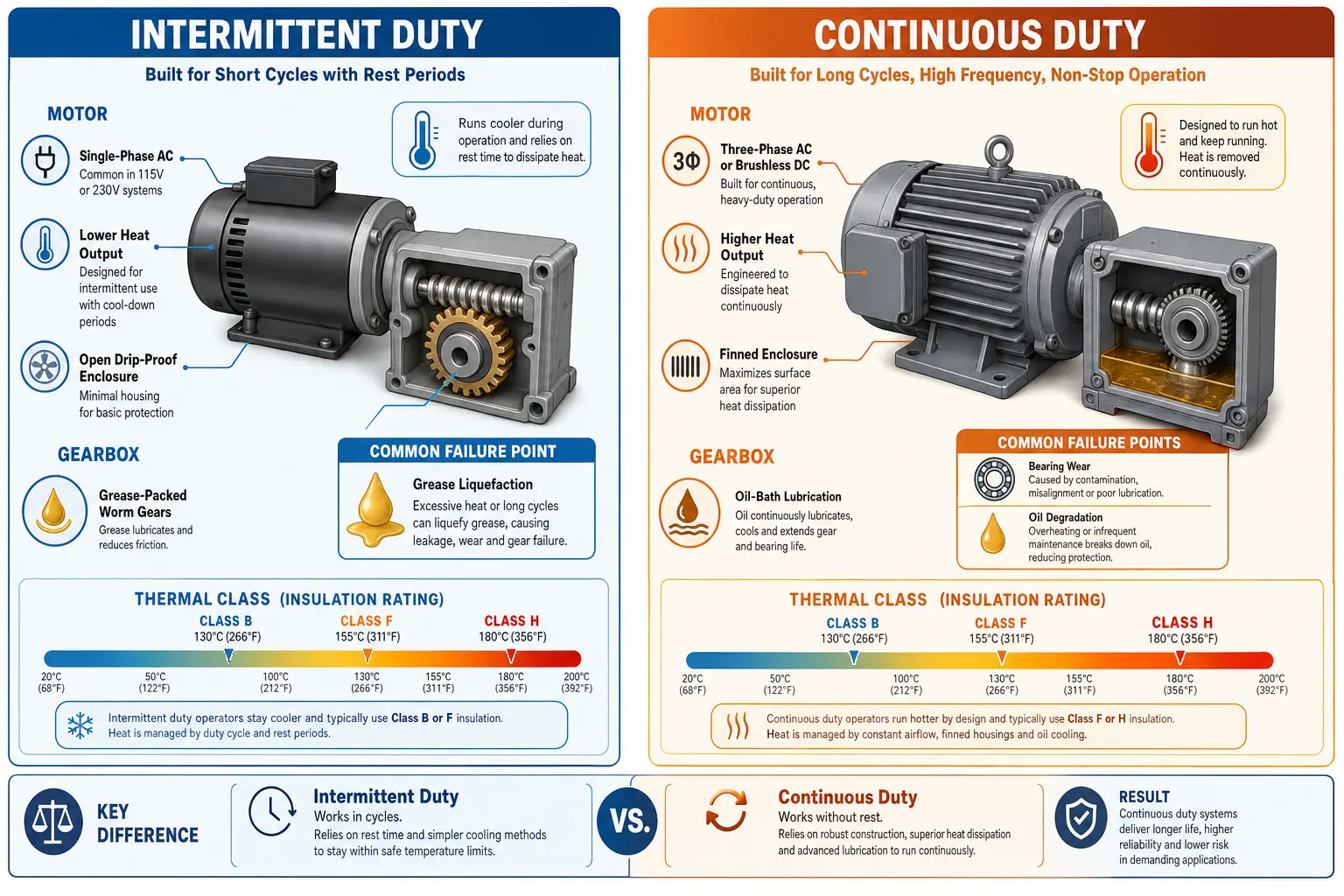
Visualizing how thermal design and motor architecture differentiate intermittent single-phase operators from continuous three-phase or brushless DC models, explaining why continuous duty models handle more cycles and higher heat loads.

The operational divide between intermittent and continuous duty operators lies in thermal dissipation and component engineering. Under IEC 60034-1 standards, intermittent duty motors (S3 rating) are designed for periodic operation with built-in rest periods. They typically feature single-phase AC power, Class B (130°C) motor winding insulation, and grease-packed worm gearboxes. Under continuous cycling, gearbox temperatures can exceed 95°C, causing grease saponification, oil separation, and rapid gear tooth erosion within 12 to 18 months.

Continuous duty models (S1 rating) are engineered for uninterrupted operation. Built with Class H (180°C) insulation, heavy finned cast housings, and continuous oil-bath gear reducers, these units maintain thermal equilibrium under constant load. Furthermore, continuous duty operators utilizing three-phase power draw up to 30% less current under load compared to single-phase equivalents (IEEE standards). This significant reduction in current draw minimizes internal resistive heating, protecting winding varnish and extending total equipment lifespan.

Still stuck? Get it fixed today.
24/7 emergency service from licensed local technicians.
Call (860) 362-3018

Commercial Duty Classification Matrix


To size an operator correctly, facility managers must map operational demand against standard motor specifications:

  • Light Duty: Rated for 7–10 Cycles Per Hour (CPH) and a maximum of 25 cycles per day. Utilizes single-phase AC motors with Class B insulation. Designed for low-traffic storage bays.
  • Medium Duty: Rated for 12–15 CPH and 50–80 cycles per day. Utilizes single or three-phase power with Class F (155°C) insulation. Suitable for standard commercial warehouses with predictable traffic.
  • Heavy Duty: Rated for 15–25 CPH and 100–200 cycles per day. Features three-phase AC drives and hardened gear trains for active logistics facilities.
  • Continuous Duty: Rated for 25–80+ CPH and unlimited daily cycling. Powered by three-phase AC or Brushless DC (BLDC) motors paired with oil-bath gearboxes. Essential for high-frequency distribution centers and parking structures.

When evaluating what size garage door opener do i need, selecting the appropriate duty classification takes precedence over mechanical horsepower alone.

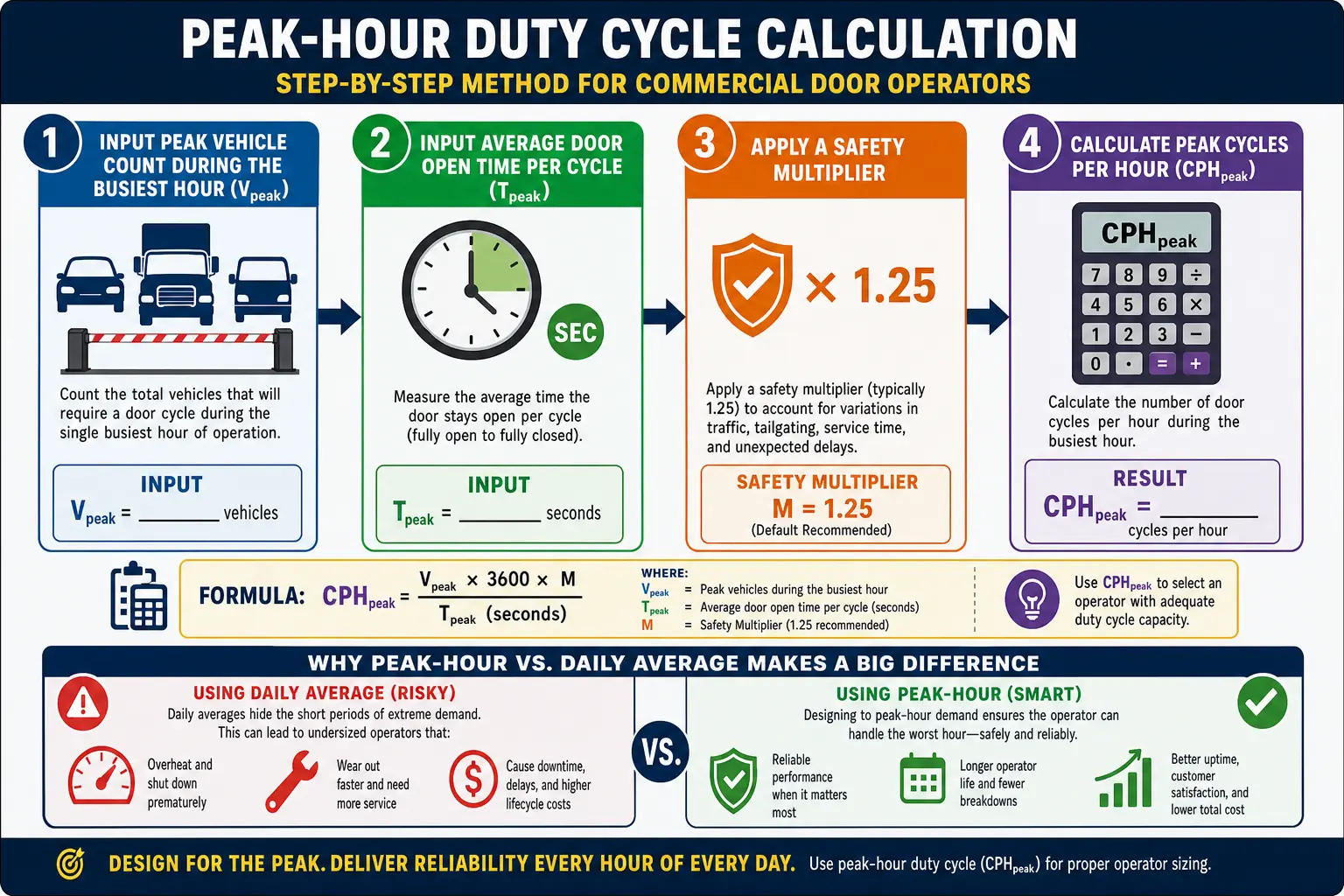
The Peak-Hourly Duty Cycle Calculation Methodology


Breaking down the peak-hour duty cycle formula stepwise to show facility managers and specifiers how to accurately size door operators for real-world high-traffic conditions.

Relying on daily cycle averages masks operational spikes that cause motor failure. Specifiers should calculate duty requirements using peak hourly demand adjusted for environmental variables:

$$text{CPH}{text{peak}} = left( frac{V{text{peak}}}{T_{text{peak}}} right) times text{SF}$$

Where $V{text{peak}}$ represents maximum vehicle passes during the busiest shift window, $T{text{peak}}$ is the duration of that window in hours, and $text{SF}$ is the environmental Safety Factor (1.0 for ambient indoor environments; 1.2 to 1.4 for high-wind exposure or cold storage differentials). If your calculated peak throughput exceeds 15 cycles in any 60-minute window, specifying a continuous duty operator is vital to avoid thermal overload lockouts.

Failure Modes of Underspecified Operators


Installing an intermittent operator in a continuous application creates a chain reaction of mechanical and electrical degradation:

  1. Thermal Overload Lockout: As motor windings exceed operating thresholds, the bimetallic thermal protector trips. According to NEMA MG-1 standards, thermal recovery requires a mandatory 15 to 45-minute cooldown period, stopping loading dock traffic.
  2. Gearbox Shear: High thermal cycles liquefy standard gear grease, leading to metal-on-metal friction and stripped drive gears.
  3. Brake Slippage and Glazing: Frequent cycling creates thermal expansion in mechanical brakes, leading to pad glazing, door drift, and safety hazard lockouts.

When duty cycles exceed original equipment specifications, professional garage door opener repair services are necessary to diagnose motor winding degradation and mechanical drive failure before total operational shutdown occurs.

Economic ROI & Total Cost of Ownership (TCO) Decision Matrix


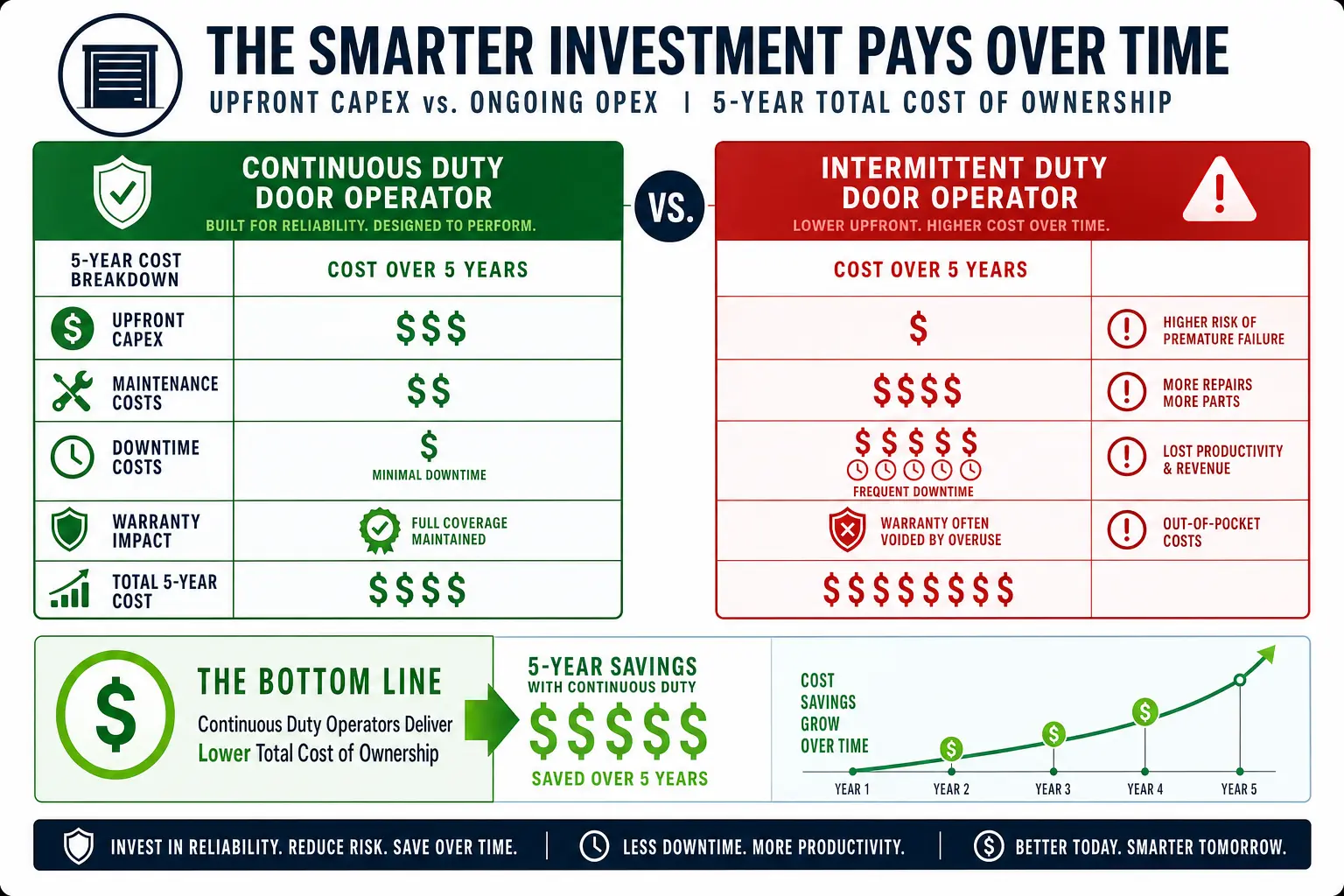
Visual memory aid clarifying how investing more initially in continuous duty operators pays off through reduced downtime and maintenance, helping facility managers justify purchases to finance teams.

While continuous duty operators require a 30% to 50% higher upfront capital investment, their 5-year Total Cost of Ownership (TCO) is substantially lower than intermittent alternatives. Avoiding just one peak-hour thermal shutdown per year offsets the initial price differential by preventing lost worker productivity, delayed freight schedules, and emergency service calls.

Frequently Asked Questions


How does three-phase power extend commercial operator life?

Three-phase power delivers continuous smooth torque without relying on start capacitors. It reduces operating current draw by up to 30%, which minimizes internal heat accumulation, protects motor winding varnish, and allows the operator to maintain continuous duty performance without thermal breakdown.

Why do intermittent door operators trip during peak shifts?

Intermittent operators rely on idle time to dissipate motor winding heat. During peak shifts, back-to-back cycling causes thermal energy to accumulate faster than the housing can dissipate it. This triggers the bimetallic thermal overload protector, forcing a mandatory 15 to 45-minute system cooldown.

Can variable speed DC motors increase an operator's duty cycle?

Yes. Brushless DC (BLDC) motors utilizing variable-speed drives feature soft-start and soft-stop profiles. This design eliminates high electrical inrush spikes and mechanical shock loads, dramatically reducing thermal stress and enabling high cycle counts without thermal breakdown.

Contact / Request a Call