When rainy weather hits, many homeowners discover their natural wood garage doors sticking, shuttering, or refusing to close. This operational friction isn’t just an inconvenience—it puts immense stress on your entire door assembly and opener motor. Understanding the relationship between wood physics and mechanical door tolerances allows you to solve the root problem without damaging your door.
Wood Garage Door Swelling in Wet Seasons: Sticking and Binding
Published: Nov 3, 2026
The Anatomy of Seasonal Wood Door Binding
Natural wood is inherently hygroscopic, meaning it continuously absorbs and releases moisture from ambient air. When relative humidity rises above 60% or direct rain strikes unsealed panels, wood moisture content (MC) increases. Ideal exterior garage door MC ranges between 9% and 12%. However, during prolonged wet seasons, wood approaches its Fiber Saturation Point (FSP) of 28% to 30%, expanding in direct proportion to humidity shifts.
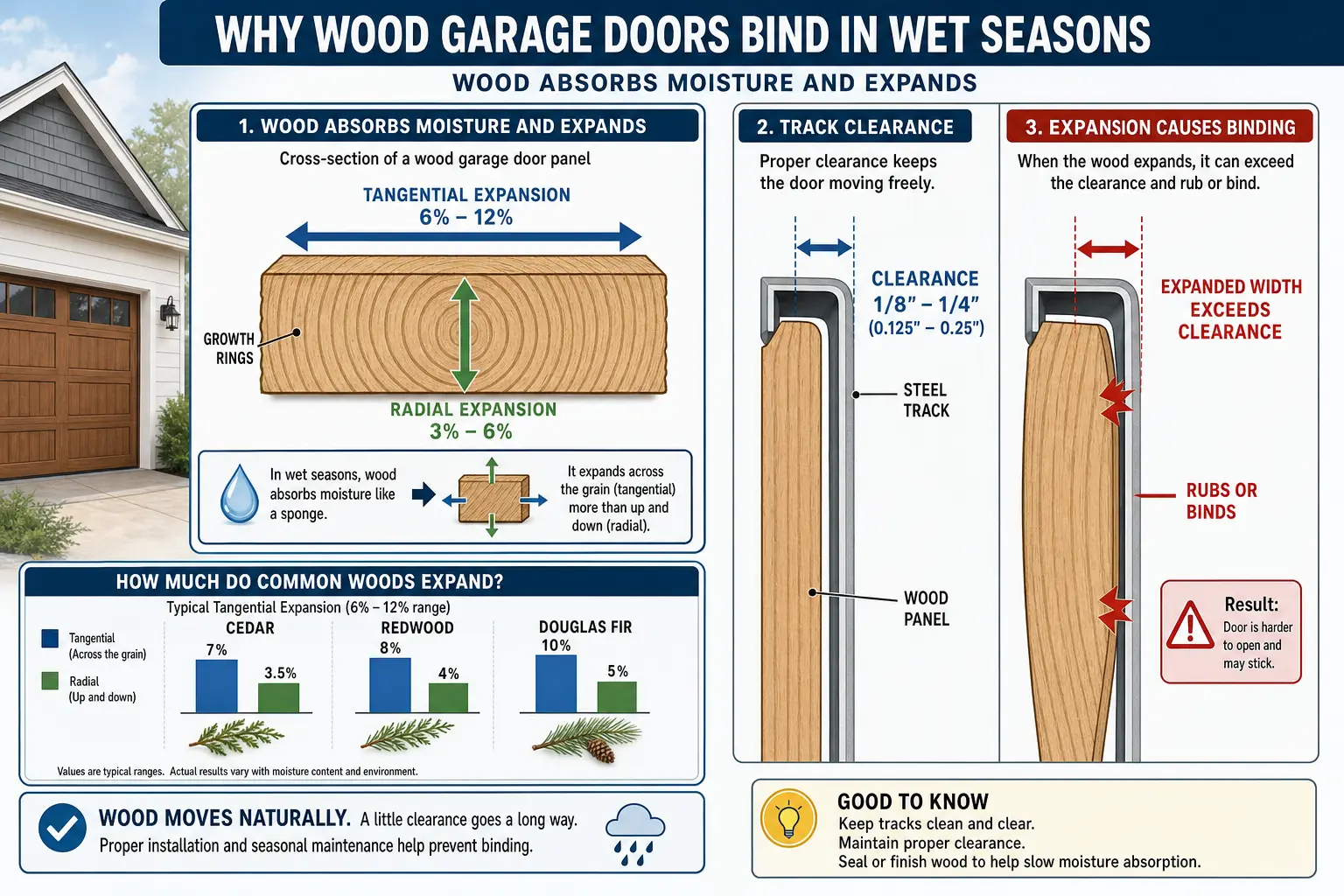
This dimensional movement is asymmetrical. While longitudinal expansion along the grain is negligible (0.1%–0.2%), tangential expansion across panel widths ranges from 6.0% to 12.0%.
Standard vertical garage door tracks are installed with precise side clearances of only 1/8 inch (0.125″) to 1/4 inch (0.25″). Consider the mechanical reality: a standard 16-foot (192-inch) double door made of Douglas Fir (which swells tangentially by 7.5% to 7.8%) experiencing a modest 4% increase in moisture content expands widthwise by roughly 0.38 inches. This single shift exceeds total side track tolerances, causing panels to press violently against steel jambs. In comparison, Western Red Cedar exhibits higher dimensional stability with a swelling capacity of only ~5.0%.
Still stuck? Get it fixed today.
24/7 emergency service from licensed local technicians.
Critical Warnings: Three Common Fixes That Ruin Wood Garage Doors
When doors stick, quick DIY remedies often cause long-term mechanical failure. Avoid these three common traps:
- Planing Swollen Wood in the Rain: Trimming or shaving off wood while it is saturated creates a temporary fit. However, when dry summer air returns and moisture content drops back to 9%, the wood contracts—leaving massive, unsightly 1/2-inch draft gaps around your garage frame.
- The Track Lubrication Trap: Applying petroleum grease or heavy lubricants inside vertical tracks destroys mechanical efficiency. Garage door rollers are designed to roll, not slide. Heavy grease traps dirt, hardens into sticky sludge during cold snaps, and causes roller bearings to skid, creating flat spots. If your motor is struggling alongside erratic power delivery, check if you need to troubleshoot why does my garage door opener battery keep dying or address mechanical motor drag.
- Over-Tightening Torsion Springs: Increasing spring tension to force a swollen door shut puts extreme strain on lifting cables and risk catastrophic spring failure.
Diagnostic Decision Tree: Where Is Your Door Binding?
To choose the right fix, pinpoint the exact point of friction.
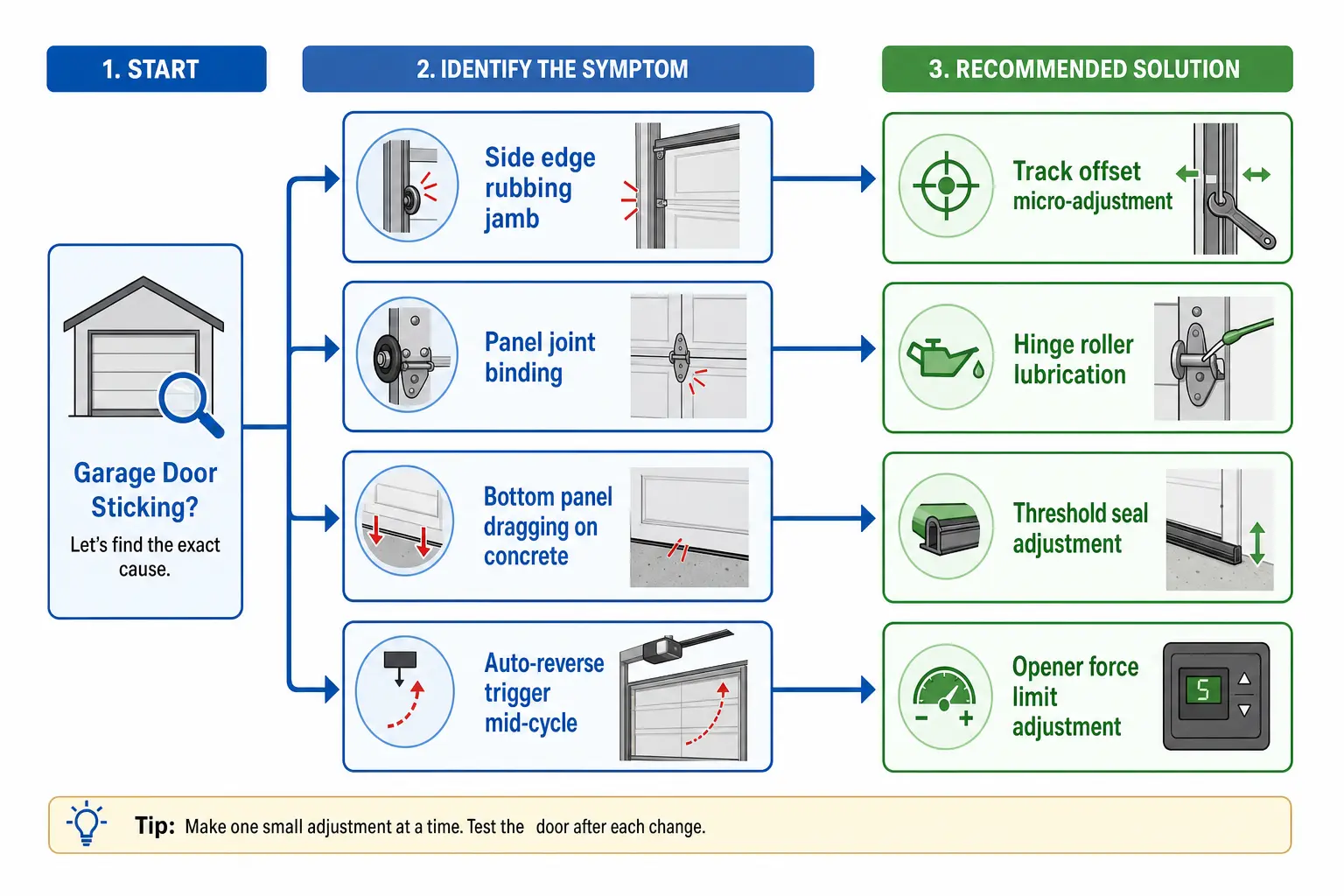
- Side Edge Rubbing Jambs: High moisture expanded the door width. Address this with track bracket micro-adjustments during wet periods.
- Panel Joints Binding in the Curve: Sectional tongue-and-groove joints are absorbing water. Apply paraffin wax to panel joints and lubricate hinge roller stems with 100% silicone spray.
- Bottom Panel Dragging on Concrete: The bottom section absorbed ground runoff. Re-align bottom astragal weatherstripping and adjust door travel limits.
- Opener Auto-Reversing Mid-Cycle: Binding resistance exceeds safety torque limits. Prompt attention prevents motor burnout; for severe alignment issues, professional 24 hour garage door repair restores safe operation.
Phase-Based Solution Blueprint
Phase 1: Emergency Wet-Season Relief (Non-Destructive)
- Chalk Identification: Run chalk along wooden door edges to identify exact points touching the frame.
- Track Micro-Adjustments: Loosen the track bracket lag bolts slightly and push the vertical track outward by 1/16 to 1/8 inch. Retighten bolts securely. This provides immediate clearance without removing wood.
- Hardware Lubrication: Spray 100% silicone on roller stems, hinges, and springs while keeping track interiors completely dry.
Phase 2: Dry-Season Permanent Sealing (The Long-Term Solution)
- Verify Moisture Content: Use a pinless moisture meter to confirm wood MC has dropped below 12%.
- Targeted Sanding: Lightly sand high spots identified during the wet season.
- The 6-Side Sealing Protocol: Apply a premium Marine Spar Urethane or penetrating epoxy sealer to all six sides of every panel. Pay extra attention to the bottom end-grain, which acts like a bundle of drinking straws absorbing ground moisture.
Solution Comparison Matrix & Cost Evaluation

| Solution Option | Est. Cost | Skill Level | Longevity | Key Benefit |
|---|---|---|---|---|
| Track Offset Adjustment | $0 – $35 | DIY (Easy) | 1 Season | Immediate relief without altering wood |
| Spring-Loaded Hinges | $60 – $100 | DIY (Moderate) | Permanent | Auto-compensates for panel swelling |
| DIY Sanding & Spar Sealing | $75 – $150 | DIY (Weekend) | 3–5 Years | Stops water absorption permanently |
| Pro Track Realignment & Tune-Up | $200 – $450 | Professional | 3–5 Years | Ensures precise track tolerance and safety |
| Faux-Wood Steel/Fiberglass Door | $2,200 – $4,500 | Professional | Lifetime | Zero seasonal expansion risk |
When to Repair vs. Replace Your Wood Garage Door
If panel wood exhibits core rot exceeding 25%, structural delamination in plywood overlays, or severe sagging that disrupts spring balance, refinishing will not restore functionality. Upgrading to modern faux-wood steel or fiberglass insulated doors offers authentic wood aesthetics without seasonal swelling. If your door becomes completely jammed during severe weather, relying on an emergency garage door repair expert ensures your home remains secure.
Frequently Asked Questions
Can I shave down my wooden garage door while it is sticking during a rainy week?
No. Trimming a wooden door while swollen removes material permanently. When humidity drops and the wood dries, the panel contracts, leaving large gaps that let in cold drafts, pests, and rain. Always wait for dry weather and verify low moisture content before sanding or planing.
Why does my garage door opener auto-reverse when rain hits?
Automatic garage door openers feature safety force settings that detect obstruction resistance. When wet weather causes wood panels to swell against steel tracks or frame jambs, friction increases. The opener interprets this mechanical drag as an obstruction and automatically reverses to prevent motor damage.
Should I grease the vertical tracks if the wood is rubbing against them?
Never apply petroleum grease or WD-40 inside garage door tracks. Grease prevents rollers from turning smoothly, causing them to slide and wear flat spots. Additionally, grease collects dirt and hardens in cold weather. Instead, adjust track brackets outward for clearance and keep track channels clean and dry.