Understanding Garage Door Roller Types And Materials


Published: Aug 3, 2026

Every time your garage door opens, a complex mechanical ballet occurs right above your head. Yet, most homeowners only notice this system when it begins to complain. That rattling, screeching vibration reverberating through your living room isn’t just an annoyance—it is the sound of accelerated wear and tear.

Selecting the right garage door roller is one of the most cost-effective ways to restore peace to your home and extend the life of your entire door system. However, choosing the perfect replacement requires looking beyond simple aesthetic choices to understand the science of materials, precise dimensional engineering, and mechanical load limits.


The Great Material Debate: Interactive Sourcing Matrix


To make an informed decision, you must first understand how different roller materials perform across five critical categories: operational lifespan, structural load capacity, ambient noise dampening, maintenance requirements, and environmental resilience.

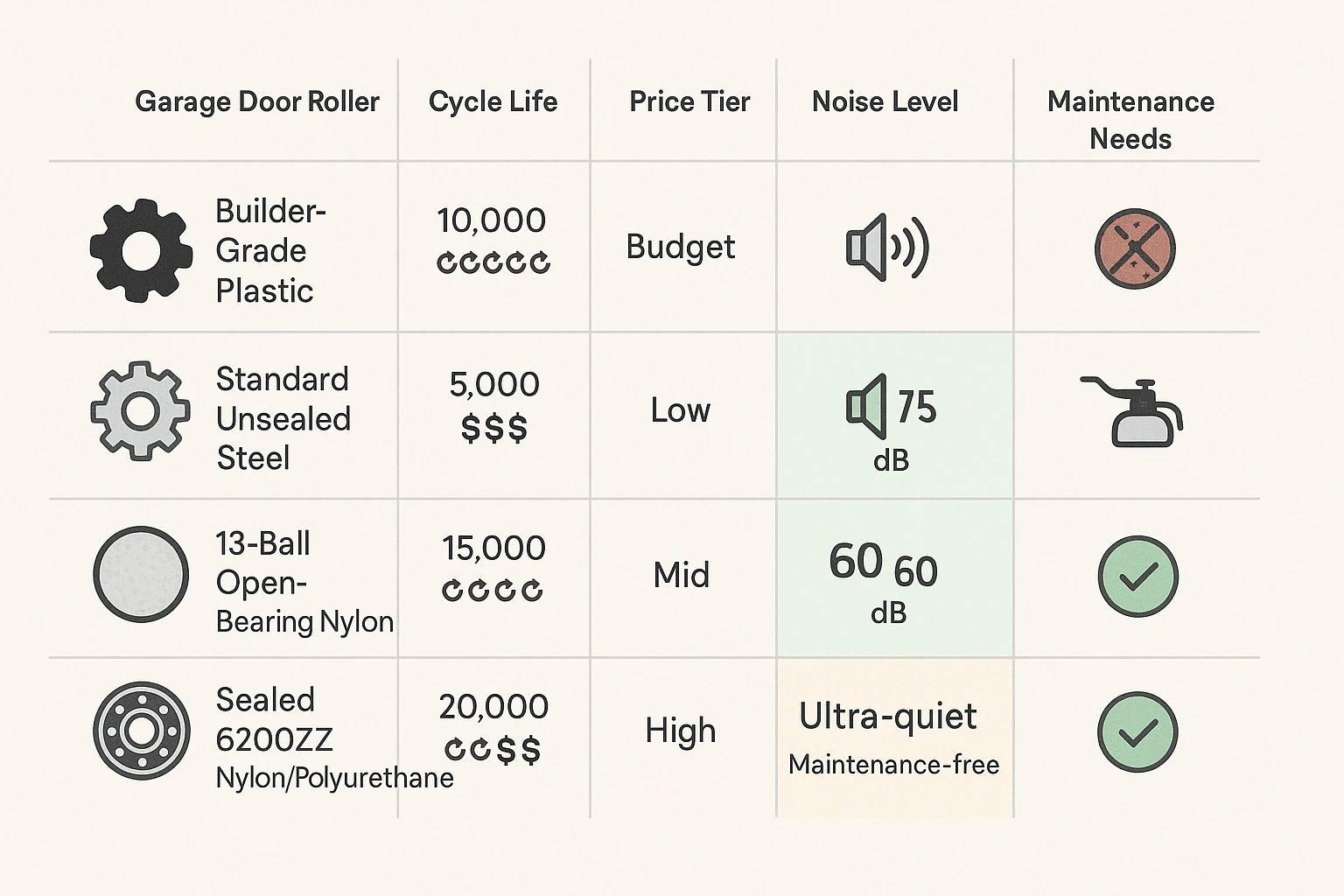
  • Builder-Grade Bearingless Plastic: These rollers represent the absolute entry level. Rated for a modest 10,000 cycles under a light 50-lb load per roller, they feature no internal bearings. They operate quietly at first but degrade quickly, often requiring a broken rollers repair when they flat-spot and drag along the tracks.
  • Standard Unsealed Steel: Equipped with 10-ball open bearings, these steel rollers are highly rigid and rated for 10,000 to 15,000 cycles. While they handle heavy doors with ease, they produce a loud metal-on-metal screech and are highly susceptible to rust in humid climates.
  • Premium Open-Bearing Nylon: Featuring 13-ball open bearings, these rollers are rated for 50,000 to 55,000 cycles on a 110-lb door. In terms of material science, manufacturers prefer Nylon 6 over Nylon 6/6 for roller tires because Nylon 6 is slightly softer, allowing it to absorb vertical track vibrations more effectively. This material upgrade reduces operational noise by up to 15 decibels (dB)—a striking 75% to 90% reduction in perceived loudness.
  • Sealed 6200ZZ Precision-Bearing Nylon or Polyurethane: The absolute gold standard of garage door hardware. By pairing a durable Nylon 6 or polyurethane tire with a double-shielded, lubricated-for-life chrome steel bearing (6200ZZ), these rollers easily exceed 100,000+ cycles under heavy residential loads. Because the bearings are completely sealed, you never have to worry about how to how to lubricate garage door rollers directly, preventing dirt and grit from seizing the internal mechanism. Knowing when to replace garage door rollers is simple once you realize that sealed-bearing rollers virtually eliminate the common symptoms of failure.

This visual clarifies the key differences among garage door roller materials, showing how cycle life, price, noise, maintenance, and rust resistance vary to help homeowners make informed upgrade decisions.


Sizing Archaeology: The Sizing Blueprint (How to Measure)


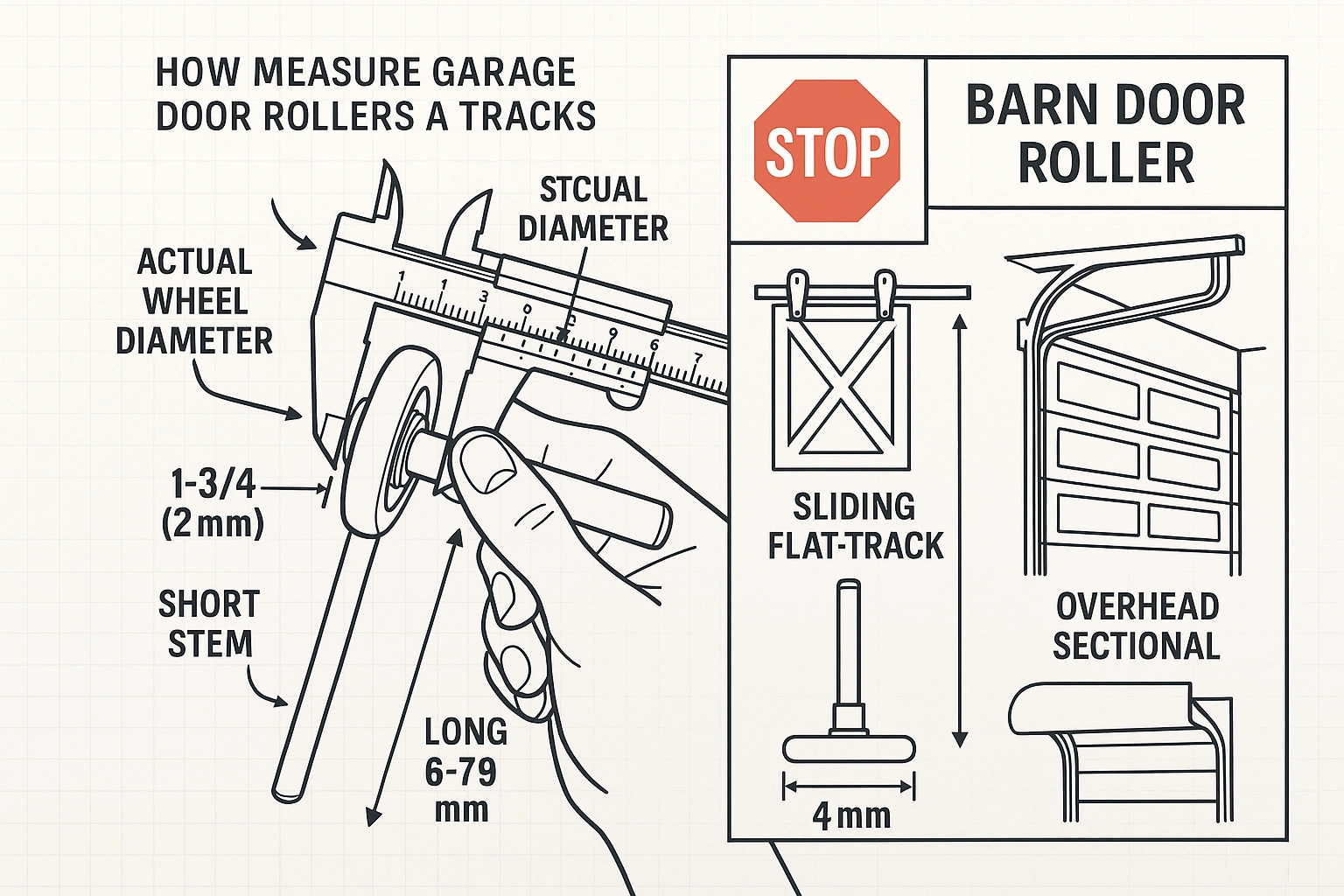
The single biggest mistake homeowners make when purchasing replacement garage door parts is falling into the “nominal sizing” trap. If you measure your garage door track, see that it is 2 inches wide, and purchase a roller with a literal 2-inch wheel diameter, the roller will bind, seize, and ruin your door’s alignment.

To guarantee compatibility, you must use actual engineering dimensions:

  • 1-Inch Nominal Roller: The actual wheel diameter is 13/16 inches.
  • 2-Inch Nominal Roller (found in 99% of residential homes): The actual wheel diameter ranges from 1-3/4 inches to 1-7/8 inches to allow for running clearance inside a standard track.
  • 3-Inch Nominal Roller (used in industrial or heavy commercial applications): The actual wheel diameter is 2-3/4 inches.

Beyond wheel diameter, stem sizing is critical. The standard residential stem diameter is 7/16 inches (0.437″). However, stem lengths vary depending on your door’s reinforcement:

  • Short Stems (4 inches): Designed for standard single-hinge side mounts.
  • Long Stems (7 to 9 inches): Mandatory for doors equipped with wind-load struts, double-hinge commercial fixtures, or heavy wooden carriage doors that require extra support, in compliance with ANSI/DASMA 115 wind-load criteria. Proper garage door track alignment relies heavily on matching these exact stem specifications.

(Please note: This guide is dedicated exclusively to overhead sectional garage door hardware. It does not apply to flat-track, exposed-wheel interior sliding barn door systems, which rely on entirely different tracking mechanics.)

This step-by-step measurement guide demystifies nominal vs actual sizing of garage door rollers and highlights the critical difference between barn door and sectional garage door roller types.


Safe Integration: Rollers, Brackets, and the Cable System


Rollers do not work in isolation; they are part of an integrated lift system. As rollers glide through the tracks, they work in tandem with torsion springs, pulleys, and high-strength stainless steel cables to manage the immense weight of the door.

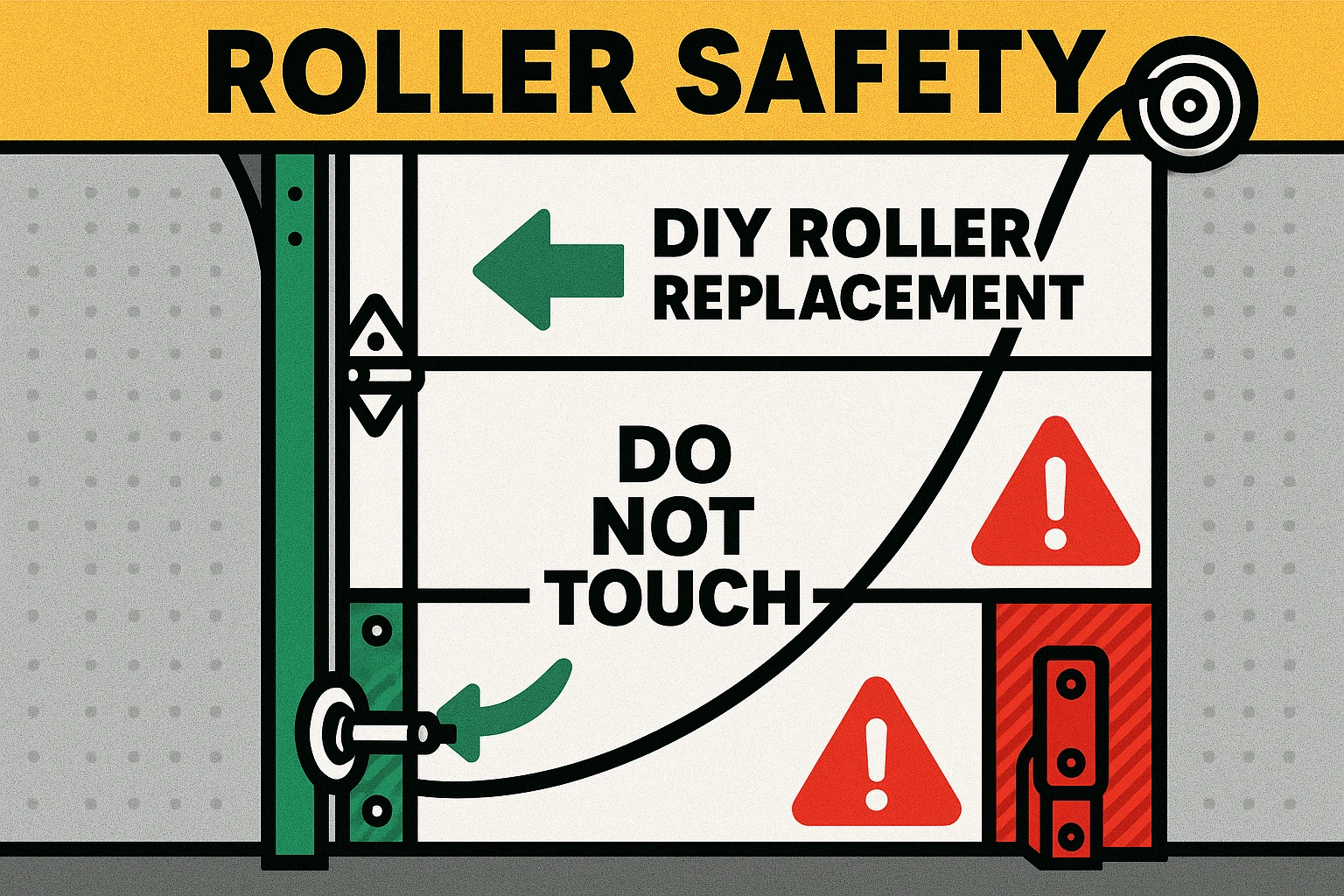
While keeping your tracks clear by performing routine maintenance to clean garage door tracks is a safe and simple DIY task, replacing the rollers themselves requires extreme caution.

⚠️ RED-ALERT SAFETY WARNING: Do not attempt to loosen, adjust, or unscrew the bolts on the bottom corner brackets of your garage door. These brackets are directly anchored to the lift cables, which remain under intense tension from the garage door springs. Accidentally releasing this bracket can cause the cable to snap violently, leading to severe physical trauma or major property damage. Always consult professional technicians for garage door spring replacement safety protocols and high-tension garage door cable replacement near me needs.

If your rollers are worn or binding, they place excessive mechanical resistance on the opener, which can eventually lead to a costly garage door opener repair or complete motor burnout.

This safety visual anchors the critical red-alert warning about the high-tension bottom corner brackets, teaching readers which garage door hardware can be safely serviced and which should never be touched.


Decisive Next Steps for Your Home


Upgrading your garage door rollers is one of the smartest, most immediate improvements you can make to your home’s daily comfort and mechanical reliability. By matching the precise actual measurements of your track system to a high-durability, sealed-bearing nylon roller, you can secure up to a 90% reduction in operating noise and decades of worry-free performance.

Because of the high-tension cable hazards associated with bottom-bracket rollers, the safest and most efficient path forward is to let an expert handle the installation. Contact a certified professional to inspect your tracking, balance your garage door, and safely perform your roller upgrade.

Frequently Asked Questions


Do nylon garage door rollers require regular lubrication?

If you have standard open-bearing nylon rollers, the bearings must be lightly lubricated with a silicone or white lithium spray twice a year. However, premium sealed 6200ZZ bearings are lubricated and sealed at the factory; they require absolutely zero maintenance.

How can I tell if my garage door rollers are bad?

Inspect the rollers for flat spots, cracks on the outer tire, or excessive lateral play. If you notice the door shaking, vibrating heavily, or producing loud scraping noises during operation, it is time to plan a replacement.

Can I mix and match steel and nylon rollers on the same door?

While physically possible, it is highly discouraged. Mixing roller materials creates uneven friction and weight distribution across your tracks, which can warp the track alignment and accelerate wear on your opener motor.


Contact / Request a Call