main logo

The Ultimate Guide to Wind-Rated Garage Doors


Published: Mar 17, 2026

During a severe storm, the largest opening on your home is also its most vulnerable point: the garage door. It’s a startling thought, but a standard garage door can fail under the immense pressure of high winds. When that happens, the sudden pressurization inside your home can lead to catastrophic damage, including the roof being lifted off its foundation.

Your garage door isn't just a convenience; it's a critical piece of your home's structural defense system. This guide will walk you through everything you need to know about choosing a wind-rated garage door that not only protects your family and investment but also complements the clean aesthetic of your modern home.

Foundation: Decoding the Code in Plain English


Before diving into styles and materials, it’s essential to understand the science behind why these doors work. The terminology can seem intimidating, but the core concepts are surprisingly simple.

What is "Wind Load" and "Design Pressure (PSF)"?
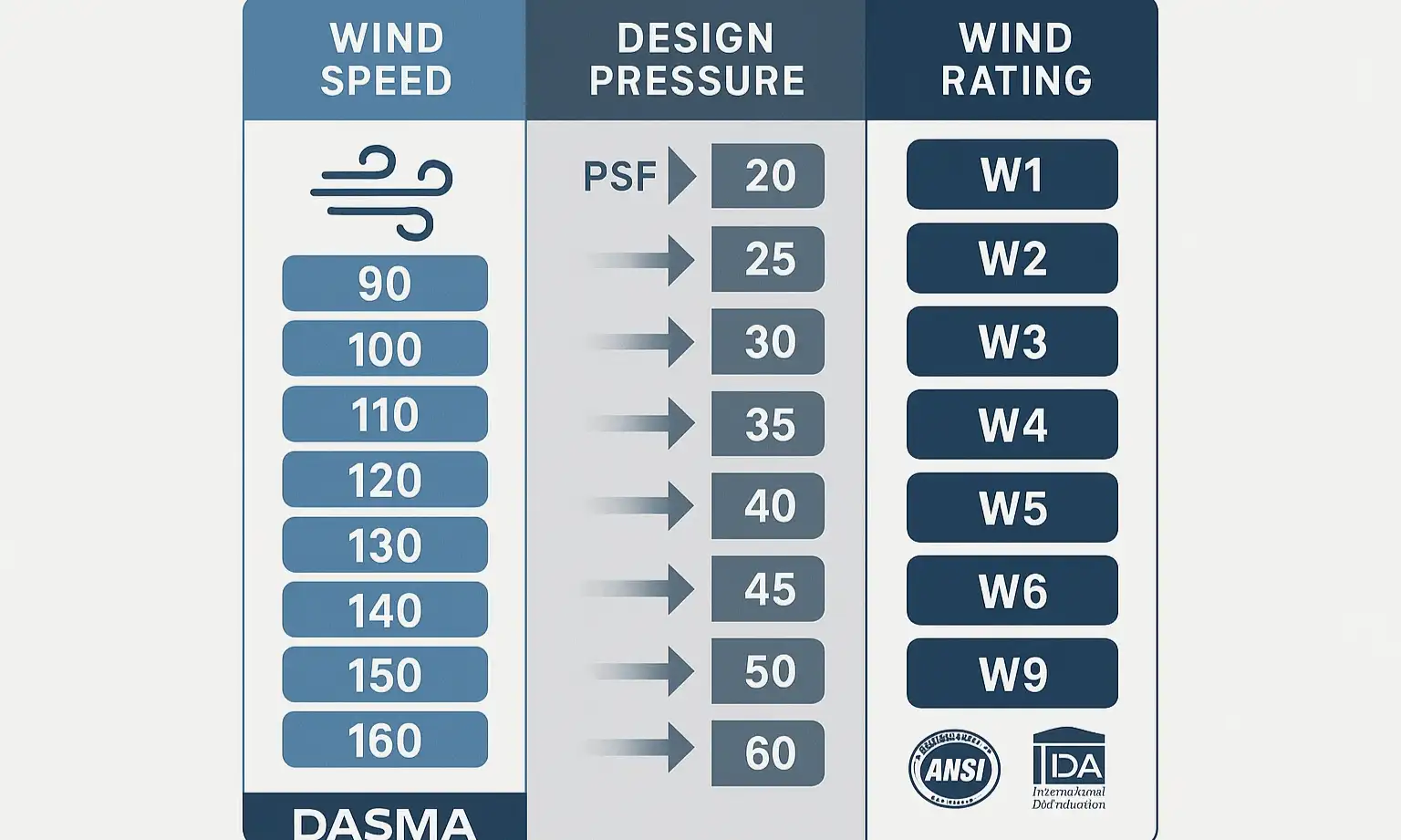
Imagine leaning against a wall. The force you exert is pressure. Now, imagine the constant, powerful force of a 140-mph wind pushing against the entire surface of your garage door for hours. That sustained force is the wind load.
This force is measured in Pounds per Square Foot (PSF). A positive (+) PSF rating measures the pressure of wind pushing against the door, while a negative (-) PSF rating measures the force of wind pulling away from it (suction). A garage door must be tested to withstand both. Your local building codes will specify the exact PSF rating your door needs to meet.
A chart showing how rising wind speeds in MPH correspond to higher design pressure ratings in PSF, with callouts for different WindCode ratings.

From Wind Speed (MPH) to Pressure (PSF): Making Sense of the Numbers

While we talk about hurricanes in terms of wind speed (MPH), garage doors are rated by the pressure (PSF) they can handle. As the image above shows, the relationship isn’t linear; as wind speed doubles, the pressure it exerts can quadruple. This is why a small increase in wind speed requires a significant upgrade in door strength.
Some manufacturers, like Clopay, use a proprietary "WindCode®" system (e.g., W-1, W-8). Think of this as a shorthand that corresponds to a specific PSF rating. The key is to first know your required PSF from your local code, then find a door—regardless of the manufacturer's rating system—that meets or exceeds it.

Understanding Your Zone: Why Location Matters Most

Why does a coastal home in Florida need a stronger door than a home 50 miles inland? Building codes divide regions into exposure categories based on terrain and proximity to the coast.

  • Coastal/Waterfront areas have no obstructions to slow the wind, so they require the highest PSF ratings.
  • Suburban areas with some trees and houses may require a slightly lower rating.
  • Dense urban areas with tall buildings can create complex wind-tunnel effects but are generally more shielded.
The bottom line: your home’s specific location is the single most important factor in determining the strength of the garage door you need.
A chart showing how rising wind speeds in MPH correspond to higher design pressure ratings in PSF, with callouts for different WindCode ratings.

A Practical Guide: Choosing the Right Door for Your Modern Home


Once you understand the "why," you can focus on the "what." This isn't just about safety; it's about finding a door that enhances your home's curb appeal.

Step 1: Find Your Required Rating

This step is non-negotiable. Before you fall in love with a specific style, you must determine the wind load requirements for your address. This information is set by your local municipality's building code department. You can usually find it on their website or by calling them directly. A professional garage door installer will also be able to verify these requirements for you.
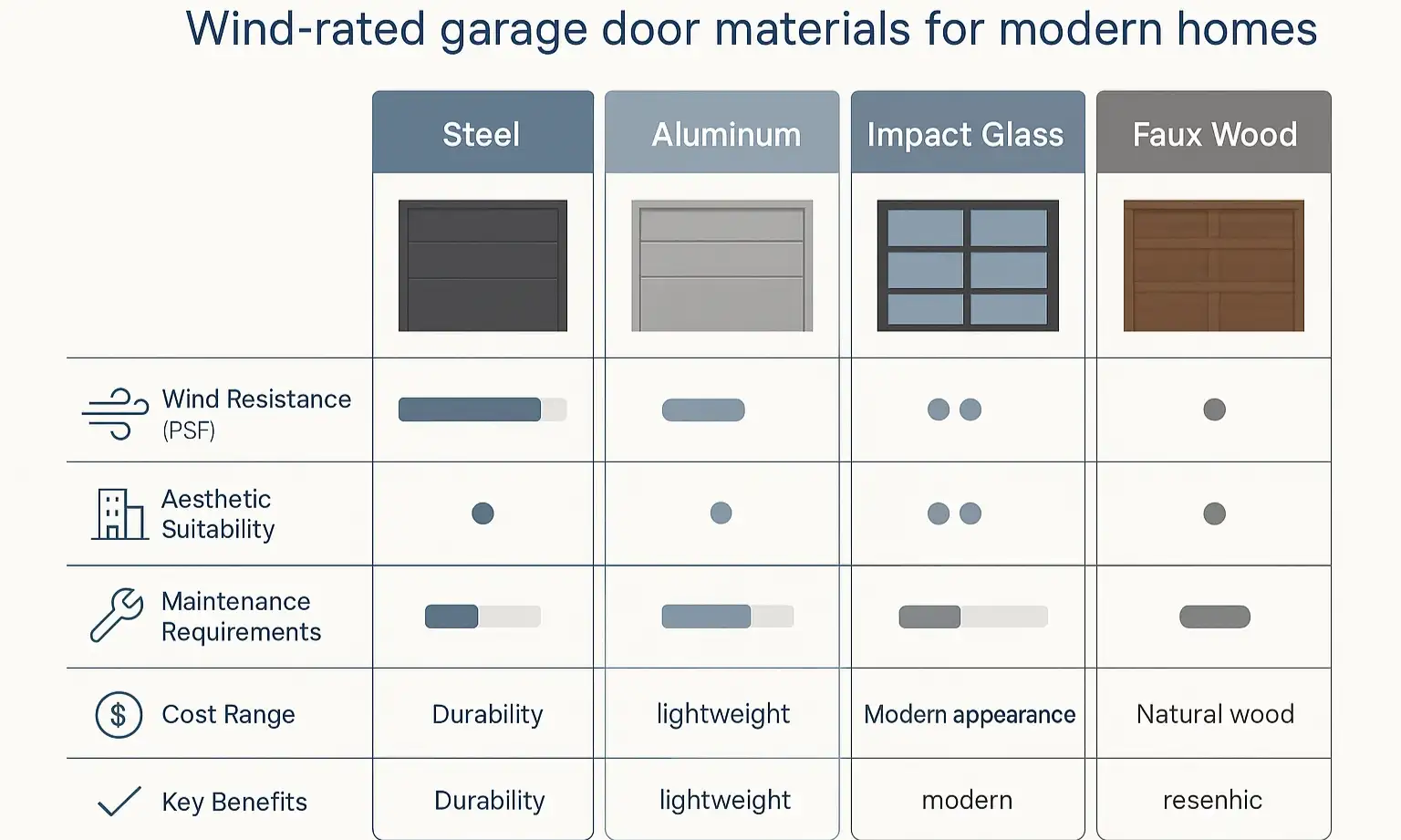
Chart comparing wind-rated garage door materials—steel, aluminum, impact glass/polycarbonate, and faux wood—by pros, cons, and best uses.

Step 2: Match Material & Style to Your Modern Aesthetic

Modern architecture is defined by clean lines, minimalist design, and an emphasis on natural light. The good news is that you don’t have to sacrifice style for safety. Today’s wind-rated doors come in a variety of materials that fit this aesthetic perfectly.

Step 3: Look Under the Hood: The Reinforcement System

Aha Moment: A wind-rated door’s strength doesn’t come from a thicker panel. It comes from a comprehensive system of reinforcements.
Compared to a standard door, a wind-rated system includes:

  • Heavy-Duty Steel Struts (Braces): Horizontal struts are added to the back of the door sections to prevent them from buckling under pressure.
  • Upgraded Rollers: These are often more durable and designed to stay engaged in the track under stress.
  • Reinforced Tracks: The vertical and horizontal tracks are made of thicker gauge steel and have more robust mounting brackets to keep the door anchored to the wall.
This complete, engineered system is what allows the door to withstand incredible forces. Exploring current garage door trends shows that manufacturers are increasingly integrating these robust features into designs that don't compromise on style.

Step 4: Wind-Rated vs. Impact-Rated: What's the Difference?

This is a common point of confusion.
  • Wind-Rated refers to the door's ability to resist pressure.
  • Impact-Rated refers to its ability to resist penetration by flying debris (like a piece of lumber) during a storm.
Chart comparing wind-rated garage door materials—steel, aluminum, impact glass/polycarbonate, and faux wood—by pros, cons, and best uses.
In many hurricane-prone areas, like Florida, codes require doors to be both. An impact-rated door often features a reinforced core and impact-resistant glazing, ensuring that if an object hits it, it won't create an opening that compromises the home.

Types of Overhead Garage Door Solutions for Modern Homes


While the principles are universal, modern design presents unique challenges and opportunities.

Edge Case: Full-View Glass Doors in High-Wind Zones

The desire for seamless indoor-outdoor living has made full-view aluminum and glass doors a staple of modern design. Can a door made almost entirely of glass stand up to a hurricane? Yes—with the right engineering.
These doors can achieve high wind load and impact ratings by using:
  • Stronger, thicker aluminum frames.
  • Impact-resistant glazing, such as laminated glass or heavy-duty polycarbonate, which can withstand strikes from flying debris without breaking through.
This allows homeowners in even the most severe weather zones to enjoy a modern, light-filled aesthetic without sacrificing safety.

Specific Application: Doors for Detached Garages and Workshops

You might wonder if a detached garage needs the same level of protection. In most cases, local codes will require it. A detached structure that fails can become a source of dangerous projectiles, threatening your main home and your neighbors' properties. Applying the same standards to all structures on your property is the safest approach. This holds true whether you have a sectional or a roll up garage door.

Need more information?

Your Wind-Rated Door Purchasing Checklist
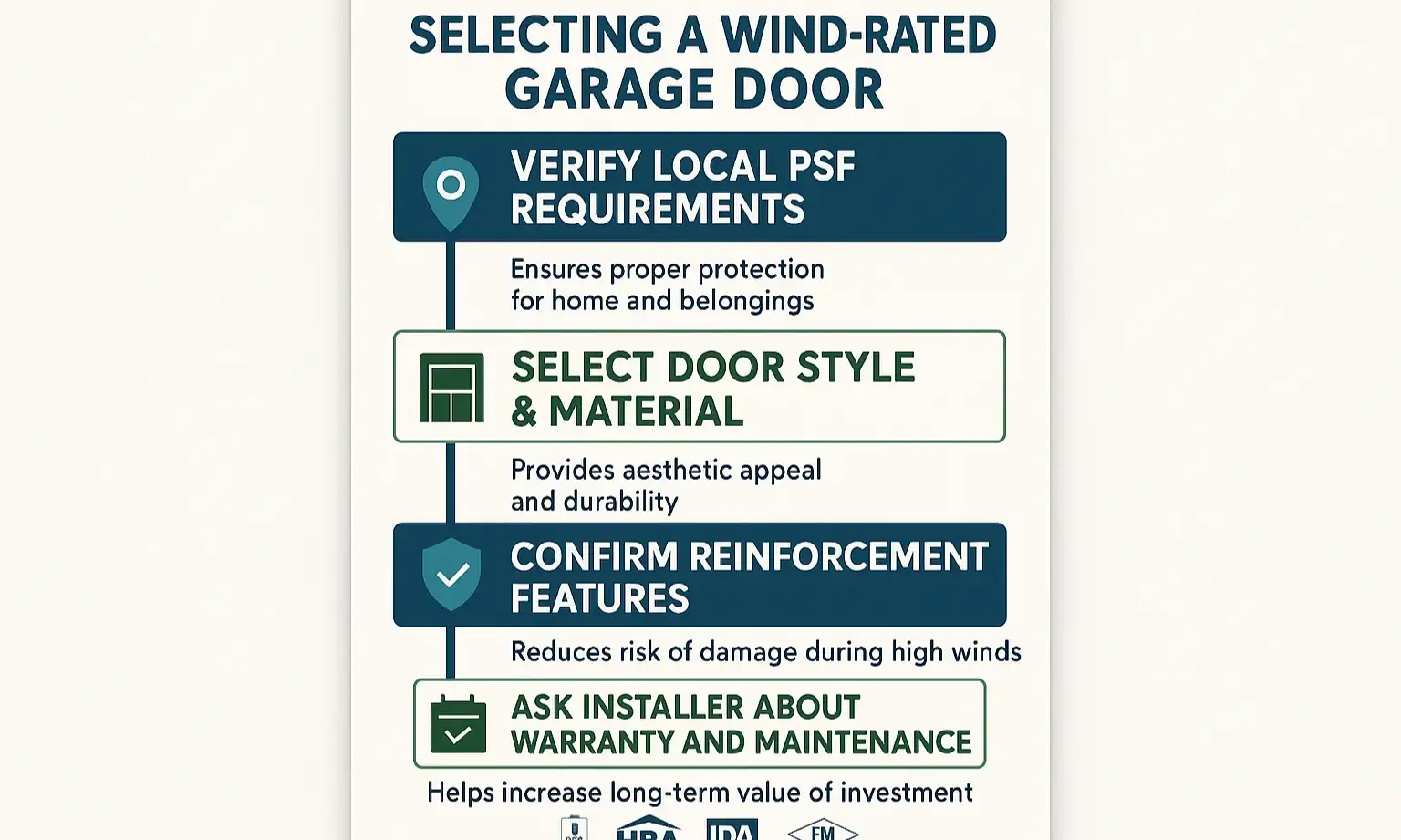

Feeling ready to talk to a professional? Use this checklist to guide the conversation and ensure you cover all your bases.
Checklist for choosing a wind-rated garage door: verify codes, pick material/style, confirm reinforcement, check warranty, and schedule installation

  • What is the required design pressure (PSF) for my specific address?
  • Can you show me the manufacturer's label on the door that certifies its wind and/or impact rating?
  • What materials do you recommend to achieve the modern look I want while meeting my code requirements?
  • What does the warranty cover for both the door and the reinforcement components?
  • Does the installation quote include all necessary components, like the heavy-duty tracks and struts?
  • Is the door opener you're recommending also rated for use with a heavier, reinforced door? For the latest options, it's worth reviewing the best garage door recommendations 2026 to ensure the entire system is compatible.
Checklist for choosing a wind-rated garage door: verify codes, pick material/style, confirm reinforcement, check warranty, and schedule installation

Frequently Asked Questions (FAQ)


What is a good wind rating for a garage door?

There is no single "good" rating. The right rating is the one that meets or exceeds your local building code. A door that is perfect for inland Georgia would be dangerously inadequate for coastal Miami.

Can any garage door be made wind-rated?

No. A true wind-rated door is designed, tested, and certified as a complete system from the factory. While you can add aftermarket braces to an existing door (a process called retrofitting), this is often a temporary or partial solution that may not satisfy building codes or insurance requirements.

How do I know if my current door is wind-rated?

Look for a sticker, usually located on the inside of the door along one of the edges. This label will contain information about the manufacturer and, if applicable, the design pressure (PSF) ratings and impact rating the door meets. If there is no sticker, the door is likely not wind-rated.
Choosing a garage door in a high-wind area is about more than just picking a color. It's about investing in the structural integrity of your home. By understanding the basics of wind load and working with a qualified professional, you can select a door that acts as a reliable shield, giving you peace of mind while perfectly matching your modern home's design.

You may also like