Road Salt Rust on Bottom Brackets: When the Cable Anchor Is Unsafe


Published: Nov 11, 2026

Winter commuting exposes bicycle bottom bracket (BB) shells to a harsh cocktail of sodium chloride, calcium chloride, and magnesium chloride. Positioned at the absolute lowest point of your frame, the under-BB area acts as a sump for corrosive road slush. While surface rust on a frame tube is often cosmetic, rust concentrated around the under-BB cable guide anchor bolt, cable stops, or welded eyelets presents a immediate mechanical risk.

Under shifting load, front derailleur cables operate under continuous working tensions of 15 to 35 lbs (66 to 155 N), spiking above 50 lbs (220+ N) during heavy chainring shifts. When road salt attacks this critical junction, it triggers galvanic corrosion, thread seizing, structural wall thinning, and sudden bolt shear under peak shift torque.
Galvanic & Chemical Mechanics of Road Salt Corrosion


According to data from NACE International, road salt solutions lower the electrical resistance of surface moisture, accelerating electrochemical oxidation rates by 10x to 15x compared to pure water exposure.

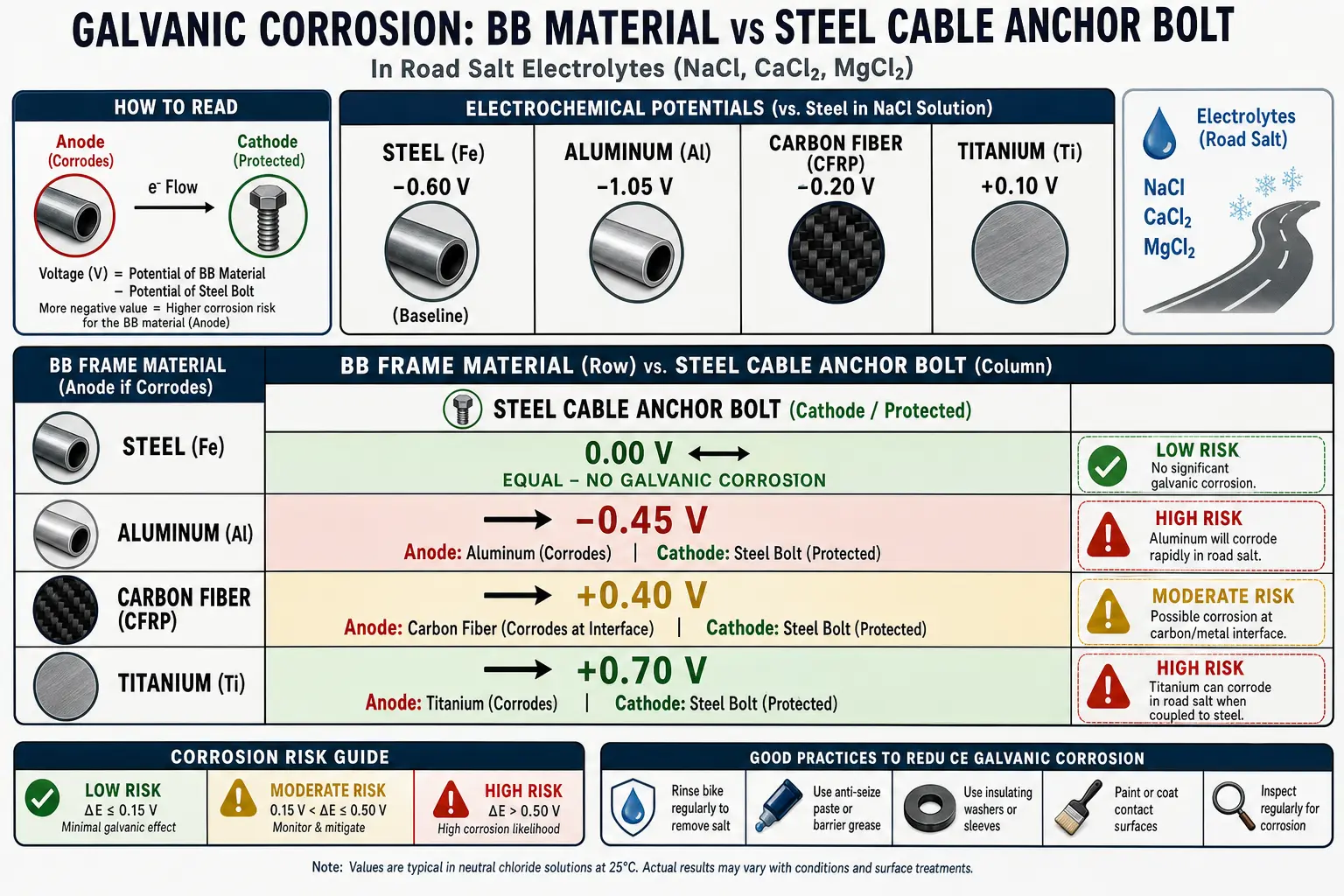
When dissimilar metals meet in a salt slurry electrolyte, an active galvanic cell forms. The potential gap between a stainless or carbon steel anchor bolt (-0.20 V to -0.60 V) and an aluminum BB shell (-0.75 V to -0.90 V) forces the aluminum shell to act as an anode. The frame sacrifices its own internal threads to protect the steel screw, freezing the hardware into a solid mass of aluminum oxide powder.

This matrix visually explains how road salt creates galvanic corrosion between different bicycle bottom bracket frame materials and steel cable anchor bolts, highlighting which parts corrode and how fast based on their electrochemical potentials.

Still stuck? Get it fixed today.
24/7 emergency service from licensed local technicians.
Call (860) 362-3018

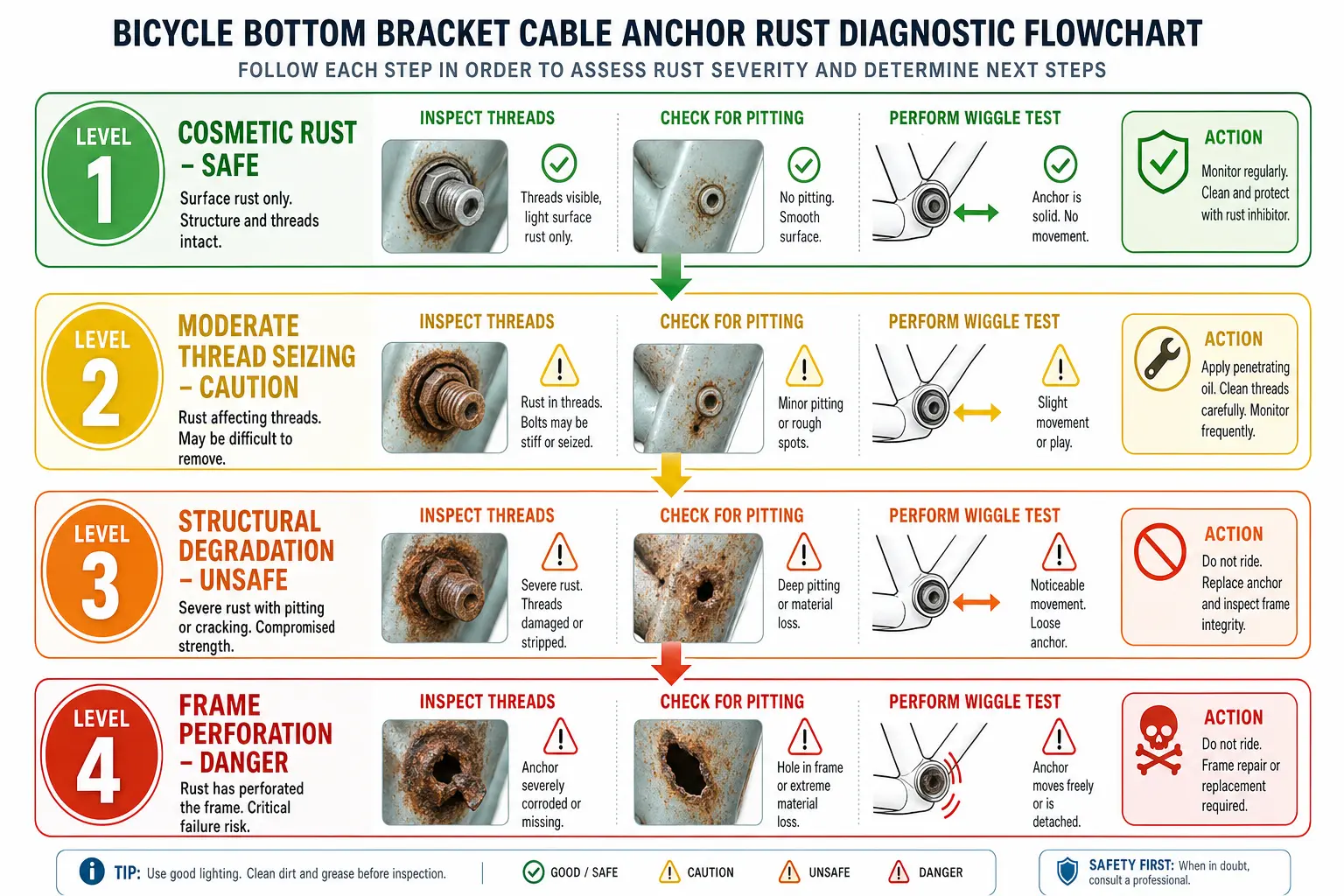
The Safety Threshold Matrix: Is Your Cable Anchor Unsafe?


Evaluating whether your corroded anchor is safe requires categorizing the damage across four distinct levels:

  • Level 1: Surface Oxidation (Safe). Light surface discoloration on the bolt head. Threads turn smoothly, and structural integrity is intact. Neutralize with anti-corrosion spray and re-grease.
  • Level 2: Thread Seizing & Minor Pitting (Caution). The M4/M5 bolt resists removal due to salt crusting. Requires penetrating oil overhaul, thread cleaning, and nickel anti-seize paste before riding.
  • Level 3: Structural Degradation (Unsafe). Severe pitting around the bolt shoulder with >30% cross-sectional metal loss. Shifting tension risks shearing the bolt head, causing immediate derailleur failure in traffic.
  • Level 4: Frame Perforation or Cable Cut-Through (Dangerous). Deep structural wall thinning or worn plastic guides allowing bare cable to saw directly into the metal shell. Riding poses structural frame failure hazards.

This flowchart guides cyclists through assessing their bottom bracket cable anchor rust condition, clearly distinguishing safe, caution, unsafe, and dangerous states based on visual and mechanical symptoms.

Visual Inspection and Diagnostic Protocol


Before riding a winter-exposed bike, conduct a visual and mechanical check of the under-BB area:

  1. The Torque and Wiggle Test: Apply gentle rotational force to the anchor bolt using a hex key. If the bolt flexes, feels soft, or binding prevents smooth removal, stop immediately to avoid shearing the head off.
  2. Drainage Check: Over 80% of bikes without factory drainage holes trap 5 to 15 mL of salt brine inside the BB shell monthly. Inspect internal shell walls for scaling rust or white aluminum oxide powder.
  3. Guide Wear Inspection: Verify that plastic cable guides haven’t degraded. Worn plastic allows steel cables to saw directly into frame tubing under tension.

How to Safely Overhaul, Extract, and Repair a Corroded Cable Anchor


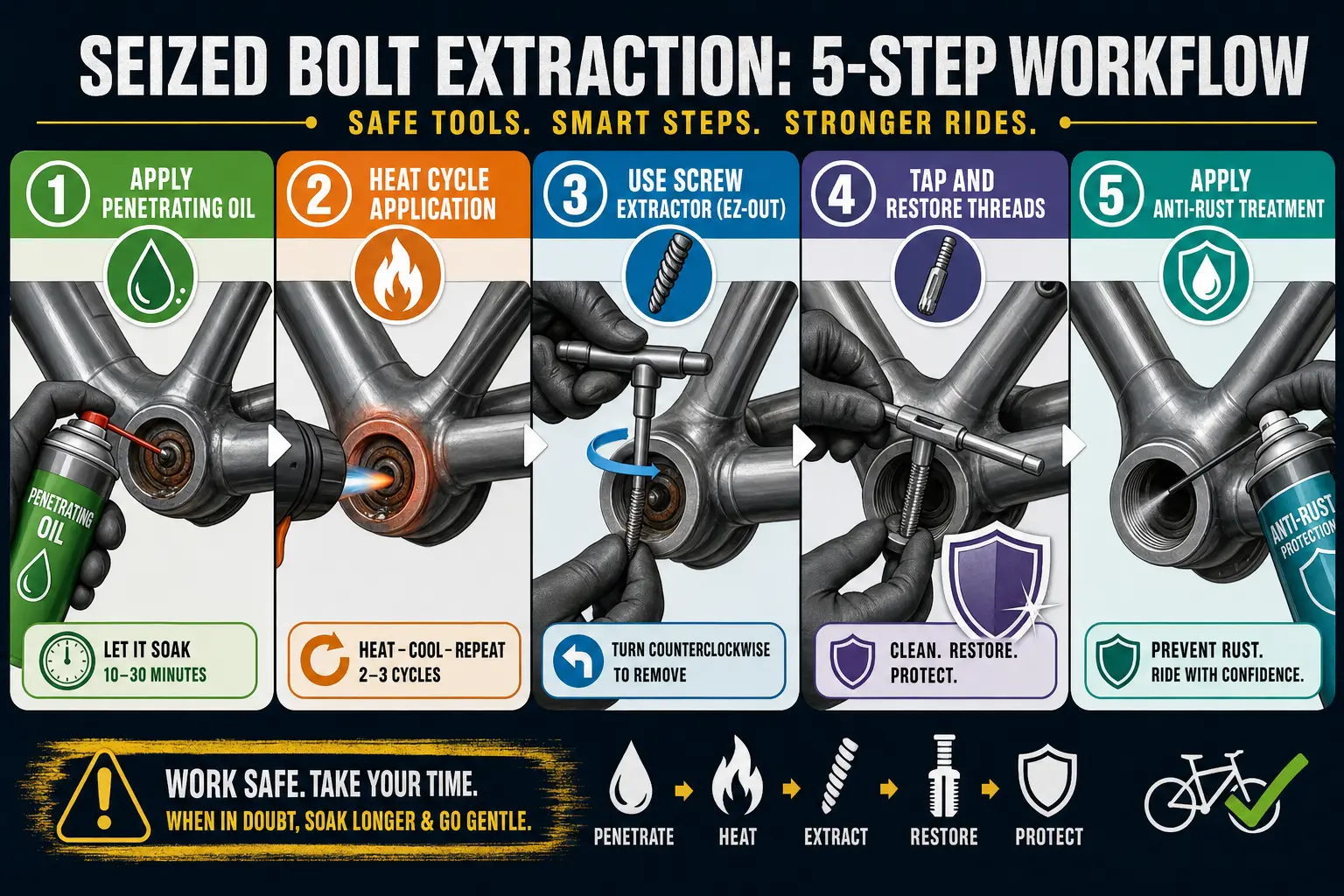
Attempting to force a frozen anchor bolt out often snaps the head, leaving a hardened steel shaft embedded in your frame. Follow a structured extraction workflow:

  1. Penetrate: Apply high-quality penetrating oil to the inner and outer thread interface and allow 12–24 hours to break salt bonds.
  2. Heat Cycle: Gently apply localized heat to the frame shell to expand the metal surrounding the bolt.
  3. Extract: Use a reverse-thread screw extractor if the fastener head is stripped or sheared.
  4. Restore: Chaser taps (M4x0.7 or M5x0.8) clean oxidized threads. Damaged aluminum threads can be restored with Helicoil inserts.

This infographic memorably outlines the stepwise procedure for safely extracting a seized bottom bracket cable anchor bolt and restoring thread integrity, helping mechanics avoid common damage pitfalls.

Emergency and Permanent Bypass Solutions


If the anchor threads are completely destroyed by galvanic corrosion, full frame replacement isn’t always necessary. You can implement three proven bypass strategies:

  • Continuous Housing: Run full-length cable housing secured with frame clamps, eliminating bare cable contact with the BB shell.
  • Clamp-On Cable Guides: Install removable bottom bracket clamps that bypass the original threaded hole entirely.
  • Drivetrain Conversion: Shift to a 1x drivetrain or wireless electronic shifting, eliminating front derailleur cable routing beneath the bottom bracket.

Just as critical home mechanical systems require timely care—much like scheduling 24 hour garage door repair to prevent unexpected structural lockouts—maintaining your frame’s load-bearing mechanical anchors prevents catastrophic failures when commuting in harsh conditions.

Frequently Asked Questions


Can I ride my bike if the under-BB cable guide bolt snaps off?

Riding with a snapped cable guide bolt is unsafe if you rely on a front derailleur. Cable tension will pull the guide out of alignment, causing unexpected shifting or jammed cables. Furthermore, an open bolt hole allows road slush and water to pool directly inside the bottom bracket shell.

Will road salt rust ruin a carbon fiber frame?

While carbon fiber itself does not rust, road salt creates severe galvanic corrosion where aluminum or steel threaded inserts are bonded into the carbon shell. As salt corrodes the metal insert, swelling oxide forces carbon layers apart, leading to frame delamination and insert failure.

How do I remove a broken cable guide screw stuck inside an aluminum bottom bracket?

Apply penetrating fluid and let it soak overnight. Apply heat to the aluminum area around the screw to expand the shell, then use a center punch to mark the bolt core. Carefully drill a pilot hole and use a micro screw extractor to back the broken screw out without damaging the frame threads.

Contact / Request a Call