One-Piece Tilt-Up Garage Door Spring Broken: What to Know


Published: Nov 10, 2026

A sudden loud bang in your garage followed by a door that refuses to lift usually points to a broken spring. If your garage features a single-panel tilt-up door, evaluating your next steps requires understanding a unique set of mechanical requirements.

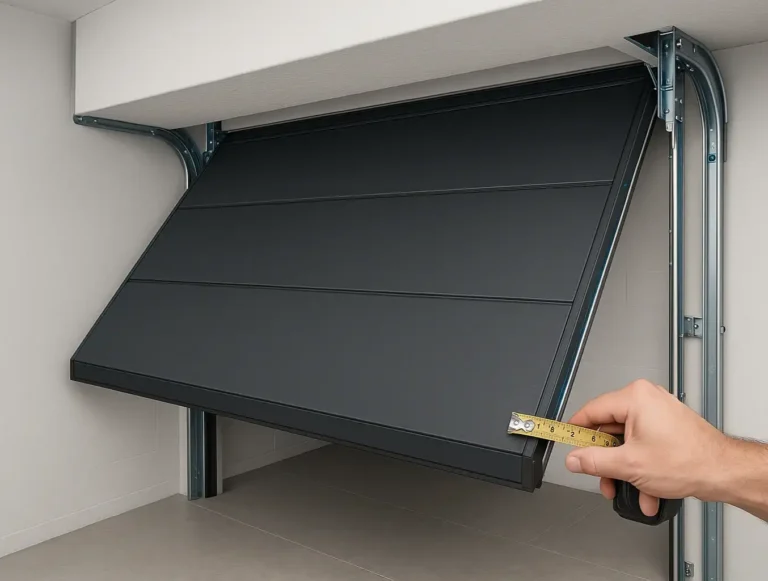
Unlike modern sectional doors, older single-piece tilt-up doors rely on heavy side jamb extension springs working alongside lever arms. When a spring snaps, a 125 to 300-plus pound wooden or metal panel suddenly loses its counterweight, creating an immediate safety hazard and leaving vehicles trapped inside.

Evaluating whether to replace the broken spring yourself, hire a technician, or upgrade to a modern sectional door requires clear data on hardware compatibility, mechanical risk, and long-term costs.
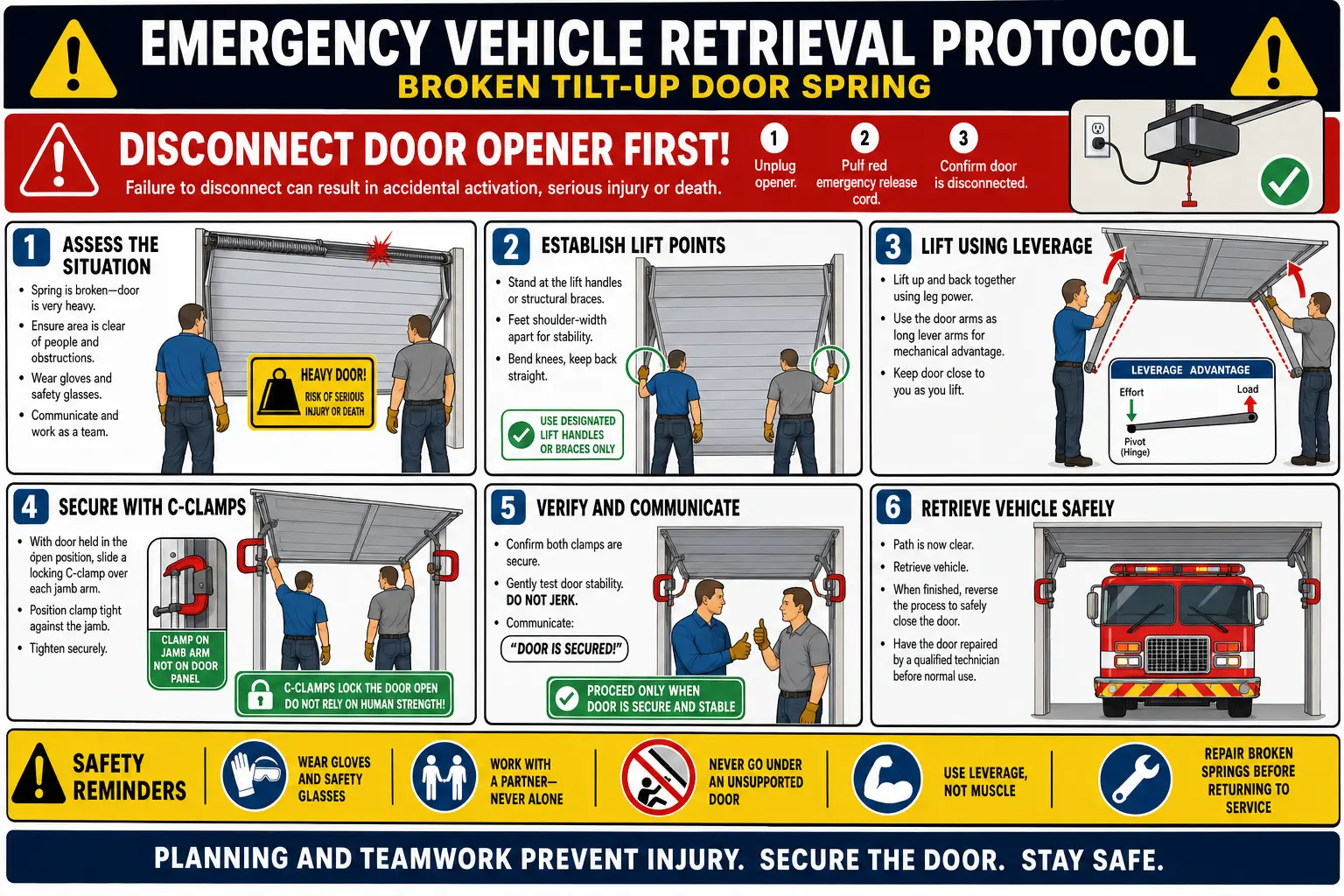
Immediate Triage: Safety Protocols and Emergency Access


When a tilt-up spring breaks, your immediate priority is stabilizing the opening without damaging equipment or risking injury.

First, disconnect your automatic garage door opener immediately. Attempting to operate an electric motor on a broken single-panel door will strip the drive gears or burn out the motor, as openers are designed to move balanced weight, not lift dead weight.

If you must retrieve a trapped vehicle, follow a safe extraction protocol:

  1. Never attempt to lift the door alone. Single-piece panels lack flex points, concentrating their full weight on the bottom edge.
  2. Position two people at opposite ends of the door and lift using your legs, maintaining equal upward pressure to prevent the panel from twisting off its jamb pivot arms.
  3. Once fully open, lock heavy-duty C-clamps onto both side jamb tracks directly beneath the roller arms to mechanically freeze the panel in place before driving out.

Follow these safe, step-by-step instructions to open a heavy one-piece tilt-up garage door with a broken spring to retrieve vehicles without risking injury or damage.

Still stuck? Get it fixed today.
24/7 emergency service from licensed local technicians.
Call (860) 362-3018

Understanding One-Piece Tilt-Up Garage Door Springs


Over 75% of online repair guides mistakenly conflate tilt-up jamb springs with sectional door torsion bars. Understanding how do garage door springs work on a single-panel system is essential when evaluating repair options.

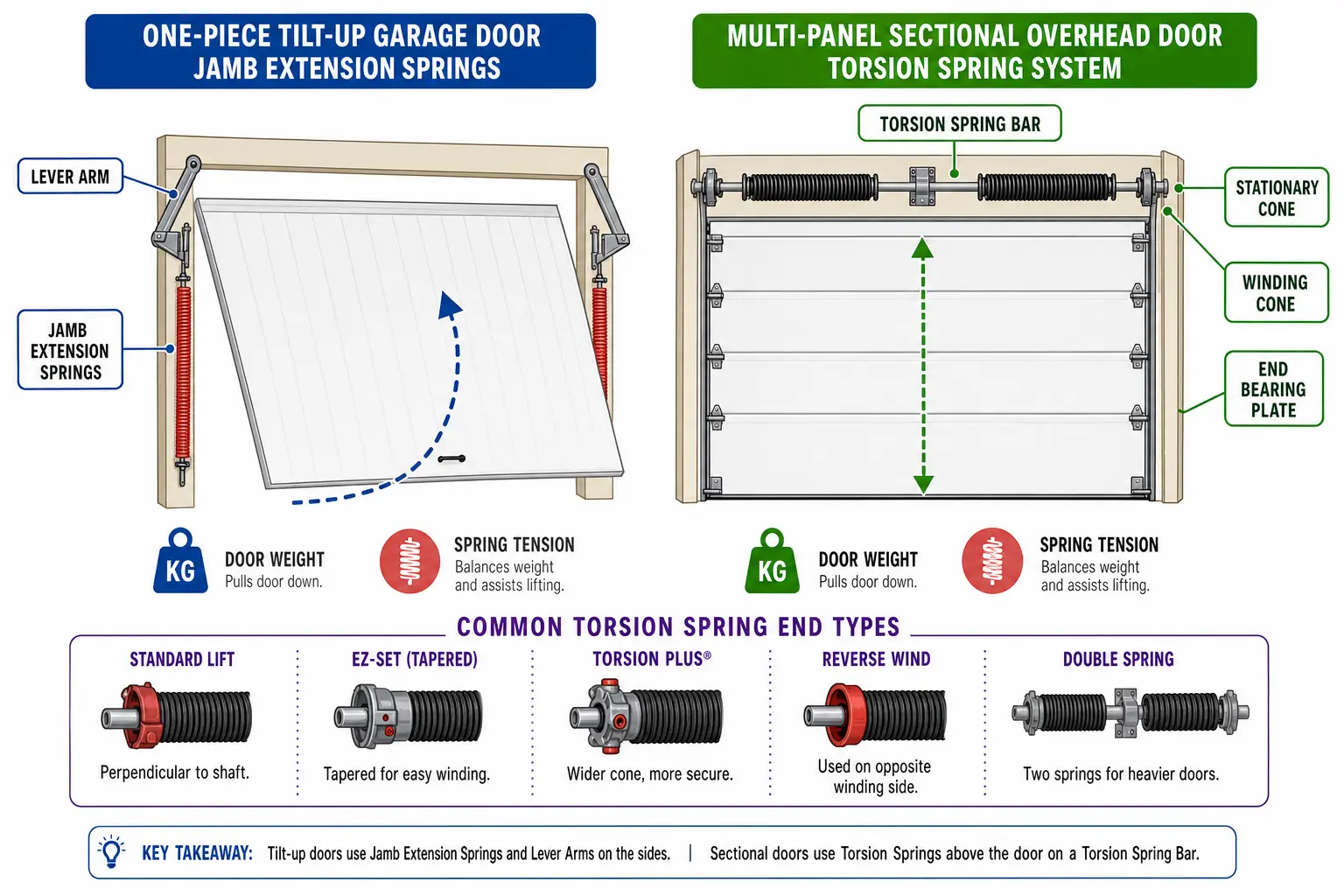
Tilt-up doors operate on side jamb extension assemblies. These springs run vertically along the left and right door frames, stretching downward as the door closes and contracting to pull the panel upward along pivot arms. Understanding garage door torsion vs extension springs highlights why tilt-up systems store energy differently: because the spring expands linearly along the frame, a snap releases energy parallel to the doorway.

Quality tilt-up hardware incorporates internal safety containment rods running through the center of the coil. These rods prevent snapped springs from recoiling through the garage like dangerous shrapnel.

This visual clarifies the fundamental mechanical differences between one-piece tilt-up garage door springs and sectional overhead torsion springs, helping homeowners avoid common confusion.

Identifying Legacy Hardware and Sizing Specs


Big-box retailers rarely carry legacy tilt-up springs, making accurate identification essential before ordering parts:

  • Wire Gauge Standards: Legacy Holmes and E900 hardware use specific wire thickness ratings, typically ranging from #5 gauge down to #9 gauge (0.177″ wire diameter). A lighter gauge cannot safely counterbalance solid wood panels.
  • Coil Lengths: Common relaxed coil-to-coil lengths include 28″, 29″, 32″, and 42″. Measuring the unbroken opposite spring while un-stretched is crucial.
  • End Configurations: Tilt-up springs feature distinct connection points:
  • Plug-End: Screws directly into plastic or metal end plugs.
  • Lock-End (SLR series): Features hooked steel loops that latch onto pivot arm brackets.
  • Clip-End: Uses C-clips to secure to hardware plates.

Matching SKUs like P728, SL728, or SLR729 ensures your replacement matches your door panel weight rating (typically 90 to 250 lbs).

Repair, Replace, or Upgrade: Evaluating Your Options


When facing a broken spring on an older tilt-up door, homeowners generally consider three main paths.

Replacing springs yourself requires careful handling of high-tension hardware. A proper garage door spring installation always involves replacing both side springs simultaneously. Field data shows that replacing only the snapped spring leads to a 70%+ failure rate within six months for the remaining spring due to metal fatigue and uneven torque distribution.

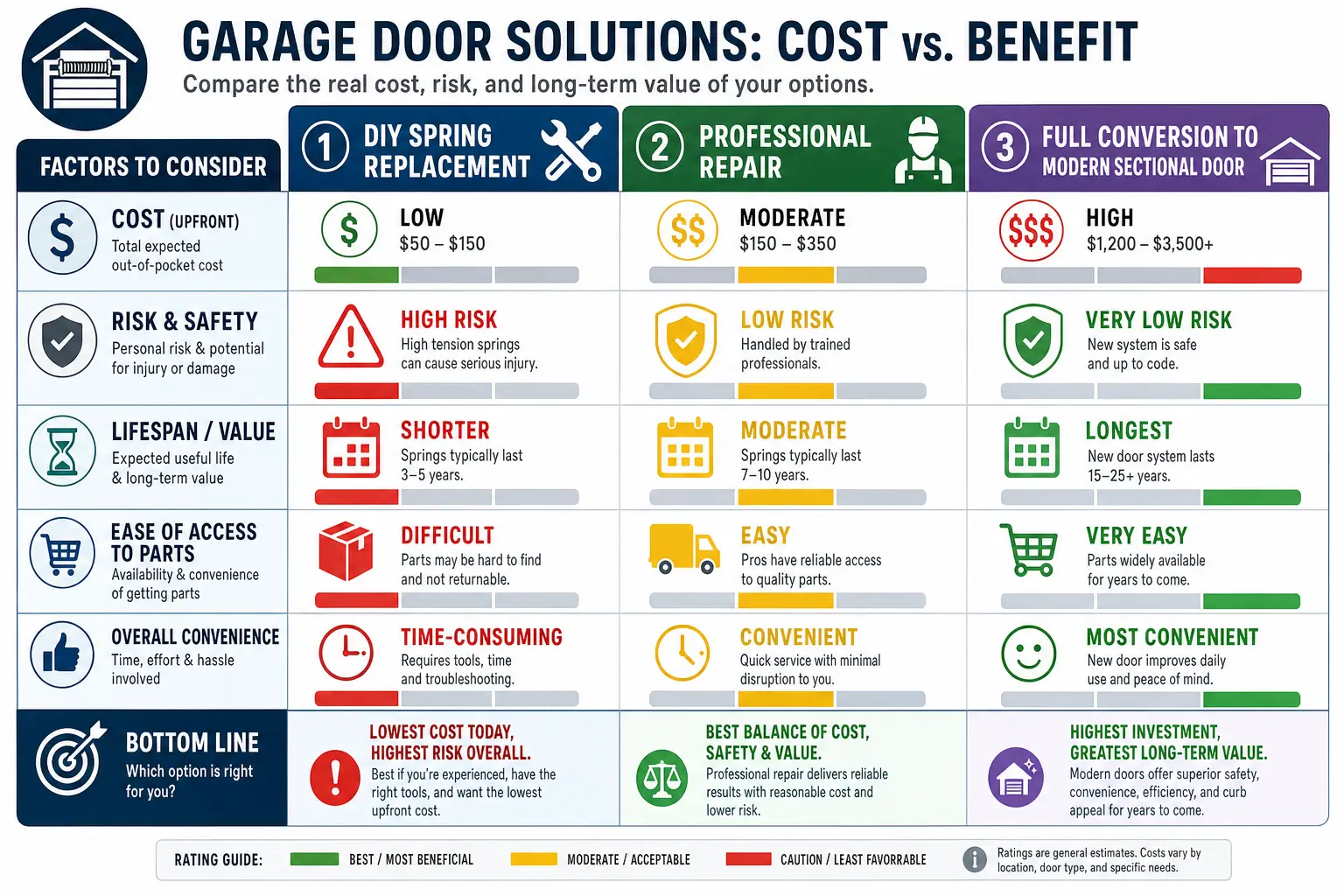
This decision matrix helps homeowners quickly visualize and compare repair costs, safety risks, and long-term benefits of replacing springs themselves, hiring pros, or upgrading to a sectional door.

  • DIY Spring Swap ($45–$90 parts): Cost-effective if you have mechanical experience, leverage tension tools, and can source exact Holmes or E900 hardware specs. High physical safety risk during stretch-tensioning.
  • Professional Repair ($180–$350 parts + labor): Technicians properly balance side jamb arms, inspect pivot hardware for wear, and install matched spring pairs with safety containment rods.
  • Full Sectional Door Conversion ($1,200–$3,200): If your single-panel door is warped wood or binding along the jambs, converting to a modern multi-panel sectional door offers improved insulation, quiet operation, and enhanced safety features.

Choosing the Right Path for Your Garage Door


Resolving a broken tilt-up spring comes down to balancing urgency, hardware complexity, and long-term reliability. Identifying your exact spring specifications and securing the panel during emergency retrieval prevents further property damage. Whether opting for a professional spring replacement or upgrading to a modern sectional system, taking a methodical approach ensures safe, smooth garage access for years to come.

Frequently Asked Questions


Can I replace just one broken spring on my tilt-up door?

Replacing only one spring creates uneven tension across a heavy single panel. Field data shows over a 70% failure rate for the remaining original spring within six months due to metal fatigue, making paired replacement essential for balance and safety.

How do I identify the exact replacement spring for my hardware?

Measure your unbroken spring’s relaxed coil length (typically 28″ to 42″), identify the wire gauge (#7, #8, or #9), and note the connection style (plug-end, lock-end, or clip-end). Legacy codes like P728 or SL728 map directly to door weight capacities.

Should I repair my tilt-up door or convert to a sectional door?

If your single-panel door and jamb frame are structurally sound, replacing dual springs is a practical fix. However, if the door panel is heavy, rotting wood or lacks safety containment features, converting to a modern sectional door improves home security, energy efficiency, and operational safety.

Contact / Request a Call