Bent Torsion Shaft After a Spring Break: Diagnostic and Decision Guide


Published: Nov 9, 2026

When a garage door torsion spring violently snaps, it sends a sudden mechanical shockwave through your overhead system. Standard residential torsion springs operate under 30 to 36 quarter-turns of tension, holding roughly 2,000 to 3,000 lbs of torque force. When that energy discharges in milliseconds, the resulting shock wave does not always stop at the broken spring.

If your overhead steel tube looks visibly bowed, binds when operated manually, or causes your cables to slip, you may be facing a deformed torsion shaft. Attempting to operate or adjust a compromised assembly carries severe risks—the U.S. Consumer Product Safety Commission (CPSC) reports over 20,000 emergency room injuries annually related to garage door component failures. This guide provides an authoritative mechanical diagnostic workflow to help you assess structural shaft damage, understand repair limits, and make a cost-effective decision.
Mechanical Anatomy: Why Torsion Shafts Bend When Springs Break


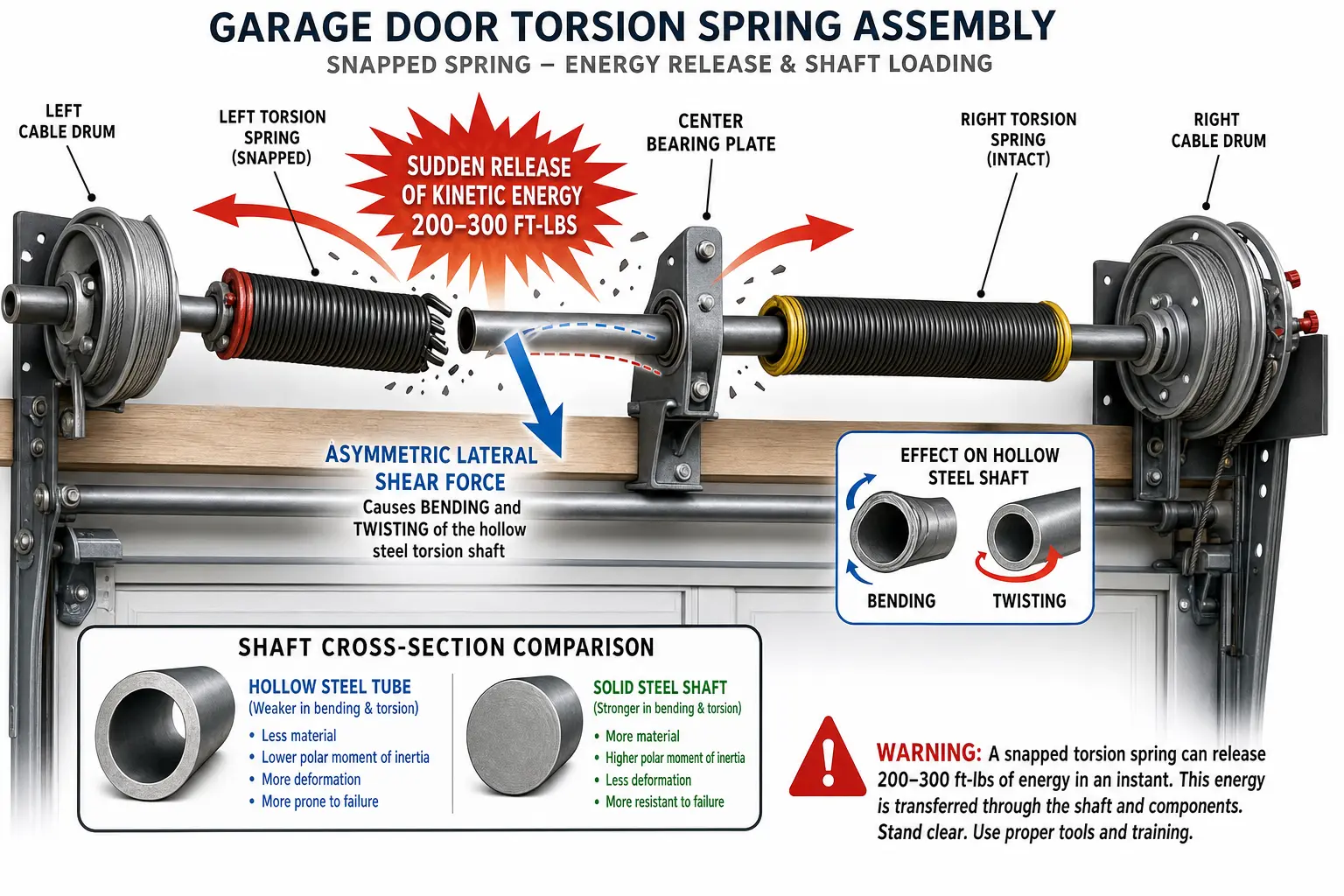
This diagram visualizes how the massive kinetic energy released when a torsion spring breaks creates a lateral shear force that bends and twists the hollow steel torsion shaft, explaining the root cause of shaft deformation after spring failure.

During normal operation, dual torsion springs distribute torque symmetrically across the overhead steel bar. When one spring snaps, over 200 to 300 foot-pounds of stored torque release instantly. This sudden failure transfers an intense, asymmetrical lateral shear force to the shaft assembly.

Most standard residential overhead systems use a 1-inch outer diameter, 14-gauge hollow steel tube. When subjected to instantaneous single-sided shock, this hollow wall can experience plastic deformation—meaning the steel bends past its elastic recovery point.

Secondary damage vectors often follow:

  • Bearing Plate Seizure: Asymmetric force slams the shaft sideways, binding or cracking the center stationary bearing plate.
  • Cable Drum Slippage: Deflection along the shaft axis shifts the end drums, causing a broken garage door cable or slack on one side.
  • Rotational Friction: A micro-bowed tube creates extreme resistance inside the end bearing brackets, placing excess strain on your automatic opener motor.
Still stuck? Get it fixed today.
24/7 emergency service from licensed local technicians.
Call (860) 362-3018

Step-by-Step Diagnostic Workflow for a Bent Torsion Shaft


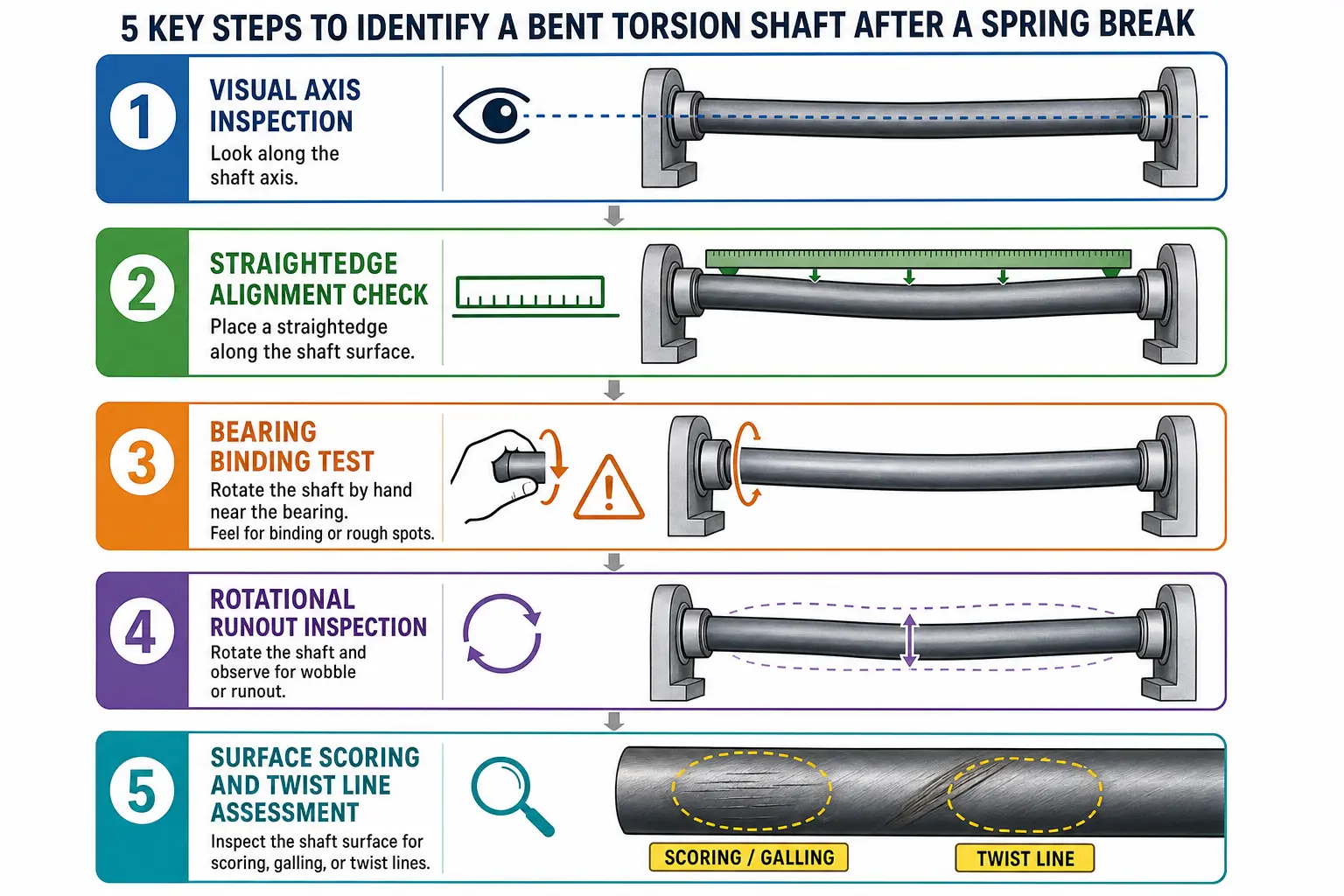
Follow this step-by-step diagnostic guide to accurately detect if your torsion shaft is bent or damaged after a spring breaks, empowering safe and informed repair decisions.

Before committing to a service call or ordering replacement components, use this 5-point visual inspection protocol to isolate shaft distortion from general track misalignments.

Sightline Alignment Test

Stand on a sturdy step ladder near the left end plate and look directly down the horizontal axis of the shaft toward the right side. A healthy torsion tube forms a perfectly straight line across all support brackets. Any visible sagging, arching, or wave patterns indicate permanent plastic deformation.

The Straightedge Method

Place a 4-foot metal level or straightedge against the underside of the torsion tube between the center anchor bracket and the end bearing plate. A bent shaft will reveal uneven gaps or rocking points exceeding 1/16th of an inch along the straightedge.

Center Bearing Plate Inspection

Examine the stationary center plate where the springs mount. If the shaft shifted violently during the spring snap, the bearing race may be cocked at an angle. Look for metallic shavings, wall gouges, or severe binding where the tube passes through the center bushing.

Rotational Runout Assessment

Disconnect your opener by pulling the emergency release cord. With the tension released from the broken spring, carefully rotate the shaft manually by turning the remaining unbroken spring cone (if safe) or tube. Watch the cable drums at each end. If a drum wobbles eccentrically as it turns, the shaft ends are out of round.

Surface Scoring and Torque Twist Lines

Inspect the outer wall of the hollow steel tube. High torsional shock leaves spiral scoring marks or flaking paint along the stress lines. If you notice a garage door cable has too much slack paired with shaft scoring, structural integrity has been compromised.

Repair vs. Replacement: Structural Realities


A common question during evaluation is whether a bent hollow torsion shaft can be straightened with a mallet or lever.

From a metallurgical standpoint, straightening a hollow steel tube is structurally unsafe. Cold-working bent 14-gauge steel creates localized stress risers and microscopic fractures. When high-tension replacement springs are wound back onto a straightened bar, those stress points become prime locations for catastrophic fatigue failure.

Solid vs. Hollow Shafts

  • Standard 14-Gauge Hollow Tubes: Cost-effective for standard residential doors, but vulnerable to lateral bending when springs fracture.
  • Solid 1-Inch Keyed Shafts: Engineered for heavy commercial doors or high-cycle double-car doors. Solid steel bars resist bending shear completely, providing long-term reliability.

If your system uses a single continuous tube across a double door, upgrading to a two-piece shaft connected by a central steel shaft coupler simplifies future spring replacements and enhances system balance.

Cost Breakdown and Decision Matrix


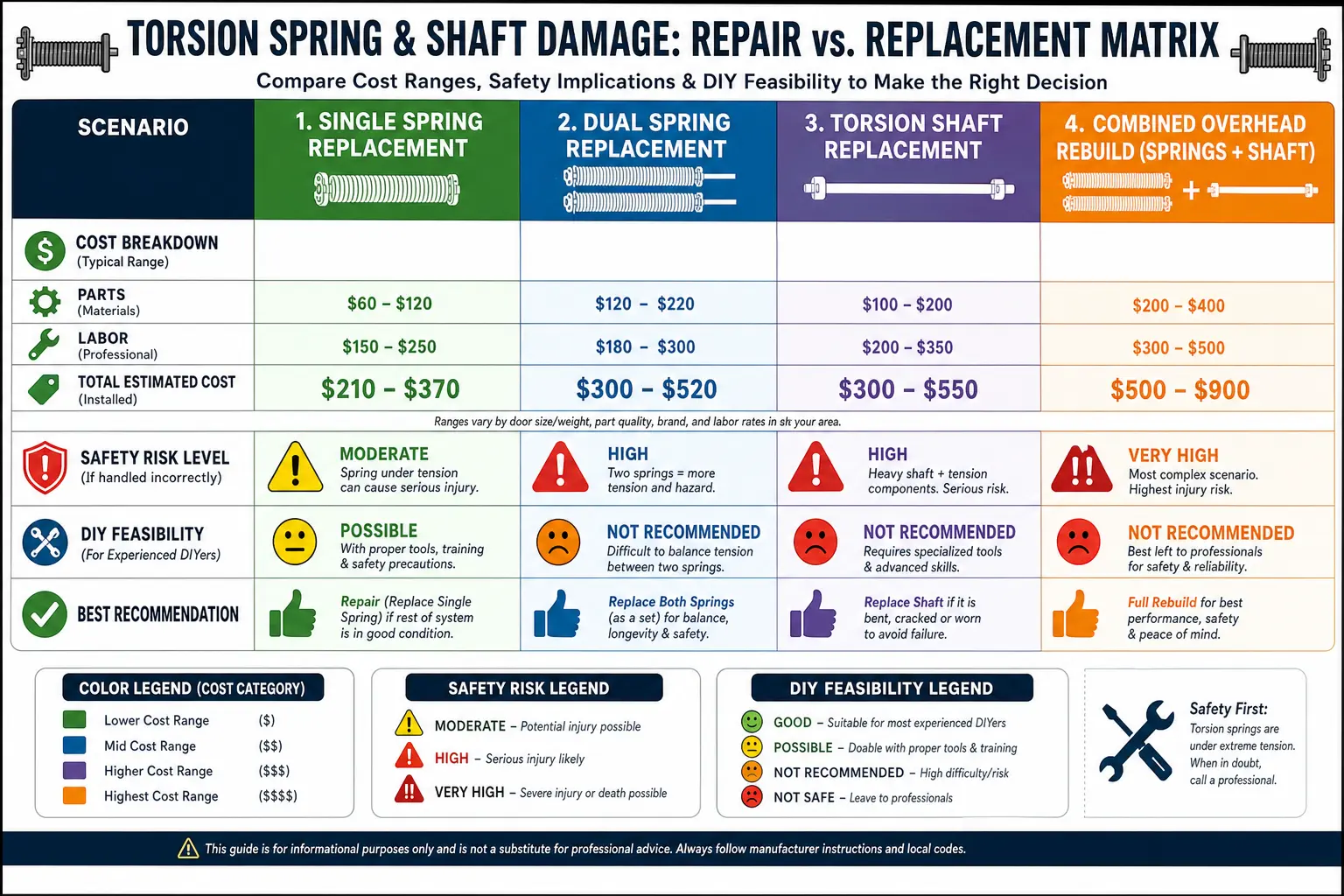
This cost-and-safety decision matrix summarizes 2026 pricing benchmarks and risk assessments, helping homeowners quickly weigh repair versus replacement options for garage door torsion components.

Replacing a torsion shaft at the same time as a broken spring saves substantial labor costs, as the technician must completely teardown the overhead assembly anyway.

Service / Component Scope Average Parts Cost Professional Labor Total Estimated Range
Single Torsion Spring Swap $40 – $90 $110 – $210 $150 – $300
Dual Torsion Spring Swap $80 – $160 $170 – $290 $250 – $450
Torsion Shaft Only (Standalone) $75 – $150 $200 – $400 $275 – $550
Combined Rebuild (Springs + Shaft + Bearings) $180 – $320 $220 – $430 $400 – $750

Bundling your repair into a single complete overhead rebuild avoids paying for duplicate labor down the road. If you require immediate technical assessment, professional 24 hour garage door repair ensures calibrated tensioning and precise alignment of all components. Comprehensive garage door cable and spring repair protects your entire opener system against future mechanical failure.

Frequently Asked Questions


Can I hammer a bent torsion shaft back into shape?

No. Straightening a bent hollow steel shaft weakens the metal structure and creates localized stress points. Under the intense force of fully wound springs, a re-straightened shaft can buckle or snap, causing structural damage or severe injury.

Should I replace both springs if the shaft is bent?

Yes. Torsion springs are manufactured to endure fixed operational cycles (typically 10,000 cycles). If one spring breaks and bends the shaft, the surviving spring has experienced the exact same mechanical wear and structural shock. Replacing both springs alongside the shaft restores full system balance.

How can I tell if my center bearing plate needs replacement too?

Check for metal shavings around the plate, visible cracking on the mounting flange, or rotational stiffness when turning the shaft. If the force of the spring break was strong enough to bend the steel tube, the internal bearings inside the center plate are often crushed or misaligned and should be swapped out.

Contact / Request a Call