16-Foot Double Door Bowing in Nor’easter Gusts: Causes and Fixes


Published: Nov 6, 2026

When coastal wind gusts howl during a New England Nor’easter, hearing your 16-foot double garage door groan and visibly flex inward is a nerve-wracking experience. A 16-foot span represents one of the largest structural vulnerabilities in any home. According to FEMA storm mitigation data, garage door failures account for over 80% of residential structural blow-outs during severe wind events. When high winds breach a wide opening, internal pressure ramps up rapidly, putting the entire roof structure and building envelope at risk.

If your 16-foot door flexes, creases, or pulls away from its tracks under heavy storm conditions, evaluating your options requires an understanding of wind physics, thermal stresses, and mechanical counter-balances.
The Physics of 16-Foot Door Bowing in Nor'easters


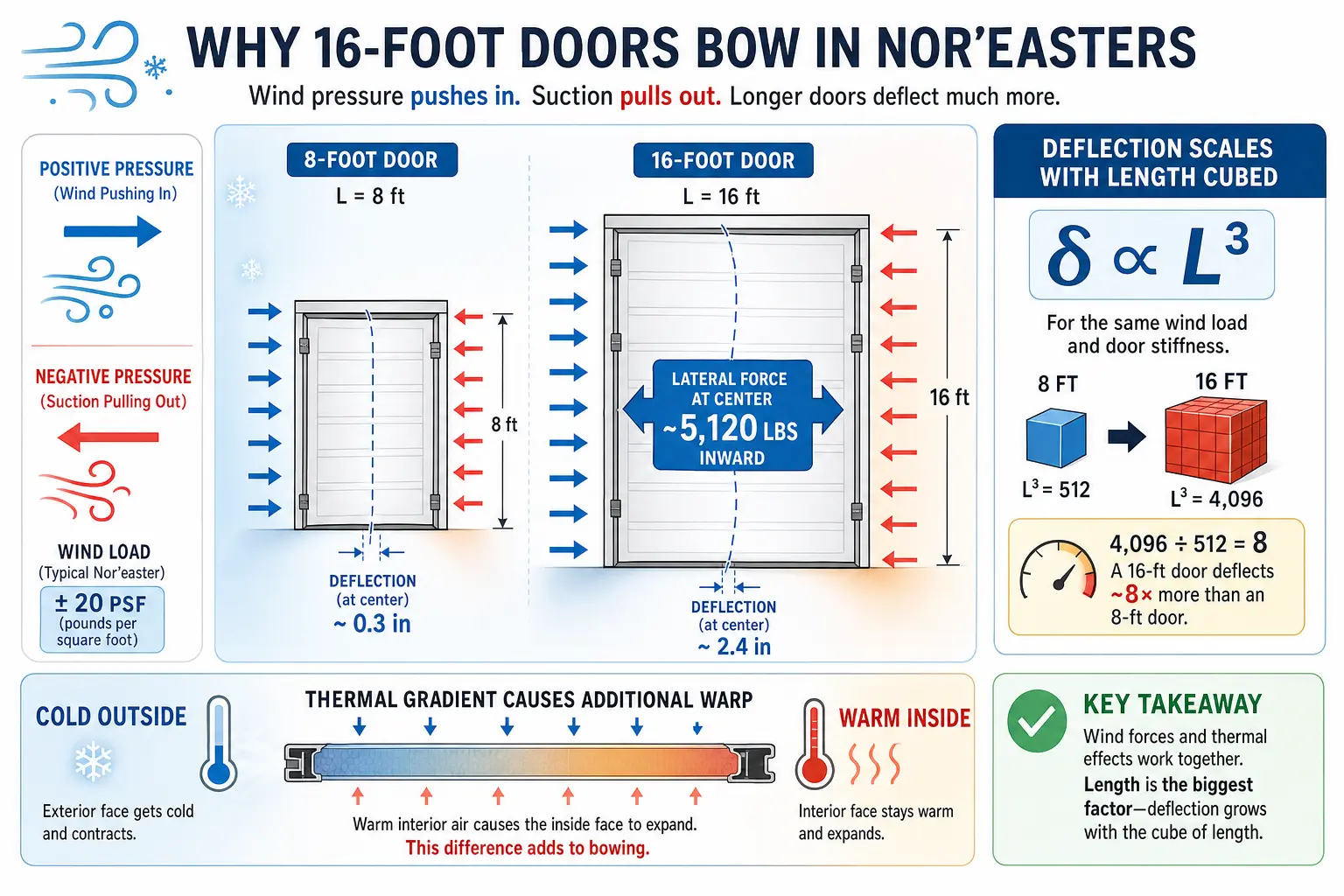
This image clarifies why 16-foot doors experience exponentially greater bowing under strong Nor'easter gusts, combining wind pressure physics and thermal contraction stress.

Why do 16-foot double doors experience such dramatic bowing compared to standard 8-foot single doors? The answer lies in structural beam deflection physics. Bending deflection ($delta$) scales with the cube of the span length ($delta propto L^3$). Because of this exponential relationship, a 16-foot door flexes up to 8 times more under identical wind pressure than an 8-foot single door constructed of the same gauge steel.

Under ASCE 7-22 wind load standards, a 75 mph Nor’easter gust subjects an exterior surface to positive inward pressures ranging between +22.5 and +28.8 PSF (Pounds per Square Foot). For a standard 16′ x 7′ double garage door (112 sq ft), this creates 2,500 to 3,200 lbs of lateral force pushing directly against the center of the door panels.

Nor’easters also create a severe thermal contraction gradient. When exterior temperatures hover at $15^circtext{F}$ while the garage interior is heated or insulated at $65^circtext{F}$, the $50^circtext{F}$ differential causes the outer steel skin to contract faster than the inner face. This thermal-mechanical stress causes a pre-existing bow of 3/8″ to 3/4″ before high winds even begin. Compromised garage door weather stripping allows freezing air infiltration, worsening thermal warping and pressure fluctuations inside the opening.

Still stuck? Get it fixed today.
24/7 emergency service from licensed local technicians.
Call (860) 362-3018

Root Causes and Track System Vulnerabilities


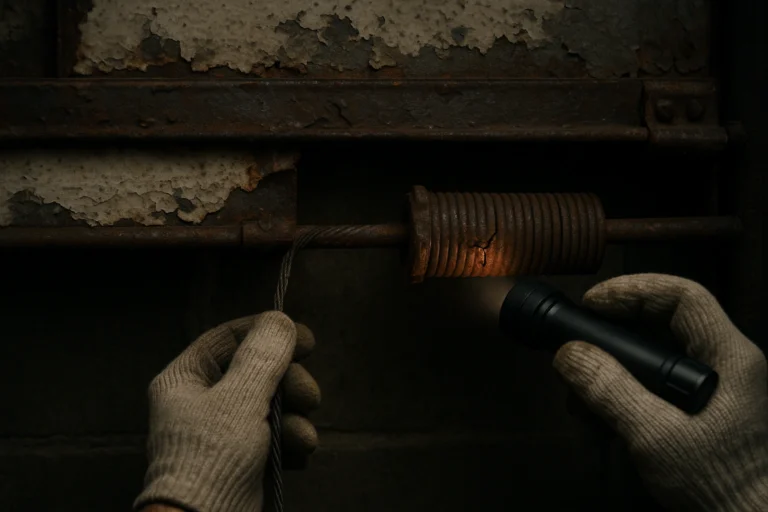
Standard builder-grade 16-foot doors often utilize unreinforced 24-gauge steel panels designed for basic closure rather than extreme coastal weather. As wind pressure flexes the center of the 16-foot span, the sides pull inward, putting immense dynamic tension on the track rollers.

Sustained gust loading leads to several cascading structural issues:

  • Track Lip Roll & Derailment: The inward pulling force exerts sideways leverage on vertical tracks, causing roller pop-out.
  • Track Deformity: Excessive lateral torque can leave you with a bent garage door track, preventing the door from opening or closing after a storm.
  • Roller Separation: Over-extended hinges allow individual rollers to bind, requiring immediate structural stabilization or a detailed garage door off track repair cost evaluation.

Fix Matrix & Solution Comparison (MOFU Evaluation Framework)


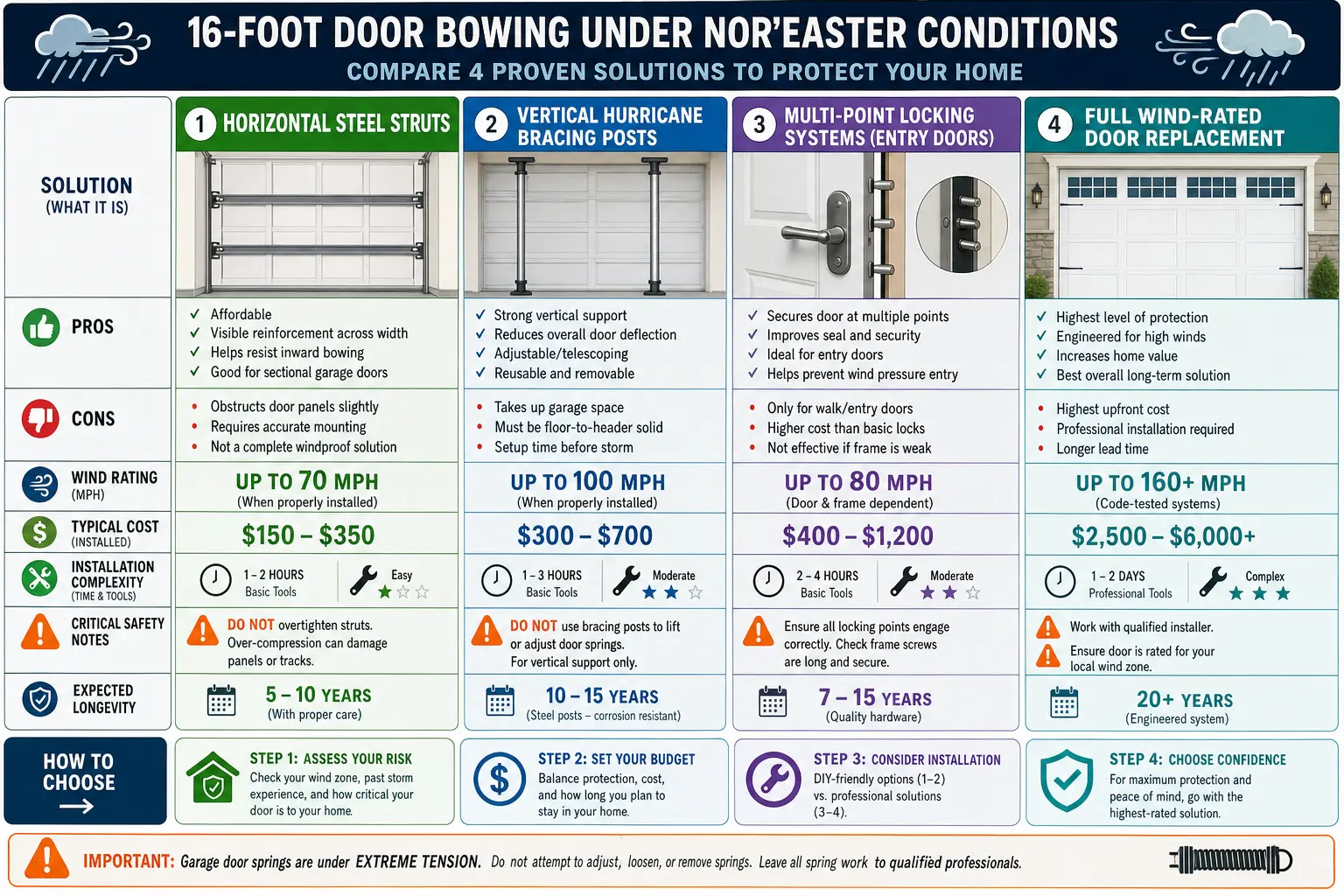
A step-by-step decision matrix to evaluate and compare fixes for 16-foot door bowing, helping homeowners choose solutions based on cost, wind resistance, and installation complexity.

Property owners evaluating retrofits versus replacements for bowing 16-foot doors can weigh three main engineering solutions:

  • Option 1: Horizontal Steel Reinforcement Struts (20-Gauge U-Channels)
    • Cost: $150 – $350
    • Wind Rating Resistance: Up to 110 mph gusts.
    • Engineering Consideration: Installing 2 to 4 horizontal struts across a 16-foot span adds 25 to 40 lbs of dead weight to the door assembly. This weight addition requires precise adjustments to the door’s counter-balance system. Attempting to lift a retrofitted door without recalibrating torsion springs can lead to snap failures on worn broken garage door springs or burn out electric drive gears, requiring unexpected garage door opener repair.
  • Option 2: Vertical Removable Hurricane Bracing Posts
    • Cost: $250 – $500
    • Wind Rating Resistance: 150+ mph gusts.
    • Engineering Consideration: Vertical telescoping posts anchor securely into the concrete floor slab and heavy structural header. They eliminate mid-span deflection completely during storms, though they must be manually installed prior to high-wind events.
  • Option 3: Complete Wind-LOAD / Impact-Rated Door Replacement
    • Cost: $2,200 – $5,500
    • Wind Rating Resistance: DP30 to DP60+ (ASCE 7-22 compliant).
    • Engineering Consideration: If panels exhibit permanent structural creasing or hairline metal tears along center stiles, retrofits will not restore integrity. Investing in a full garage door replacement engineered with internal heavy-gauge stiffeners delivers long-term peace of mind and potential home insurance discounts. Where damage is isolated to a single buckled section, targeted broken garage door panel repair connecticut can restore structural performance at a fraction of full replacement costs.

Step-by-Step Fix Implementation & Safety Protocols


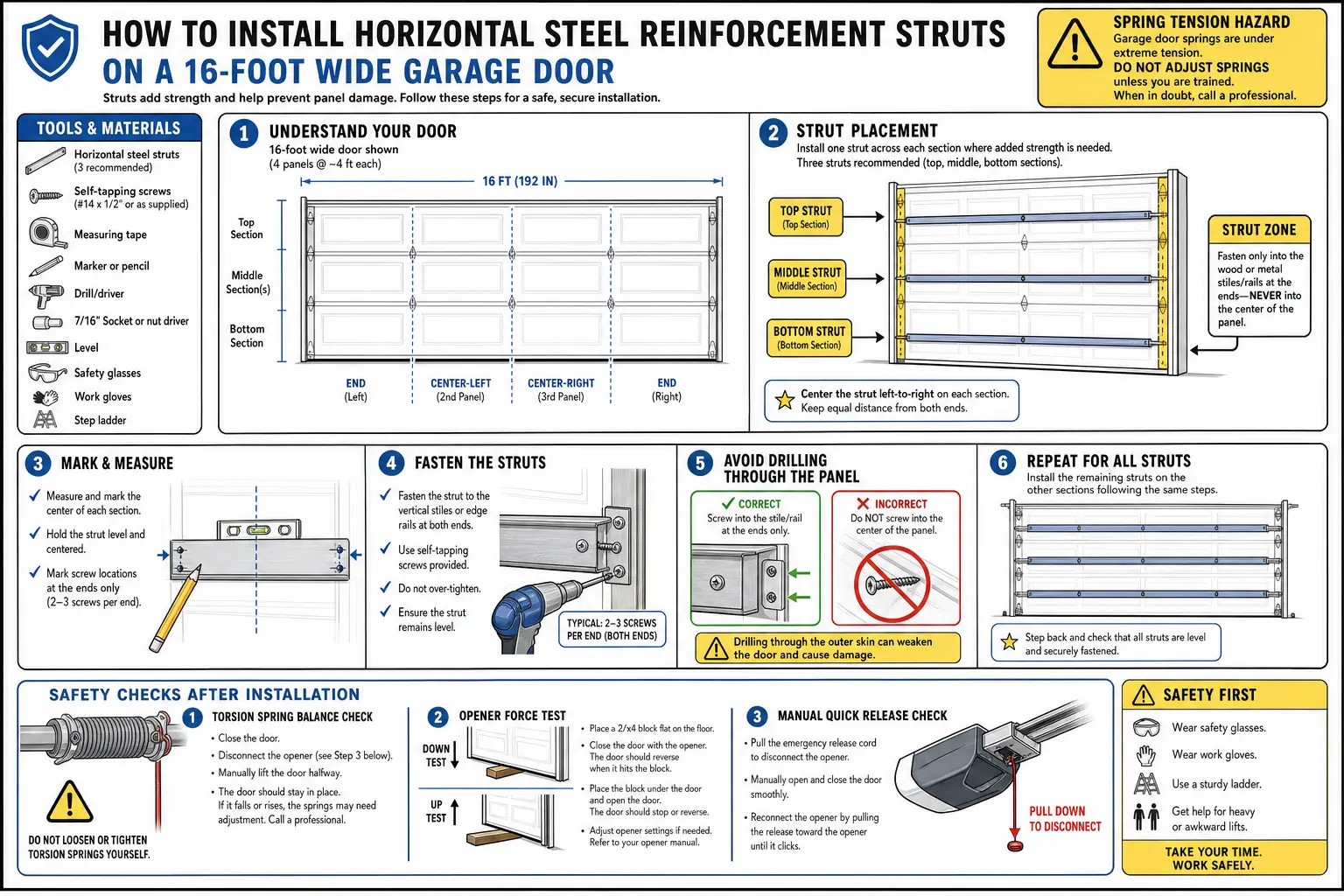
This image anchors memory by visually guiding homeowners through a safe, effective horizontal strut installation process, emphasizing key safety steps to protect door opener and springs.

If you select horizontal U-channel struts to resolve mid-span flex, follow these implementation and safety protocols:

  1. Calculate Total Added Weight: Weave 20-gauge steel U-channel struts horizontally across the center hinges of affected sections. Verify strut weight (typically 8–10 lbs per 16-foot bar).
  2. Secure Fasteners Without Piercing Exterior Skin: Fasten struts directly into vertical steel stiles using self-drilling tek screws. Never drill through the outer decorative face.
  3. Perform Torsion Spring & Balance Recalibration: Because adding struts alters door counterbalance, torsion springs must receive additional quarter-turns to offset the dead weight. High-tension springs carry immense force—schedule a professional garage door tune up to execute spring tensioning safely.
  4. Reset Opener Travel and Force Limits: Re-program automatic opener limits and perform a safety reverse check to confirm smooth mechanical operation.

Frequently Asked Questions


Can adding horizontal struts eliminate bowing on an existing 16-foot door?

Yes, installing 20-gauge horizontal U-channel struts across the center stiles dramatically increases rigidity, reducing mid-span deflection in gusts up to 110 mph. However, adding struts increases door weight, requiring torsion spring recalibration to maintain safe manual and automatic operation.

How do I know if my bowed 16-foot door needs complete replacement instead of a retrofit?

If door panels exhibit permanent metal creases, split welds, tears around hinge mounting plates, or twisted vertical tracks, structural integrity has been compromised. In these cases, retrofits cannot restore baseline wind resistance, making an impact-rated door replacement necessary.

Will adding strut reinforcement kits damage my garage door opener?

Retrofit strut kits add 25 to 40 pounds to a 16-foot door. If the torsion springs are not adjusted to balance this extra mass, the automatic opener will experience excessive strain on internal drive gears and motor windings, eventually leading to opener failure.

Ready to protect your home against incoming coastal storms? Contact 24H Garage Doors for expert structural assessments, wind-load retrofitting, and professional torsion spring balancing across Connecticut.

Contact / Request a Call